
Most affiliate About pages read like a résumé. Visitors don’t care. They’re trying to answer one thing fast above the fold: can I trust you before I click your links?
A good affiliate About page works like a handshake. It introduces you, sets expectations, and shows you’re not hiding the “how I get paid” part. As a core affiliate marketing strategy, it fits into your broader content plan by building trust early, so readers feel safe, stay longer, and click with less doubt.
What makes an affiliate About page feel trustworthy (and still get clicks)
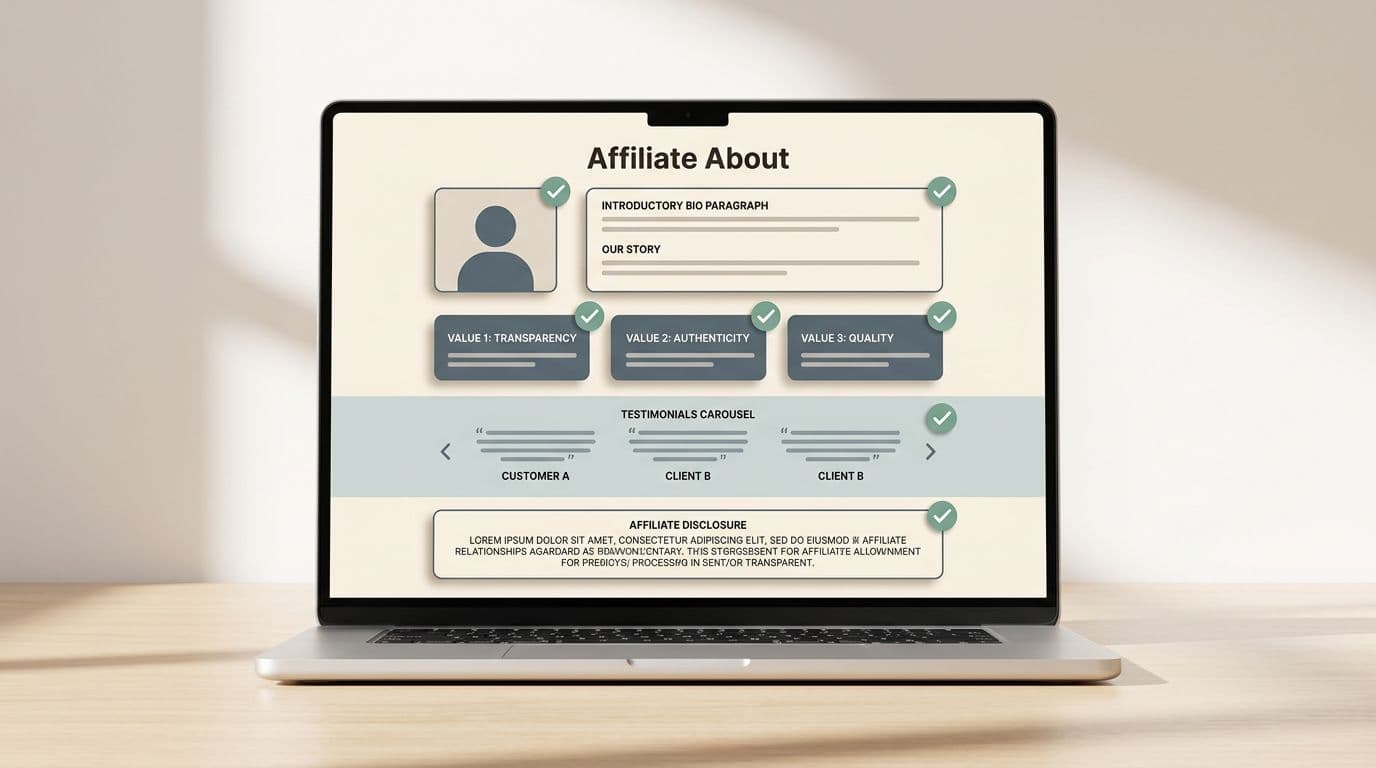
Your About page isn’t “just branding.” It’s a decision page. People land there when they’re cautious, curious, or close to buying. So it needs to do three jobs quickly:
First, tell them who you help and what you help with for strong target audience engagement. “I blog about X” is weak. “I help [type of person] choose [type of product] without wasting money” is clear.
Next, explain how you recommend things. Readers don’t expect perfection, but they do expect a method. Even a simple standard builds confidence.
Finally, be open about affiliate income. Hiding it feels shady. A plain disclosure, placed early, often increases clicks because it removes tension. If you want to study how other affiliates structure these pages, this collection of affiliate page examples and landing page examples is useful for patterns and layouts.
If your About page makes readers hunt for the catch, they’ll assume there is one.
Affiliate about page template (fill in the blanks, copy and paste)

Use this affiliate about page template, affiliate landing page template, or affiliate program landing page as a full page, or trim sections to fit your style. These professional design templates can be customized to build a high converting landing page.
Headline
Hi, I’m [YOUR NAME]. I help [WHO YOU HELP] [GET RESULT] without [COMMON FRUSTRATION].
Quick credibility (1 to 2 lines)
I’ve spent [TIMEFRAME] learning/testing [TOPIC/TOOLS] so you don’t have to guess. My approach is [SIMPLE PRINCIPLE, example: “practical, beginner-first, no hype”].
What you’ll find here (set expectations)
On this site, I share:
- [CONTENT TYPE #1, example: step-by-step guides]
- [CONTENT TYPE #2, example: honest tool reviews]
- [CONTENT TYPE #3, example: simple comparison posts or a lead generation form]
How I choose what to recommend (your “rules”)
I only recommend products/services that match these standards: [STANDARD #1], [STANDARD #2], [STANDARD #3].
If something isn’t a fit, I’ll say so and suggest a different path when I can. (This is also a good place to link your vetting process, for example a checklist like this affiliate program vetting checklist for a SaaS affiliate program.)
Affiliate disclosure (clear, calm, compliant)
Some links on this page and across the site are affiliate links. If you choose to buy, I may earn a commission at no extra cost to you. I only recommend what I believe is genuinely helpful.
Non-legal-advice disclaimer (plain English)
This content is for education and general information only. It isn’t legal, tax, or financial advice. You’re responsible for your own decisions, so consider getting professional guidance for your situation.
Proof and reassurance (pick 1 to 3)
[SHORT RESULT], [SMALL WIN], or [READER FEEDBACK].
(Examples: “X readers use my guides each month,” “I update recommendations when tools change,” “I test free plans before I suggest upgrades.”)
Your main call to action (one primary next step)
If you’re new here, start with: [START HERE PAGE NAME] (add a call to action button here)
If you’re comparing tools, go to: [BEST-OF / RECOMMENDED PAGE NAME]
If you want to reach me, use: [CONTACT PAGE]
Consider including a lead generation form nearby for building an email list.
Three shorter About page variants (use when you want less text)
1) The minimalist version
I’m [YOUR NAME], and I help [AUDIENCE] [OUTCOME]. I publish [TOPIC TYPES] and share tools that make the process easier. Some links are affiliate links, which means I may earn a commission if you buy, at no extra cost to you. I only recommend what I’d suggest to a friend. Start here: [START HERE LINK].
2) The story-first version
I started this site because [RELATABLE PROBLEM]. After trying [WHAT DIDN’T WORK], I found a simpler way: [YOUR APPROACH]. Now I share the steps and the tools that helped, plus what to avoid. Some links are affiliate links, and I may earn a commission if you purchase. Want the easiest next step? [PRIMARY CTA].
3) The standards-first version
I don’t recommend everything. I use a short set of rules: [RULE 1], [RULE 2], [RULE 3]. If a product fails them, it doesn’t get featured. Some links are affiliate links, so I may earn a commission if you buy. See my top recommendations here: [BEST-OF LINK].
CTA copy options that fit an About page (buttons or text links)
- Start here: “Show me the first steps”
- Best-of page: “See my top picks (with pros and cons)”
- Free training/lead magnet: “Get the beginner roadmap”
- Contact: “Ask me a quick question”
For more general conversion ideas (especially if you use an About page like a landing page), these landing page examples can spark clean CTA phrasing for your call to action button.
A quick trust audit before you publish (2 minutes)
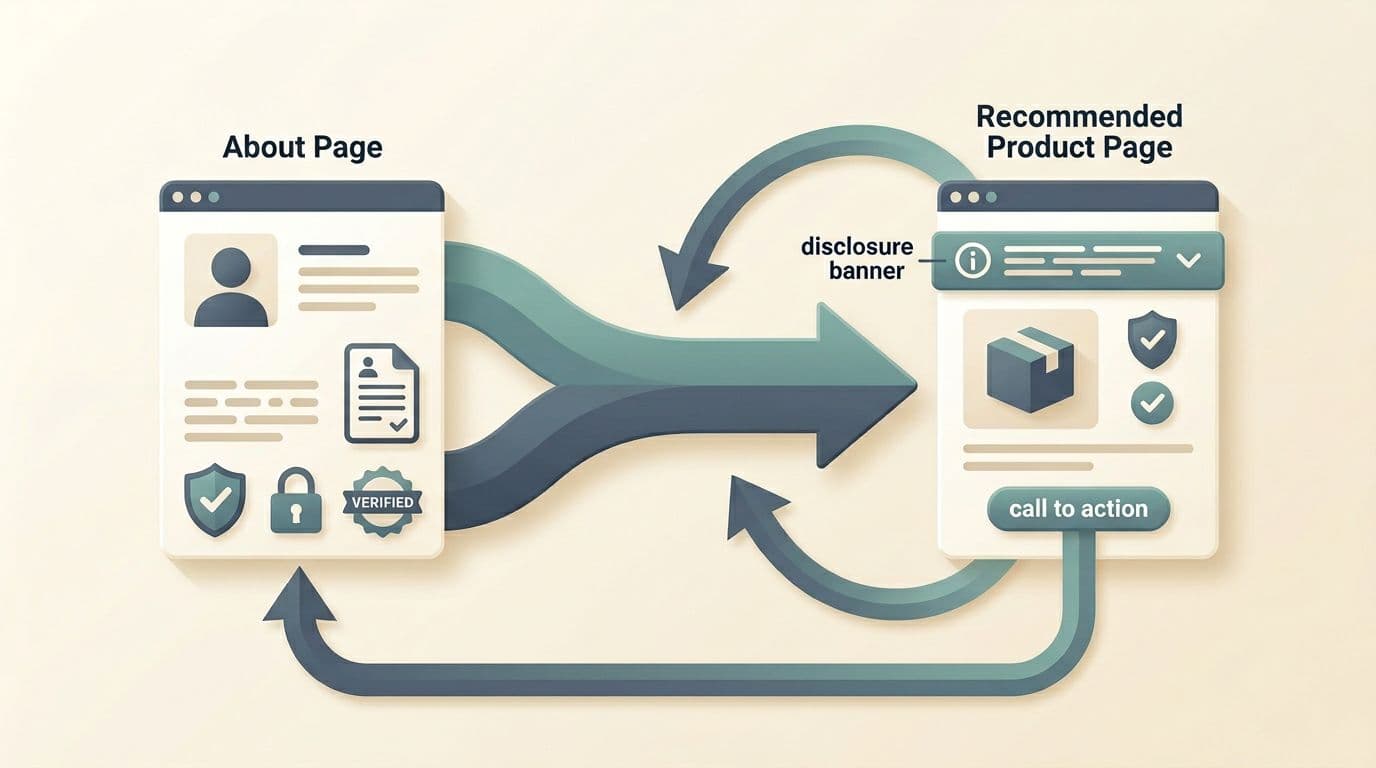
To support user journey optimization and marketing campaign performance tracking, scan your About page (or affiliate program landing page) and answer these honestly:
- Identity feels real: You include a name and a friendly photo (or a clear brand face).
- Purpose is obvious: Readers know who the site is for in 10 seconds.
- Recommendations have a process: You explain how you decide what to suggest.
- Disclosure is early: It appears before the first affiliate link or CTA.
- No vague claims: You avoid income guarantees and “too good to be true” promises.
- Tailored for niche specific landing pages: The content connects directly with your audience’s needs.
- One main next step: The page doesn’t dump five different offers at once.
- Easy to contact you: A contact option for inquiries or affiliate partner applications is visible, not buried.
If you want to tighten monetized pages without making them feel pushy, use these affiliate disclosure examples you can copy and keep the wording plain.
Where to place internal links on your About page (so it flows)
Your About page should guide, not scatter. Add a few internal links in predictable spots, like signs in a store, to support a responsive design and mobile friendly layout.
Here’s a simple placement map:
| Internal link destination | Best placement on About page | Why it works |
|---|---|---|
| Start-here page | Near the top, right after “what I help with” | Helps beginners take action fast |
| Best-of (recommended tools) | After your “how I choose” section | Matches comparison intent |
| Contact page | Near the end, plus a small mention earlier | Builds safety and accountability |
| Disclosure/privacy | In your disclosure line, and in the footer | Keeps transparency easy to find |
| Technical pages (affiliate commission fees, terms and conditions, cookie policy expiration) | In the footer or disclosure section | Satisfies the internal linking strategy |
Also, if your About page includes any product links or referral tracking links, treat it like any other monetized page. Keep clicks natural by following a simple structure like this affiliate landing page template.
Conclusion
A strong About page doesn’t beg for trust. It earns it with clarity, standards, and a visible disclosure. Start with the affiliate about page template above to craft an affiliate program landing page, then cut anything that sounds like fluff. For a high converting landing page, advanced users might add a potential earnings calculator or highlight a recurring commission model and exclusive partner benefits to attract better partners or explain their business model more deeply. Keep one clear next step, and make your recommendations feel like help, not pressure. What’s the one sentence your reader should remember about you after they finish the page?