
Ever sent five affiliate applications, got two auto-responses, and then… nothing? A week later you can’t remember who you applied to, which login you used, or whether you already followed up.
Affiliate tracking software represents the high-level category for streamlining these processes, with manual spreadsheets bridging into that automated world. An affiliate application tracker fixes that. While a full affiliate marketing platform manages the data long-term, an affiliate application tracker is essential for the initial outreach phase. It’s a simple spreadsheet that tells you what’s pending, what’s approved, and who needs a polite nudge. More importantly, it keeps you from leaving commissions on the table because you missed one email.
Why an affiliate application tracker beats “I’ll remember”
Affiliate applications feel easy in the moment. Fill the form, paste your site, hit submit. Brands use complex affiliate program management tools for partner recruitment and influencer marketing campaigns, but the mess shows up later when approvals don’t arrive on a neat schedule.
Some programs reply in 24 hours. Others sit for weeks. A few need extra details (traffic sources, promo methods, country targeting). Even a simple referral program requires careful organization to ensure you don’t miss out on participation opportunities. If you don’t track those asks, you’ll end up re-checking inbox threads like you’re looking for lost keys.
A tracker also helps you stay picky. If you’re applying to everything, you’ll waste time on weak programs. Pair this spreadsheet with a quick screening process like the affiliate program checklist so you spend your energy on programs that fit your audience and pay reliably.
Treat applications like a mini pipeline. If it isn’t written down, it’s not a system, it’s a hope.
One more upside: this creates clean history. When an affiliate manager asks, “When did you apply?” or “Did you reply to our compliance email?” you’ll have an answer in seconds.
Copy/paste-ready tracker columns (with example rows)
Use one row per program. Keep it boring and consistent. The goal is fast scanning, not perfection.
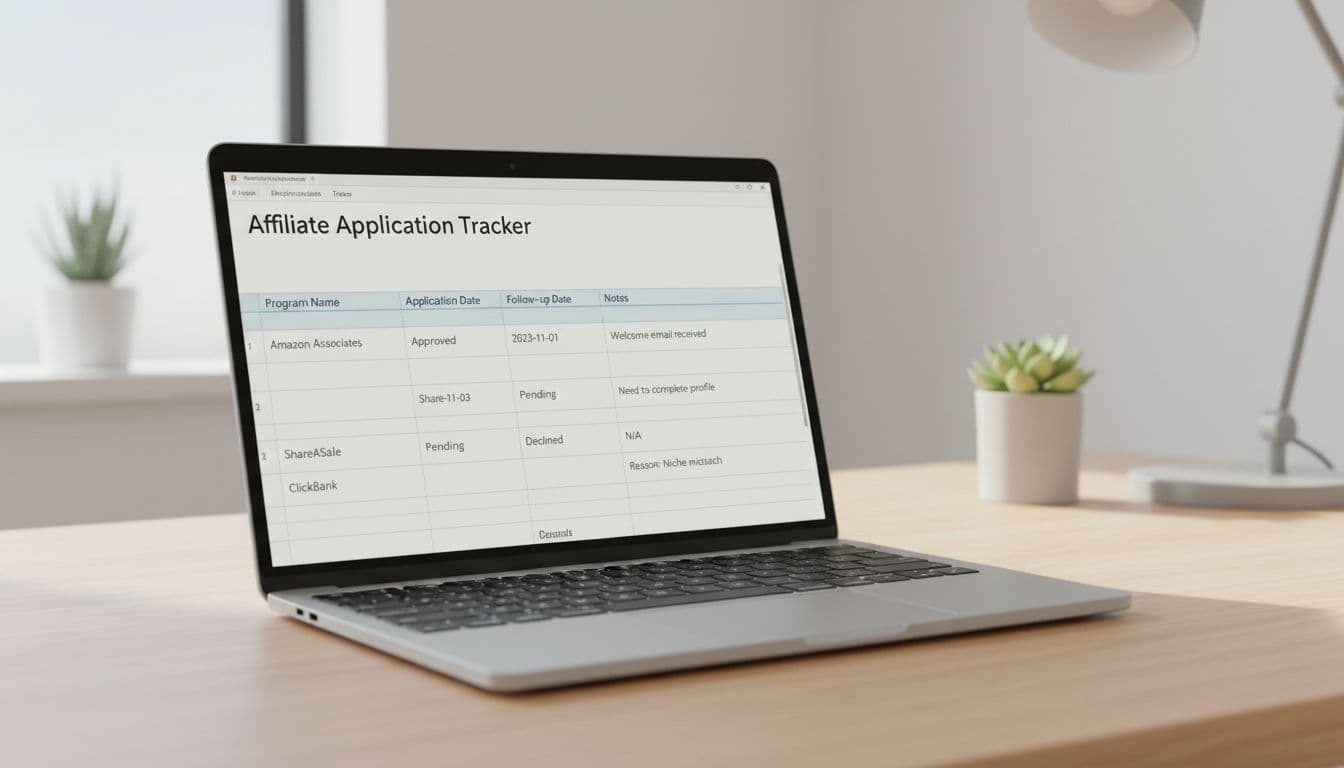
Paste this into Google Sheets or Excel, then adjust the columns to match your workflow:
| Program | Website | Network/Platform | Applied (Date) | Status | Contact (Name/Email) | Last Touch (Date) | Next Follow-up (Date) | Follow-up # | Approval Date | Commission | Notes |
|---|---|---|---|---|---|---|---|---|---|---|---|
| ConvertKit | https://convertkit.com | In-house | 2026-03-01 | Pending | partnerships@convertkit.com | 2026-03-01 | 2026-03-08 | 0 | Recurring | Asked for site URL + promo method | |
| Impact Brand A | https://brand-a.com | Impact | 2026-03-02 | Needs info | Alex (alex@brand-a.com) | 2026-03-05 | 2026-03-12 | 1 | 10% | Send media kit + traffic screenshot | |
| SaaS Tool B | https://tool-b.com | PartnerStack | 2026-03-04 | Approved | Jamie (jamie@tool-b.com) | 2026-03-06 | 2026-03-06 | 30% | Set up affiliate link tracking and conversion tracking, add to “Tools” page |
Quick setup tips (worth doing):
- Add a dropdown for Status: Pending, In review, Needs info, Approved, Rejected, Paused.
- Freeze the header row and turn on filters.
- Keep “Network/Platform” consistent (PartnerStack for SaaS affiliate software, Impact, CJ, ShareASale, in-house); ecommerce integrations often dictate which network a brand uses, making sorting easier.
If you want inspiration for earnings-focused layouts after approvals, compare your sheet to a purpose-built tracker like PayKickstart’s free affiliate tracker template or this Google Sheets affiliate tracker overview. Then keep your application tracker separate so it stays clean.
Follow-up cadence that gets approvals (Day 7, 14, 21)
Most affiliates don’t lose approvals because they’re unqualified. They lose them because the application sits in limbo and nobody circles back.
Here’s a simple cadence that’s a key part of personal commission management and works well in 2026 without sounding pushy:
| Timing | What to do |
|---|---|
| Day 7 | Friendly check-in, confirm they received it |
| Day 14 | Add one useful detail (traffic, promo plan, audience fit) |
| Day 21 | Final follow-up, offer to close the loop |
Showing professional follow-up behavior helps you stand out in the brand’s affiliate program management dashboard.
How to use this in your tracker: set “Next Follow-up” when you apply, then update “Last Touch” every time you email or reply. Increase “Follow-up #” so you know where you are at a glance.
Sample email follow-up scripts (copy, edit, send)
Day 7 follow-up (short + polite)
Subject: Quick check on affiliate application
Hi [Name], I applied to the [Program Name] affiliate program on [Date]. I wanted to confirm you received it, and ask if you need anything else from me. My site is [Site Name], and I plan to promote [Product] in [content type, like tutorials and comparisons].
Thanks,
[Your Name]
Day 14 follow-up (add context that helps approval)
Subject: Re: [Program Name] affiliate application
Hi [Name], just following up on my application from [Date]. For context, my audience is mostly [who], and my top traffic sources are [SEO/YouTube/email]. If helpful, I can share example placements and how I handle disclosures.
Best,
[Your Name]
Day 21 follow-up (final nudge, easy yes or no)
Subject: Closing the loop on my application
Hi [Name], I know you’re busy. If you’re not accepting new partners right now, no problem. I just wanted to confirm whether my [Program Name] application is still under review. If it’s a “not a fit,” feel free to close it out.
Thanks again,
[Your Name]
Once you’re approved and gain access to the affiliate marketing platform, you can start monitoring performance metrics and click-through rates. The next bottleneck is usually clicks, not links. Use the affiliate link placement map to put links where readers actually act.
Conditional formatting and a simple dashboard (Sheets and Excel)
A tracker only works if it nags you a little. While affiliate tracking software handles complex tasks automatically, conditional formatting turns your spreadsheet into a quiet assistant that taps your shoulder when something stalls.
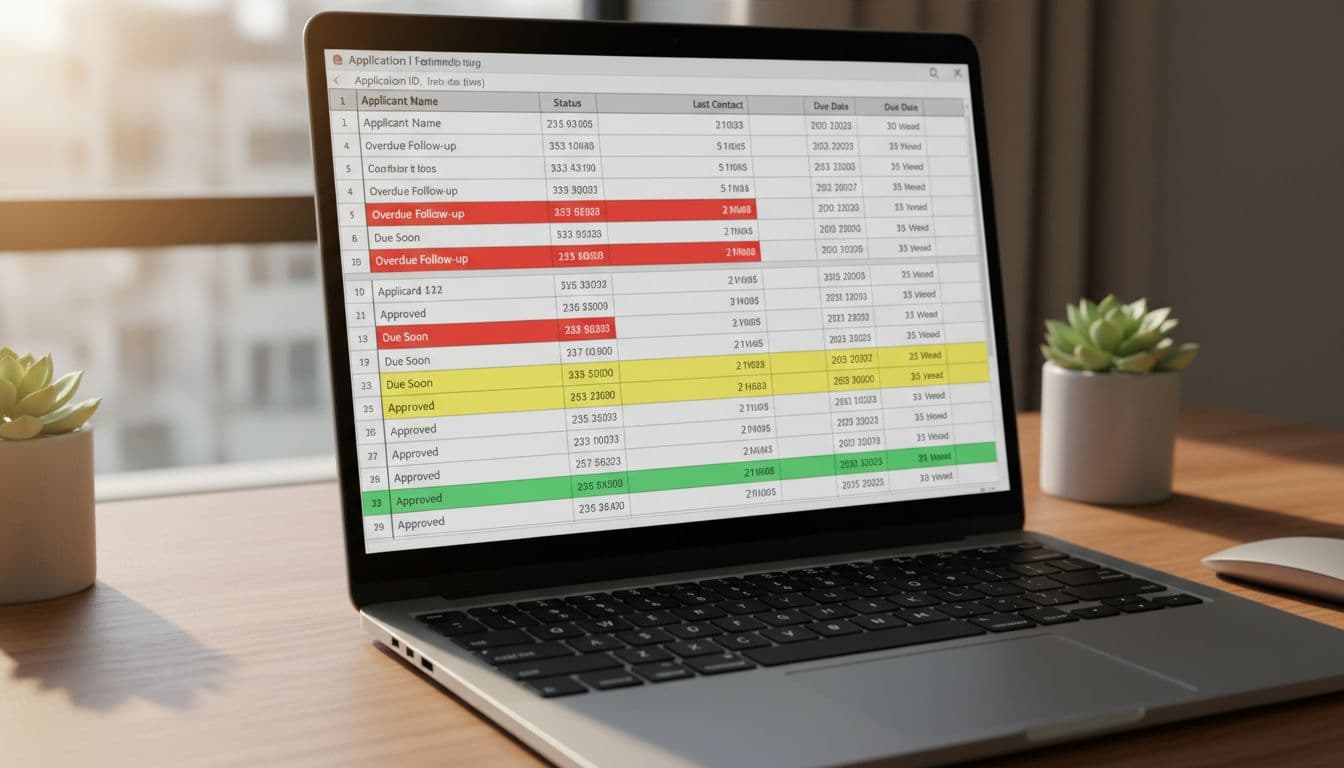
Assume your columns match the table above (Status in E, Next Follow-up in H, Last Touch in G). Apply these to your row range (example: A2:L1000).
Conditional formatting rules (same idea in both tools)
Overdue follow-up (red)
Custom formula (Google Sheets) or “Use a formula” (Excel): =AND($H2<>"",$H2<TODAY(),$E2<>"Approved",$E2<>"Rejected")
Due soon (yellow, next 48 hours)
Formula: =AND($H2<>"",$H2>=TODAY(),$H2<=TODAY()+2,$E2<>"Approved",$E2<>"Rejected")
Stalled application (orange, no movement in 21 days)
Formula: =AND($G2<>"",$G2<=TODAY()-21,$E2="Pending")
Approved (green)
Formula: =$E2="Approved"
Build a lightweight dashboard tab (optional, but nice)
A “Dashboard” sheet helps when you’re managing a lot of applications. It also gives affiliate managers a quick view if you share it internally. Unlike the real-time analytics in affiliate tracking software, this manual setup mimics basic ROI tracking and fraud detection through status summaries and follow-up lists.

Keep it simple:
- A status count (Approved, Pending, Needs info, Rejected).
- A list of follow-ups due in the next 7 days (filter by Next Follow-up).
- A monthly view of how many you applied to (pivot table on Applied Date).
While spreadsheets require manual updates for conversion tracking, a scalable affiliate program relies on payout automation and custom commission structures in professional software. The platforms you apply to often use advanced affiliate tracking methods like server-to-server tracking, first-party cookies, and cross-device tracking for accurate conversion tracking, sometimes with multi-touch attribution or coupon code tracking. Features such as a white-label portal, Stripe integration, and mass payouts make these programs even more attractive once approved.
If you want a more onboarding-style manager view, this affiliate signup and onboarding tracker template can spark ideas, but your own sheet usually wins because it matches how you work.
Conclusion
A good affiliate application tracker feels like a seatbelt. You don’t notice it until it saves you. Set up the columns, lock in the Day 7/14/21 follow-ups, and let conditional formatting call out anything stuck. Then apply to your next program and log it immediately, before your inbox buries the details.
When you outgrow the spreadsheet, affiliate tracking software is the logical next step. With a solid history of your applications in hand, affiliate program management and an affiliate marketing platform become far more manageable.