

In the world of affiliate marketing, asking for more commission can feel awkward, like you’re tapping on the glass while someone’s busy. The truth is, an affiliate manager at any top affiliate program expects this conversation, as long as you make it easy to say yes.
A solid affiliate commission increase email is not a rant, and it’s not a vague “can you bump my rate?” It’s a short business case, with proof, a clear ask, and a next step.
Below are practical scripts you can copy, plus a quick checklist to prep in under 10 minutes.
What affiliate managers need to see before they approve a higher rate
Most commission increases get approved for one simple reason: the manager believes you’ll send more profitable customers with higher customer lifetime value if they improve your commission rate from their affiliate program.
That means your email should answer three questions fast:
- Are you already driving results?
- Can you scale (more promotional assets, more email traffic, or higher volume)?
- Will the program still make money after the increase?
Before you write, pull a few “proof points” from your network dashboard and your own analytics. If your tracking feels messy, clean it up first so your numbers are credible. This walkthrough on how to track affiliate sales in GA4 is a good starting point, especially if you want consistent UTMs and click events.
Here’s the kind of evidence that usually lands well.
A quick table like this keeps your request grounded in reality:
| Proof item | What to share | Why it matters to them |
|---|---|---|
| Clicks | Last 30 to 90 days | Shows demand, not a one-off win |
| Conversion rate and volume | Orders or leads | Proves intent, not just traffic |
| Revenue | Sales amount (if available) | Helps them justify margin |
| EPC | Earnings per click | Quick “quality” signal |
| AOV | Average order value | Higher AOV can support higher payout |
| Cookie duration | Program’s cookie length | Longer duration improves performance attribution |
| Plan to scale | Next 30-day actions | Gives them confidence to approve |
If you don’t have every metric, don’t stall. Share what you do have, then offer to send more.
A mini checklist you can complete in under 10 minutes
Do this once, then every commission request gets easier.
- Confirm your current terms and commission structure: [CurrentRate], cookie window, tier rules, “new customer” limits.
- Pick one date range: usually the last 30 or 60 days relevant to the affiliate program (keep it simple).
- Grab 3 numbers: clicks, conversions, and EPC (or revenue if available).
- Choose one growth lever: new review, email send, homepage placement, comparison table update.
- Decide your ask: [ProposedRate] (or a tiered option if that’s more realistic).
- Write one sentence on margin: why the increase still makes sense (higher AOV, fewer refunds, better funnel fit).
- Ensure all content includes a proper “FTC disclosure” before sending your request.
- Prepare a fallback: a temporary bonus, a tier, or a test period.
- Set a follow-up date: 3 business days later.
One more tip: if your links are buried or scattered, use an outreach strategy focused on link placement before you negotiate. Better placement lifts conversions, which strengthens your case. This affiliate link placement map helps you find the spots readers actually click.
Copy-paste affiliate commission increase email templates and subject lines

These email templates use a personalized email approach for affiliate commission increase requests. When you send an affiliate commission increase email, you’re not asking for a favor. You’re proposing a trade: better payout in exchange for more volume and cleaner positioning.
If you want a quick refresher on negotiation framing, this video is general, but the structure maps well to partner conversations.
Template 1: The clean “commission review” request (best first email)
Subject line: Commission review request for [ProgramName]
Hi [FirstName],
I’m [YourName] from [YourSite]. I’ve been promoting [ProgramName] and wanted to request a quick commission review.
Over the last [TimeRange], my placements drove:
Clicks: [Clicks]
Conversions: [Conversions]
EPC (or revenue): [ProofMetric]
I’m planning to scale [ProgramName] next month by [SpecificPlan], and I can prioritize your offer more prominently. With that in mind, can you increase my rate from [CurrentRate] to [ProposedRate]?
If it helps, I’m happy to share the pages I’ll update and the dates I’ll run promotions.
Thanks,
[YourName]
[YourSite]
[AffiliateID]
Why this works: It’s short, measurable, and points to a specific scaling action in your affiliate program. It also asks for a clear decision, not an open-ended chat.
Template 2: When they say “we can’t” (tier or test-period counter)
Subject line: Re: Commission review for [ProgramName]
Hi [FirstName],
Thanks for getting back to me. If [ProposedRate] isn’t available right now, could we try one of these options?
Option A: A [TrialLength]-day test at [TrialRate], tied to [VolumeGoal].
Option B: A setup with performance-based tiers, such as [Tier1Rate] up to [Tier1Volume], then [Tier2Rate] above that.
Option C: A temporary bonus for content placements on [TopPageOrSection] through [EndDate].
I can commit to [SpecificPlan] during the test so we can measure impact quickly. Which option is easiest on your side?
Thanks,
[YourName]
Why this works: It gives them “easy yes” paths that still protect your upside. It also shows you understand internal limits and budget cycles for the affiliate program.
Template 3: The follow-up that doesn’t sound impatient
Subject line: Quick follow-up on [ProgramName] commission review
Hi [FirstName],
Just following up on my commission review request for [ProgramName]. I’m finalizing my content updates for [DateWindow], and I’d like to confirm whether we can adjust my rate from [CurrentRate] to [ProposedRate] (or a test period).
If you want, I can send a quick screenshot of performance for the last [TimeRange] and the URLs I’ll feature.
Thanks,
[YourName]
Why this works: It creates a timing reason to respond, without pressure. It also offers to reduce their work by sending exactly what they need.
For more examples of affiliate email formats and tone, compare your message to a few from Post Affiliate Pro’s commission increase templates and swipe the parts that match your style.
Timing, tone, and the one mistake that kills your chances
The best time to ask is right after you’ve proven momentum. For example, a strong month, a successful product launch, or fresh social proof like a noticeable EPC lift after you improved placement.
Keep the tone calm. Use solid negotiation tactics instead of ultimatums. Managers read those as risk, even when you’re right.
In affiliate marketing, the fastest way to lose a commission increase is to make it about what you “deserve,” instead of what you can reliably deliver next.
Also, don’t negotiate from shaky tracking. If attribution rules are working against you (coupon poaching, last-click overrides), fix that before you pour on more traffic. This guide on how to spot last-click attribution traps can help you ask smarter questions and protect your credit.
Finally, have a backup plan. If a program won’t move, you still need income stability to protect your affiliate marketing revenue stream. This backup plan for affiliate commission cuts is useful even when commissions are steady, because it keeps you from relying on one partner too heavily.
A simple follow-up email sequence that closes more maybes
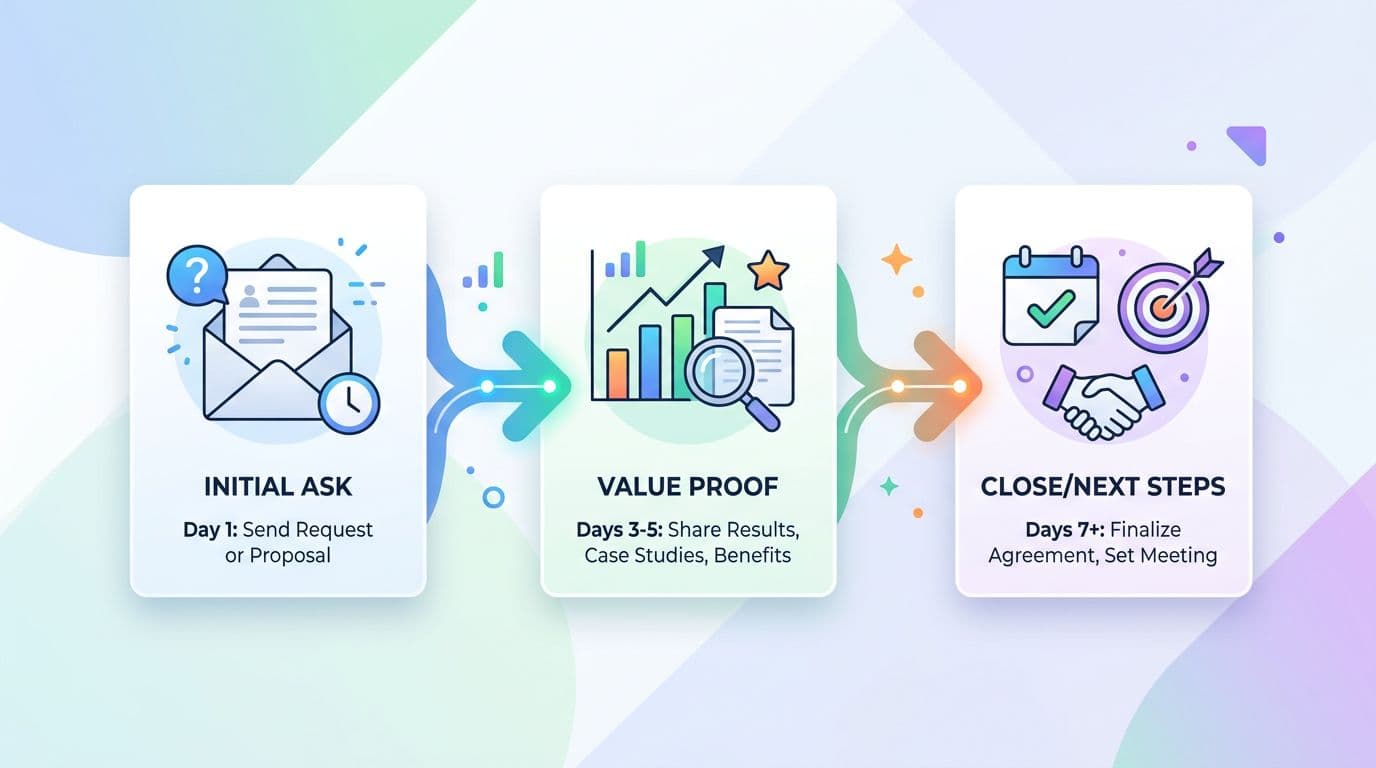
If you don’t hear back, your follow-up emails are essential; don’t assume it’s a no. Affiliate inboxes get slammed, especially around month-end.
Think of this like a mini re-engagement campaign for your partnership. Use this simple rhythm:
- Day 0: Send Template 1.
- Day 3: Send Template 3 (short follow-up).
- Day 7: Reply again with one extra proof point (a screenshot, top page list, or the next promo date).
If they still don’t answer, pause for two weeks, then try a new angle. For example, a seasonal promo, a new placement, or a tier request based on volume.
Need more inspiration for outreach strategy beyond commission asks? Skim a few affiliate email examples and prompts to keep your writing sharp without sounding robotic. Study lead magnets or welcome series for additional ideas.
Conclusion
A good affiliate commission increase email doesn’t beg; it makes a clear trade while focusing on building value-driven relationships rather than just asking for money. Lead with proof, ask for a specific rate, and show how you’ll scale. If you send the templates above with real numbers and a calm tone, you’ll get more yeses, and better counteroffers. Your next step is simple: pick one affiliate marketing partner, run the 10-minute checklist, and send one request for a payout increase today.