
Ever publish an affiliate post that “should” convert, but it attracts the wrong readers? The writer hits the required Word Count, the SEO boxes look checked, yet the page pulls in people who want definitions, not decisions.
In 2026, that mistake costs more than time. AI summaries, tougher SERPs, and pickier audiences reward pages that satisfy Search Intent and punish vague ones.
A tight affiliate content brief fixes this as a cornerstone of your Content Marketing Strategy, because it forces one simple agreement before anyone writes: who your Target Audience is, what the searcher wants, and what your page will deliver. Using an affiliate content brief ensures clarity and alignment in your content creation process, making it easier to address specific audience needs.
In conclusion, leveraging a comprehensive affiliate content brief can serve as your roadmap to successful content creation.
Why affiliate posts go off-intent (and how a one-page Content Brief Template prevents it)
Creating an effective affiliate content brief is vital for successful content marketing, as it provides a structured approach to meeting reader expectations and search intent.
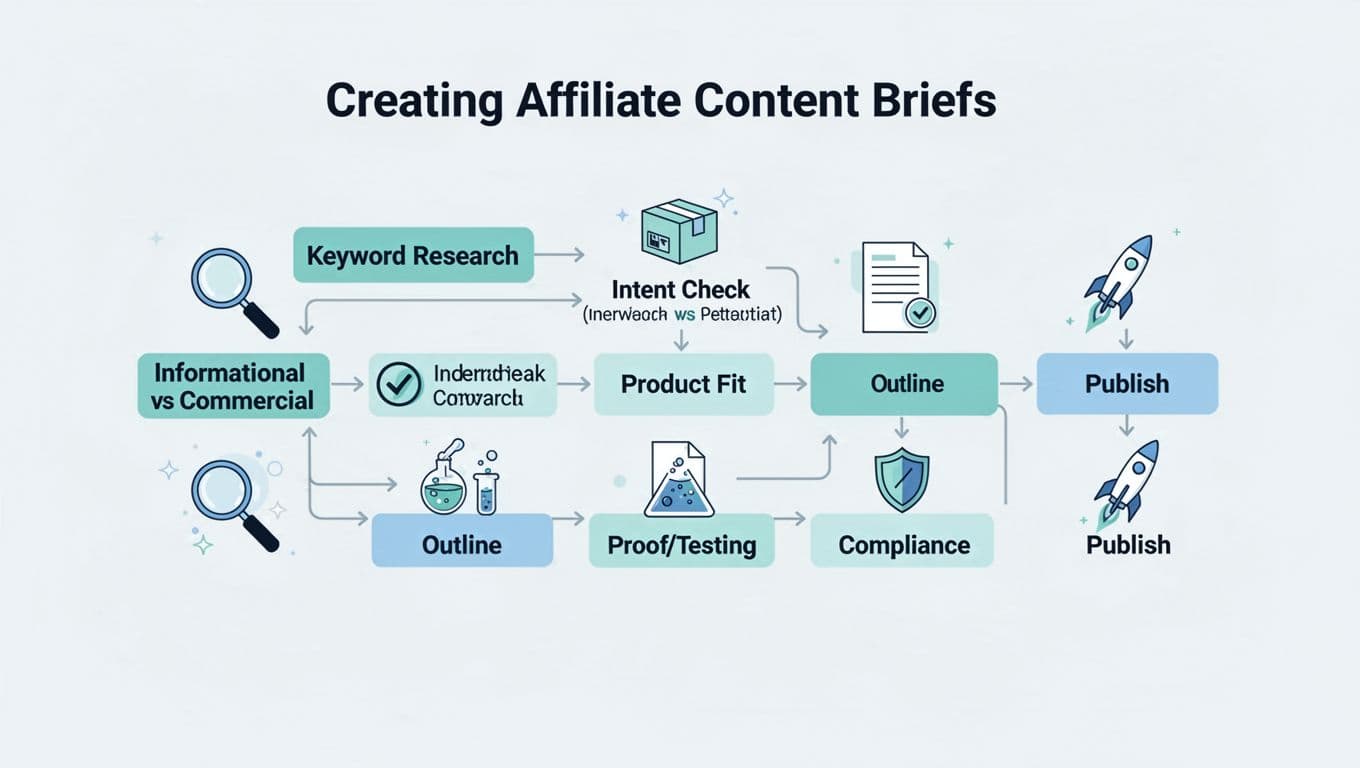
The foundation of a successful campaign lies in a well-crafted affiliate content brief, which guides the writing process and keeps content aligned with audience intent.
Most “off-intent” affiliate posts fail in one of these spots:
1) The query is informational, but the draft is salesy.
Example: “how to start email marketing” turns into “Best Email Tool (Buy Now)” halfway down the page. Readers wanted steps and a Value Proposition, not just a sales pitch.
2) The query is commercial, but the draft plays it safe.
Example: “best budget standing desk” gets a soft lifestyle intro, then vague pros and cons. The reader wanted a short list, clear picks, and buying constraints to match Search Results.
3) The offer doesn’t match the Target Audience.
A beginner lands on a page written for pros. Or a US-only offer gets pitched to global traffic.
4) Proof is missing, so the page sounds recycled.
In 2026, “trust me” doesn’t work. Privacy changes also mean you need cleaner tracking and clearer intent signals, not more fluff.
One page fixes this because it acts like a guardrail. It keeps the writer from drifting, and it gives editors a fast way to say “yes” or “rewrite,” while improving overall Conversion Rates by reducing fluff.
For further insights into crafting an effective affiliate content brief, explore various resources and examples tailored for your niche.
Remember, an effective affiliate content brief not only outlines content but also adapts to the feedback received from your audience.
If your niche still feels fuzzy, tighten the audience first using this affiliate niche selection guide. A clean niche makes intent calls much easier.
For extra context on proven affiliate post structures, Ahrefs has a solid lesson on blog post templates for affiliate content.
The one-page Content Brief Template (copy, paste, publish)
Ultimately, a well-structured affiliate content brief can significantly enhance your content’s performance and reader engagement.
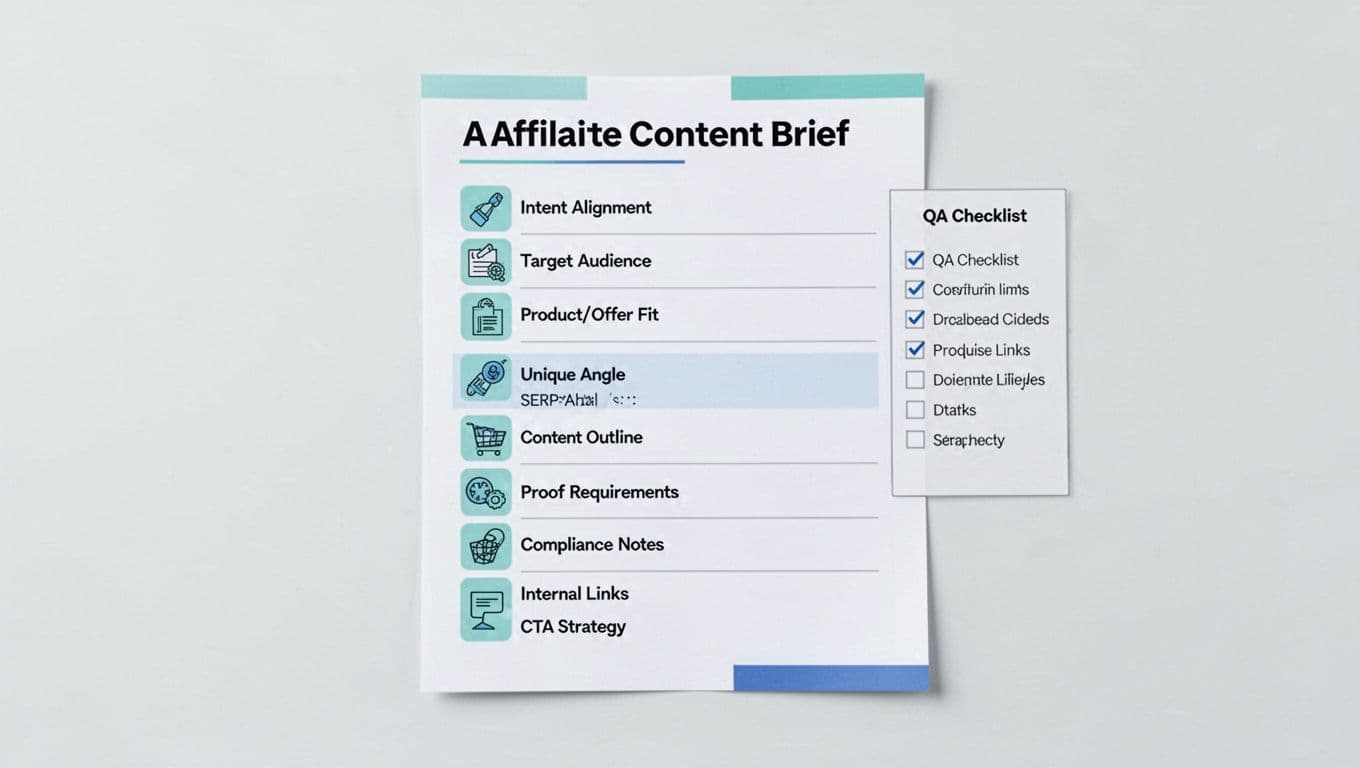
Use this as your standard. Keep it to one page on purpose. Constraints make people decide.
One-page brief (table version)
| Section | What to fill in (keep it specific) |
|---|---|
| Working title | Match the primary keyword and search intent (no hype) |
| Primary Keyword | Exact search keyword you are targeting |
| Target Keywords | 3 to 5 secondary keywords to cover naturally |
| Search Volume | Monthly searches for primary keyword and targets |
| Search Intent | Informational, commercial, transactional (pick one) |
| Reader job-to-do | “They want to ___ so they can ___” |
| Target Audience | Skill level, budget range, location limits |
| Offer + funnel role | What you promote, and where it fits (first touch vs ready-to-buy) |
| Offer fit rule | “Recommend only if ___; otherwise suggest ___” |
| SERP reality check | What ranks now, and what is missing or weak |
| Unique angle | 1 sentence, must be useful (not “better”) |
| Outline (H2s only) | 4 to 6 headings, in a logical order |
| Subheadings | H3s and below planned for each H2 |
| Proof requirements | Hands-on steps, screenshots, tests, pricing check date, sources |
| Meta Description | Optimized 150-char summary with primary keyword |
| Metadata | Title tag, Open Graph tags, schema notes |
| Compliance notes | Disclosure placement, claim limits, who it is not for, brand guidelines |
| Call to Action strategy | Primary CTA, backup CTA, and where they appear |
| Internal/external refs | 2 to 5 must-include links (if any) |
This evolution is vital for maintaining the relevance and effectiveness of your affiliate content brief.
Paste-into-Docs/Notion version
Before proceeding, ensure your affiliate content brief covers all essential elements to optimize engagement and conversion rates.
Working title:
Primary Keyword:
Target Keywords:
Search Volume:
Search Intent (pick 1): informational / commercial / transactional
Reader job-to-do:
Target Audience (skill, budget, location):
Offer (product/service) + funnel role:
Offer fit rule (recommend if / don’t recommend if):
SERP notes (what top pages do):
Unique angle (1 sentence):
Outline (H2 list):
Subheadings (H3s):
Proof needed (hands-on, tests, sources, update date):
Meta Description:
Metadata (title, OG, schema):
Compliance (disclosure, claims, permissions, brand guidelines):
Call to Action strategy (primary + secondary + placements):
Links to include (internal/external):
The affiliate content brief should act as a living document, evolving as your content strategy matures.
This affiliate content brief example showcases how to balance intent with actionable steps to engage your audience effectively.
Before you lock an offer into the brief, vet it. This affiliate program checklist prevents “looks good” programs that later block your traffic or reverse commissions.
Need more examples of brief formats? See Ryan Robinson’s free content brief template for another layout you can borrow from.
Filled example brief for Freelance Writers (commercial intent product review)
Utilizing an affiliate content brief not only helps in structuring your content but also in meeting the expectations of your target audience.
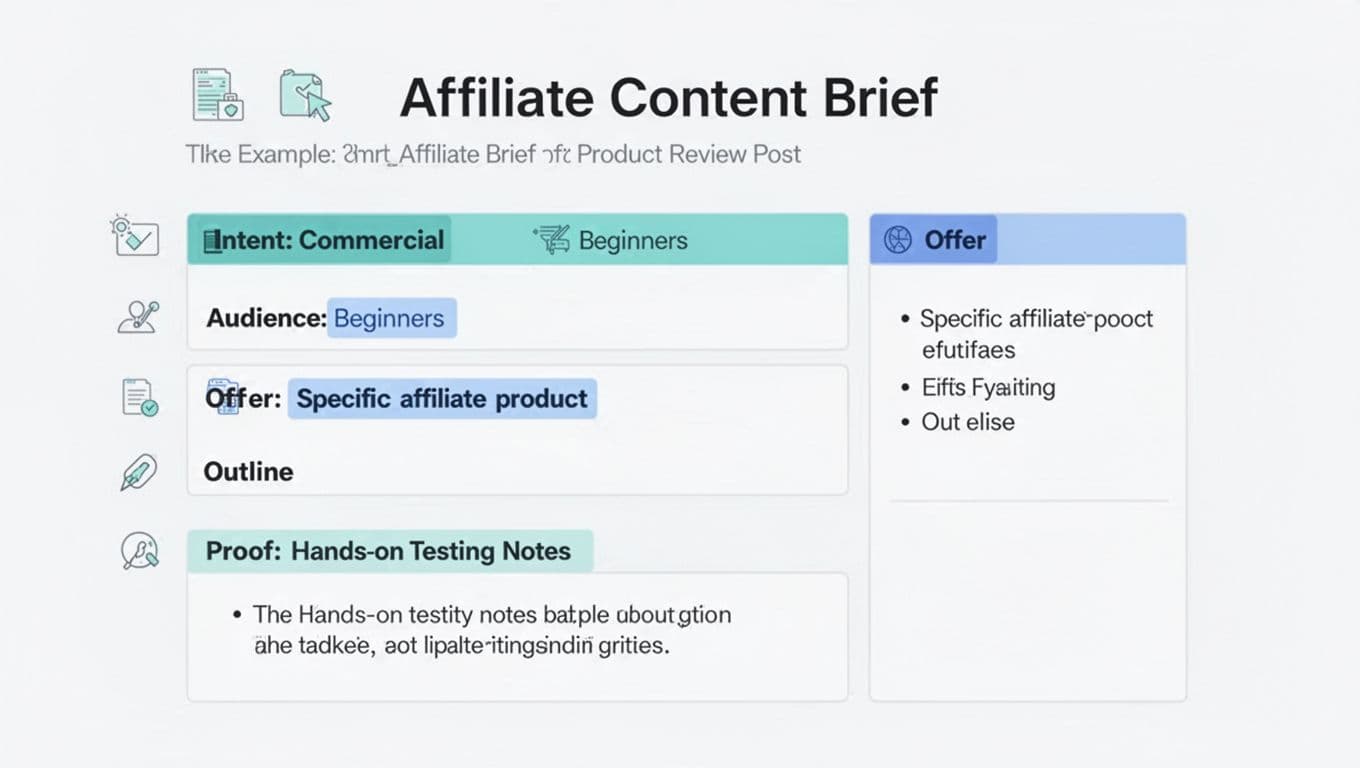
Regularly updating your affiliate content brief will keep your content aligned with changing audience needs and market trends.
Freelance Writers can swipe this complete mini-brief to ensure high-quality output. It fits into the Customer Journey by addressing the commercial stage.
The affiliate content brief also serves as a reference point for maintaining consistency across your content strategy.
Example: “Email marketing tool for beginners” review
By following a structured affiliate content brief, you can streamline the content creation process and focus on delivering value to your audience.
| Section | Filled example |
|---|---|
| Working title | “Best beginner email marketing tool (honest review + who it is for)” |
| Primary Keyword | “email marketing tool for beginners” |
| Search Intent | Commercial |
| Reader job-to-do | They want a simple tool, so they can start collecting emails and sending a basic welcome series. |
| Target Audience | New creators, low budget, low tech skills, needs templates and simple automation. |
| Offer + funnel role | Promote one beginner-friendly platform as the “start here” option, mention 1 alternative for a different need. |
| Offer fit rule | Recommend if they want simple setup and basic automation, don’t recommend if they need advanced multi-brand features. |
| SERP reality check | Top pages list 10 tools with shallow blurbs. Many skip real setup steps and real limitations. |
| Unique angle | Show a 20-minute first setup path (form, tag, welcome email), plus 3 mistakes beginners make. |
| Outline (H2s only) | Who it is for, Quick pros/cons, Setup walkthrough, Pricing and limits, Alternatives, FAQ, Recommendation |
| Social Proof and testing requirements | Create a test account, build 1 form, send a test email, confirm mobile form display, verify pricing on publish date, cite 2 credible sources if making feature claims, include screenshots for added trust. |
| Compliance notes | Put disclosure before the first link, repeat a short disclosure above the first CTA button, avoid income claims or “guaranteed results.” Use clear “as of Feb 2026” language for pricing. |
| Call to Action plan | Primary Call to Action: “Try the free plan” after the setup walkthrough. Secondary Call to Action: “See pricing” in the pricing section and conclusion. |
If you want disclosure wording that does not scare readers off, pull from these affiliate disclosure examples.
For a broader set of brief template formats (including Notion-style options), Content Harmony lists many content brief template examples.
Pre-publish QA checklist + editor scoring rubric (on-intent vs off-intent)
Use this right before publish. It catches the quiet failures.
Quick QA checklist (11 items)
- Disclosure appears before the first affiliate link (especially on mobile).
- The first 120 words confirm who the page is for.
- Intent matches the query (no early sales pitch on informational queries).
- The offer is introduced only after the reader’s problem is clear.
- At least one section includes hands-on proof (setup, test, screenshots, or measurements).
- Pricing, limits, and “who it is not for” are stated plainly.
- Claims match what you can show, verify, or source.
- Call to Action text matches the next step (“see pricing” vs “buy now”).
- Call to Action placement is calm (no link pile-ups in one paragraph).
- User Experience is optimized for easy navigation.
- The conclusion repeats the recommendation in one sentence.
If clicks are part of your goal, align CTAs with proven zones from this affiliate link placement map, and consider A/B Testing for future optimization.
Editor rubric (score it fast)
| Category | 0 (Off-intent) | 1 (Mixed) | 2 (On-intent) |
|---|---|---|---|
| Intent match | Solves a different problem | Partly aligned | Fully matches query goal, confirmed by Competitor Analysis |
| Offer fit | Random or forced | Some fit, weak logic | Clear fit rule + alternatives |
| Proof | Generic claims | Light proof | Hands-on or verifiable proof |
| Clarity | Hard to act | Some friction | Easy next step throughout |
| Compliance | Missing or vague | Present but weak | Clear, early, and repeated near CTAs |
| Key Performance Indicators | No focus on success metrics | Basic KPI alignment | Optimized for KPIs like clicks and conversions |
Score guide: 10 to 12 publish, 7 to 9 revise, 0 to 6 rewrite the brief before rewriting the post.
Conclusion
Off-intent posts feel like a GPS that keeps rerouting. A one-page affiliate content brief stops that before it starts, because it forces decisions on intent, offer fit, proof, and compliance. Copy the Affiliate Content Brief Template for 2026, require a filled example, then score every draft before it goes live. Consistent use of the Content Brief Template ties directly into a successful Editorial Calendar. Your writers will move faster, your pages will attract the right readers, and this process boosts ROI and Conversion Rates by ensuring every post is high-intent. Ultimately, authenticity is the key to long-term affiliate success in 2026.
Incorporating feedback into your affiliate content brief can enhance the quality and relevance of your content even further.
Ultimately, a detailed affiliate content brief is key to ensuring your posts resonate well with readers and drive conversions.