
Thin content feels like junk drawers. They pile up fast, and each one seems harmless. Then rankings wobble, crawl budget gets wasted, and your best pages stop getting the attention they deserve.
A solid content pruning plan fixes that without turning your site into a demolition zone. The goal of the Affiliate Content Pruning Plan is simple: stabilize organic traffic and improve search engine rankings by keeping what matches search intent and earns trust, consolidate overlap, and remove pages that create dead ends.
Start Your Content Audit with a Content Inventory That Makes Pruning Decisions Measurable
Before you touch a URL, collect organic traffic data from the last 12 months in Google Search Console and Google Analytics. That time range matters because affiliate pages can be seasonal, and short windows can trick you into deleting future winners. For a broader explanation of why pruning helps when done carefully, see Search Engine Land’s content pruning guide.
Use these thresholds as a starting point (adjust for your site size) to spot underperforming content:
- Impressions (last 3 months): under 100 often signals low demand or poor indexing.
- Clicks (last 3 months): zero is a yellow flag, not an automatic delete.
- Average position: top 50 means Google already “gets” the page topic.
- Backlinks: 2 or more referring domains means you should almost never hard-delete.
- Conversion signals (last 90 days): at least 1 affiliate clickout, email signup, or assisted conversion.
Here’s a URL inventory template you can paste into a sheet. Keep it boring and consistent, which is what makes it usable.
| Column | What to record (example) |
|---|---|
| URL | /best-budget-routers/ |
| Page type | roundup, single review, vs page, informational guide |
| Primary intent | “compare options fast” or “learn basics” |
| Top queries (GSC) | 3 to 5 query phrases |
| Impressions (3 mo) | 68 |
| Clicks (3 mo) | 0 |
| Avg position | 39.2 |
| Referring domains | 0 |
| Affiliate clickouts (90d) | 3 |
| Revenue (90d) | $0 or estimated EPC x clicks |
| Notes | outdated models, overlaps with another post |
| Proposed action | update, merge, redirect, noindex, delete |
| Destination URL | where you’ll send equity, if applicable |
If you’re also planning new content, bake pruning into topic selection. A quick search intent check upfront prevents you from publishing five near-identical “best” posts that cause keyword cannibalization and later need merging. This 60-second SERP check for affiliates helps you spot that overlap early.
Classify thin affiliate posts with a decision table (update, merge, redirect, noindex, delete)
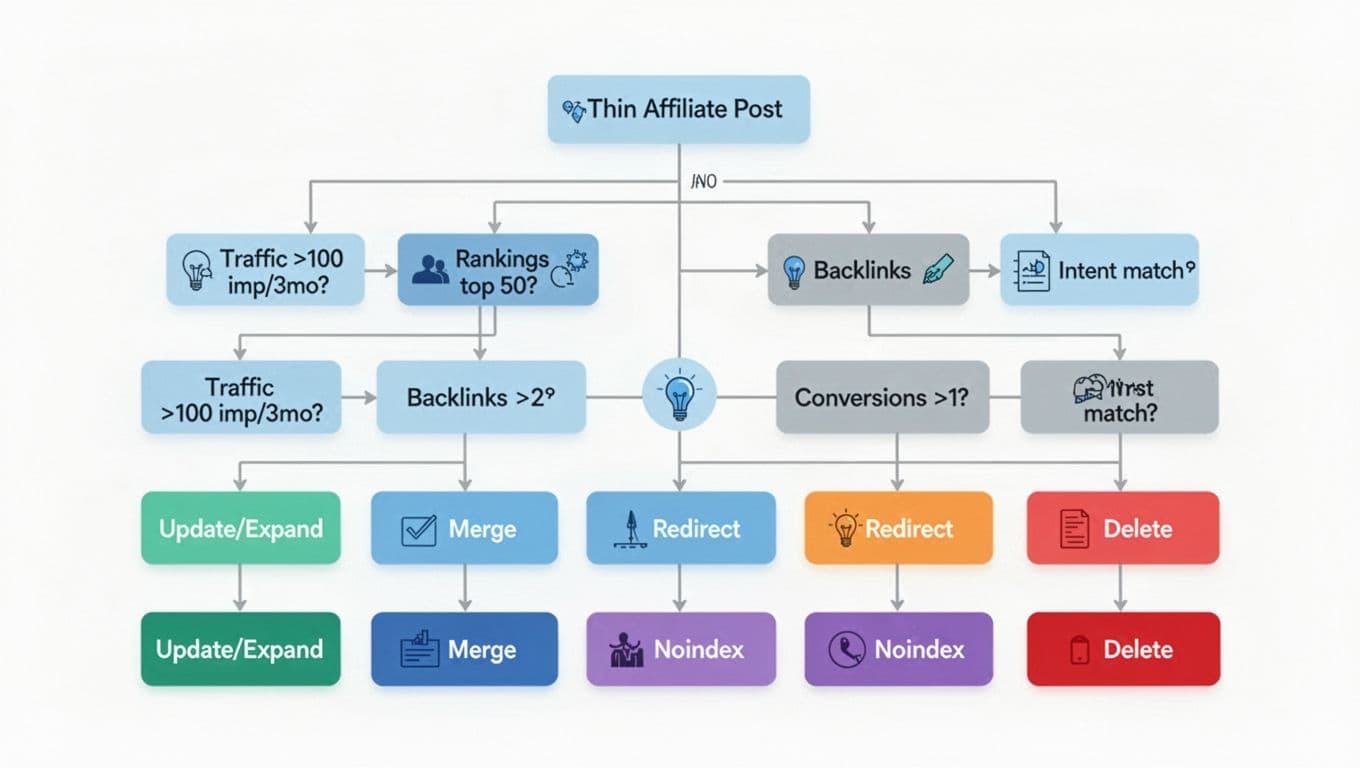
Thin content does not always mean “bad.” A 400-word post can rank if it nails a narrow intent. On the other hand, a 2,000-word roundup can still be thin if it says nothing unique, as evaluated by Google’s Helpful Content System.
Use this decision table to keep choices consistent across product roundups, reviews, and informational guides:
| Action | Use it when (measurable triggers) | Ranking-safe must-do |
|---|---|---|
| Update/Expand | Impressions 100+, or position 50+, or conversions 1+ | Preserve intent, keep URL, improve sections that match top queries |
| Merge | 2+ pages share 60%+ query overlap, both underperform, neither has strong links | Combine into one “best” page, keep the stronger URL, update internal links |
| Redirect (301) | Page has links, or ranks top 50, but a better page serves the same intent | Map top queries to the destination sections, avoid redirect chains |
| Noindex | Page supports user experience but not meant for search (thin support pages, duplicate content you must keep) | Use Noindex tag, keep it accessible, remove from sitemaps, confirm canonical behavior |
| Delete (410 or 404) | No impressions, no links, no conversions, and no clear intent match | Only after you confirm no internal links depend on it |
Gotcha: if you can’t name the page’s intent in one sentence, you’re not ready to prune it.
For affiliate sites, search intent is your safety rope. A “Product A vs Product B” page should not get redirected to a broad “best Product A” list. That swap often tanks relevance, even if traffic was small.
When you feel tempted to delete, use a second opinion framework like this strategic update vs delete framework. It’s a good reminder that some pages are better removed, but only with a plan.
Execute merges and redirects without losing query relevance (templates included)
To avoid keyword cannibalization, where multiple pages compete for the same queries, consolidate content by merging. Most ranking drops happen here, not because merging is bad, but because the new page forgets what the old page ranked for.
First, export the old page’s top queries from GSC and map them to sections on the destination page. Then carry over any unique value that users actually used, such as a comparison table, a “best for X” callout, or a FAQ that matches People Also Ask.
Merge brief template (copy into your doc)
- Source URL(s): (pages being merged)
- Destination URL: (the keeper)
- Intent statement: “This page helps [persona] choose [product] for [constraint].”
- Query map: top 5 queries per source URL, mapped to H2/H3s on destination
- Keep sections: tables, pros/cons, disclaimers, unique angles, photos, test notes
- Cut sections: duplicated intros, repeated specs, manufacturer fluff
- Add proof: 1 to 3 lightweight “receipts” (screenshots, photos, test notes)
If your affiliate reviews feel too similar to every other review, add proof without bloating the page. This guide on proof blocks in affiliate posts is perfect for making updates feel real, especially in 2026 when generic summaries get ignored.
Redirect map template (keep it tight)
| Old URL | New URL | Reason | Status |
|---|---|---|---|
/product-a-review/ | /product-a-review-2026/ | consolidated updated review | 301 |
/best-routers-under-50/ | /best-budget-routers/ | merged overlap | 301 |
Use 301 redirects to pass link equity from old pages to the new ones. After redirects go live, update internal links that point to old URLs. Otherwise, you keep sending crawl signals to pages you no longer want indexed. Also check canonicals: merged pages should usually redirect, not canonicalize. Use canonicals when both pages must exist (for example, a printable version or a near-duplicate you can’t remove).
For a deeper look at content pruning mechanics and why consolidation works, compare your approach with the Ahrefs guide to content pruning.
Rebuild internal linking and then monitor changes like a launch
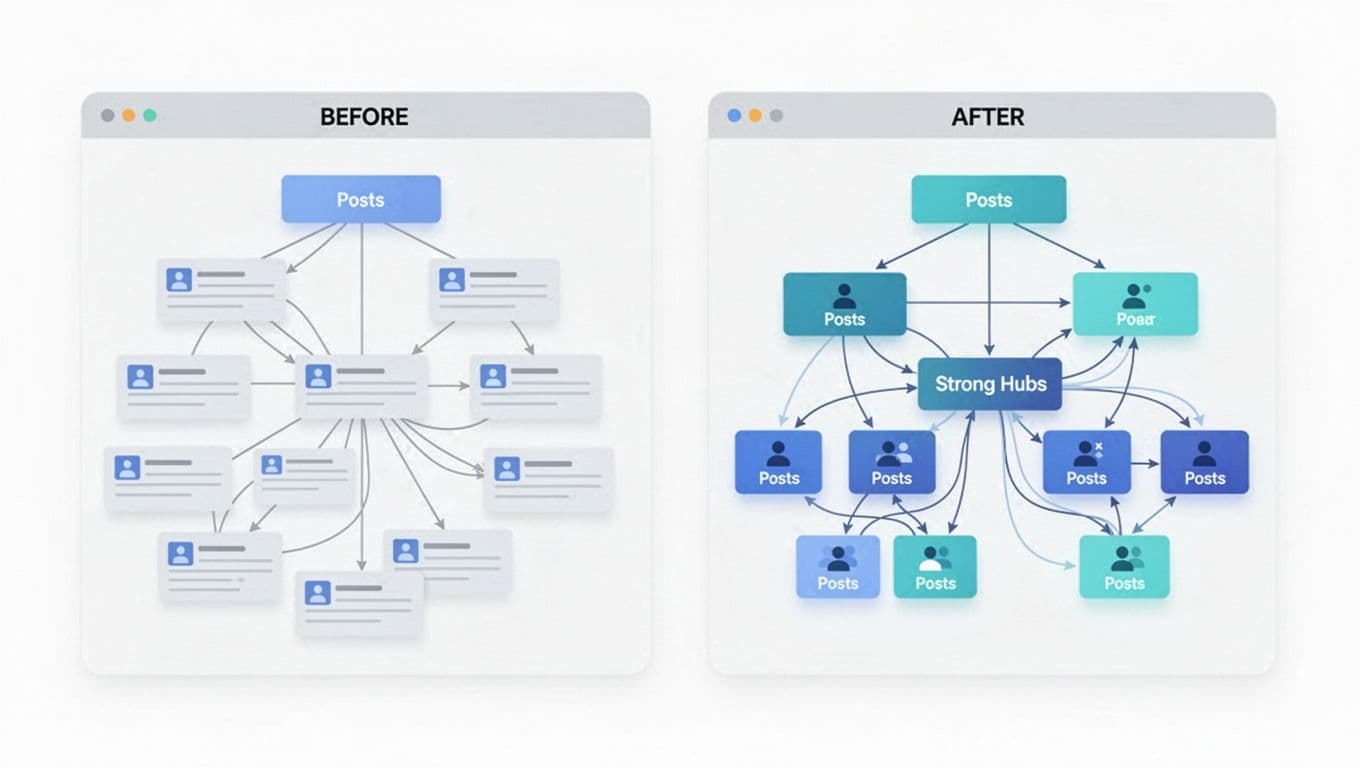
Pruning changes user paths. That’s why internal links matter as much as redirects. Optimized internal links can improve crawl depth for key hub pages, so point “best for X” posts into a strong hub, then link back out to your best comparisons and reviews.
Run this pre-publish safety checklist:
- Confirm destination page covers the same intent as the source.
- Move over any earning sections (tables, CTAs, “best for” boxes).
- Update or remove outdated information in product slots (especially in roundups). If stock changes are common in your niche, follow a repeatable swap process like this guide to handle out-of-stock affiliate products.
- Avoid redirect chains, keep it one hop.
- Re-submit updated URLs in GSC for faster recrawls.
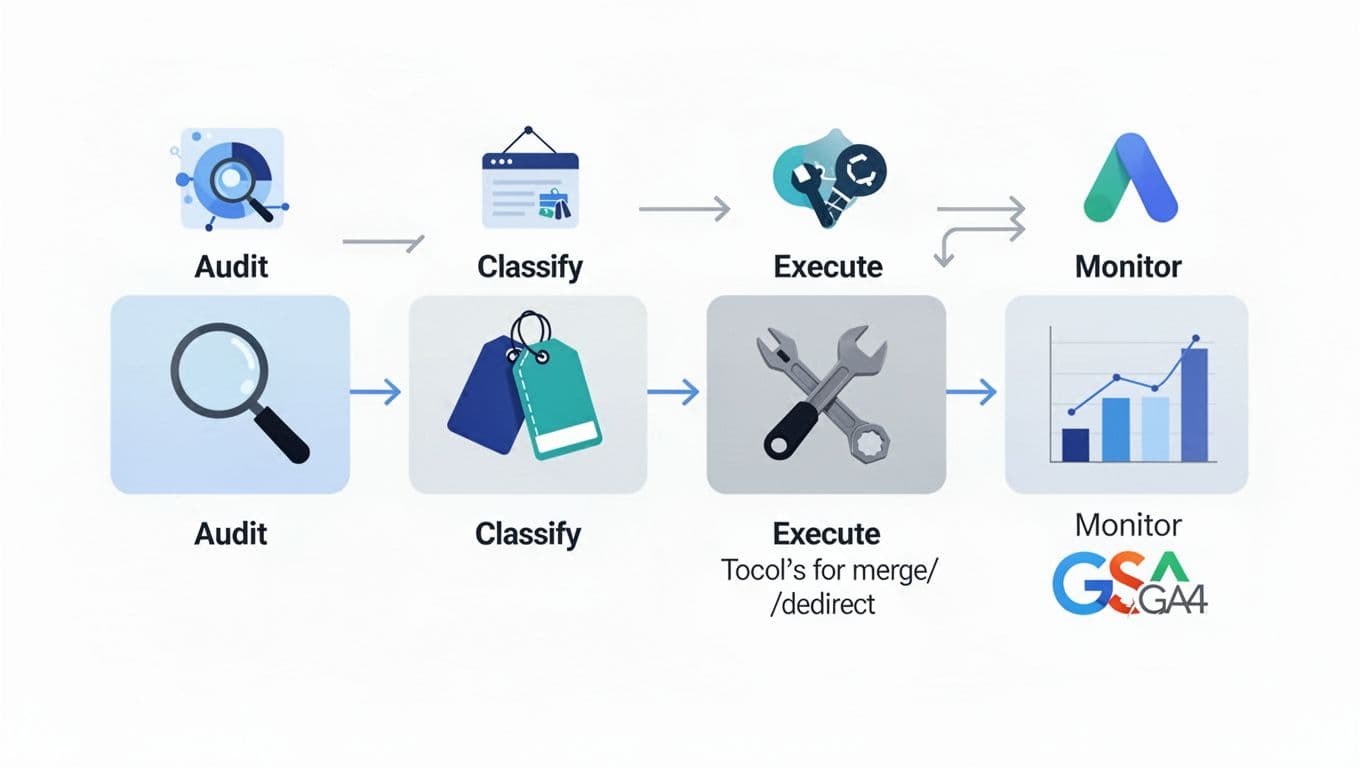
Then monitor like it’s February 2026 and every SERP is volatile (because it is) through a staged rollout to ensure site stability:
- Days 1 to 7: Coverage, indexing, crawl spikes, redirect errors.
- Weeks 2 to 6: query positions for merged URLs, not just total clicks.
- Weeks 6 to 12: conversions, EPC by page, assisted paths in GA4, and a content audit as part of the post-execution review process.
Log every change (date, old URL, new URL, action, why). When something dips, that log maintains your digital ecosystem and turns panic into a clean rollback plan.
Conclusion
Thin posts don’t need a bonfire; they need a content pruning plan that protects intent and preserves what already works. Rooted in content hygiene, this high-level SEO strategy starts with a proper content audit to inventory your URLs, classify with thresholds, merge with a query map, and clean up internal links as carefully as redirects. Over time, it builds topical authority while protecting your site’s E-E-A-T by removing low-quality pages. Then watch GSC and GA4 long enough to know what actually changed; preserving a strong backlink profile is the ultimate safeguard during content pruning. If one page vanished tomorrow, would your site get clearer or weaker?