
“Best” keywords can feel like trying to get a table at a packed restaurant on a Saturday night. You might get in, but you’ll wait forever, and the biggest brands already have the best seats.
In 2026, affiliate keyword research gets easier (and more profitable) when you target bottom-of-funnel keywords and transactional search intent that aren’t trapped behind heavy SERP features, massive brand pages, or pages that already answer everything. That’s where modifiers like “reviews,” “pricing,” and “worth it” shine, because they often signal high-intent search during a real decision in progress. This approach secures stable organic search traffic in 2026.
The “Low-Friction SERP” mindset (what you’re really hunting)
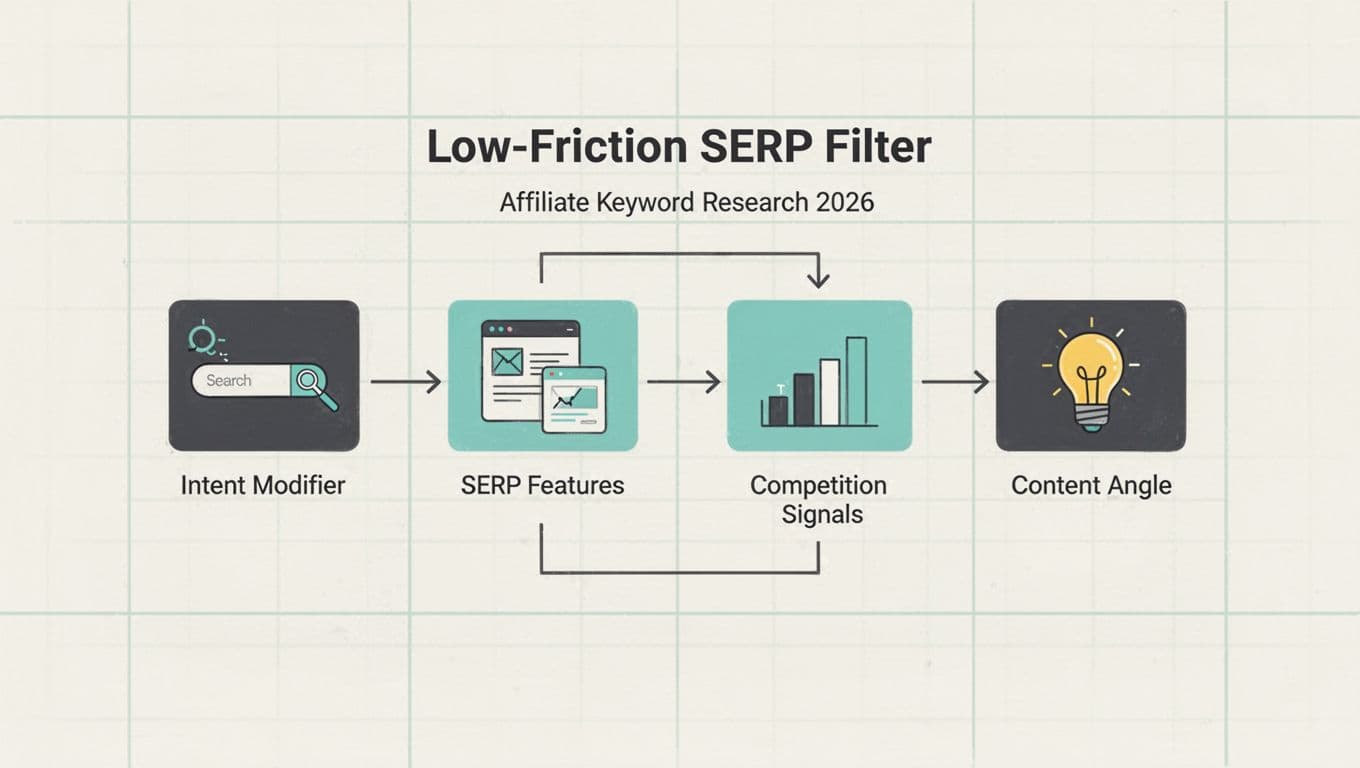
Low SERP friction means: you can publish a better page than what’s ranking without needing a huge backlink profile, a famous brand, or a decade-old domain.
This low-friction SERP filter forms a core part of your content strategy, helping you gauge search intent before chasing any keyword:
- Intent modifier: Does the query sound like a decision (not curiosity)?
- SERP features: Are AI summaries, shopping blocks, and giant aggregators taking over the clicks?
- Competitor analysis: Are results mostly big brands, or are there small publishers, forums, and “normal” sites?
- Content angle: Can you add real value (proof, constraints, pricing clarity, side-by-side choices)?
When you shift from “best” to decision modifiers, you also get cleaner page planning. If you want your review pages to convert once they rank, use a structured layout focused on Conversion Rate Optimization, for example this high-converting product review structure that walks readers from fit to proof to next step without hype.
Modifier patterns that usually convert (and where they fail)
These long-tail keywords carry high commercial intent.
| Modifier family | Query pattern examples | Intent | Ideal page type | Conversion angle | Common SERP pitfalls |
|---|---|---|---|---|---|
| Reviews | “product name review”, “product name reviews 2026” | Evaluate | Product reviews | Proof + tradeoffs | Brand’s own “reviews” page outranks everyone |
| Pricing | “product name pricing”, “product name cost”, “plans” | Budget check | Pricing terms explainer + plan fit | Prevent sticker shock | SERP is just the vendor pricing page + resellers |
| Worth it | “is product name worth it”, “worth it for beginners” | Final decision | Verdict-first review | Fit rules + deal-breakers | AI summary answers it too well with no click |
| Alternatives | “product name alternatives”, “like product name but cheaper” | Escape hatch | Alternatives list | Match personas to options | Big “top 10 software” sites dominate |
| Vs | “product A vs product B” | Compare | Comparison queries post | Use-case based winner | Comparison SERP full of tool directories |
| Trial / refund | “product name free trial”, “refund policy” | Risk control | Policy explainer + how it works | Reduce fear | Vendor policy page wins, thin affiliate pages get ignored |
| Coupon / discount | “product name coupon”, “promo code” | Deal seeking | Deal page (careful) | Save money today | Coupon sites, rules against coupon claims |
Mini SOP: Build seed lists, then expand into “review,” “pricing,” and “worth it” footprints
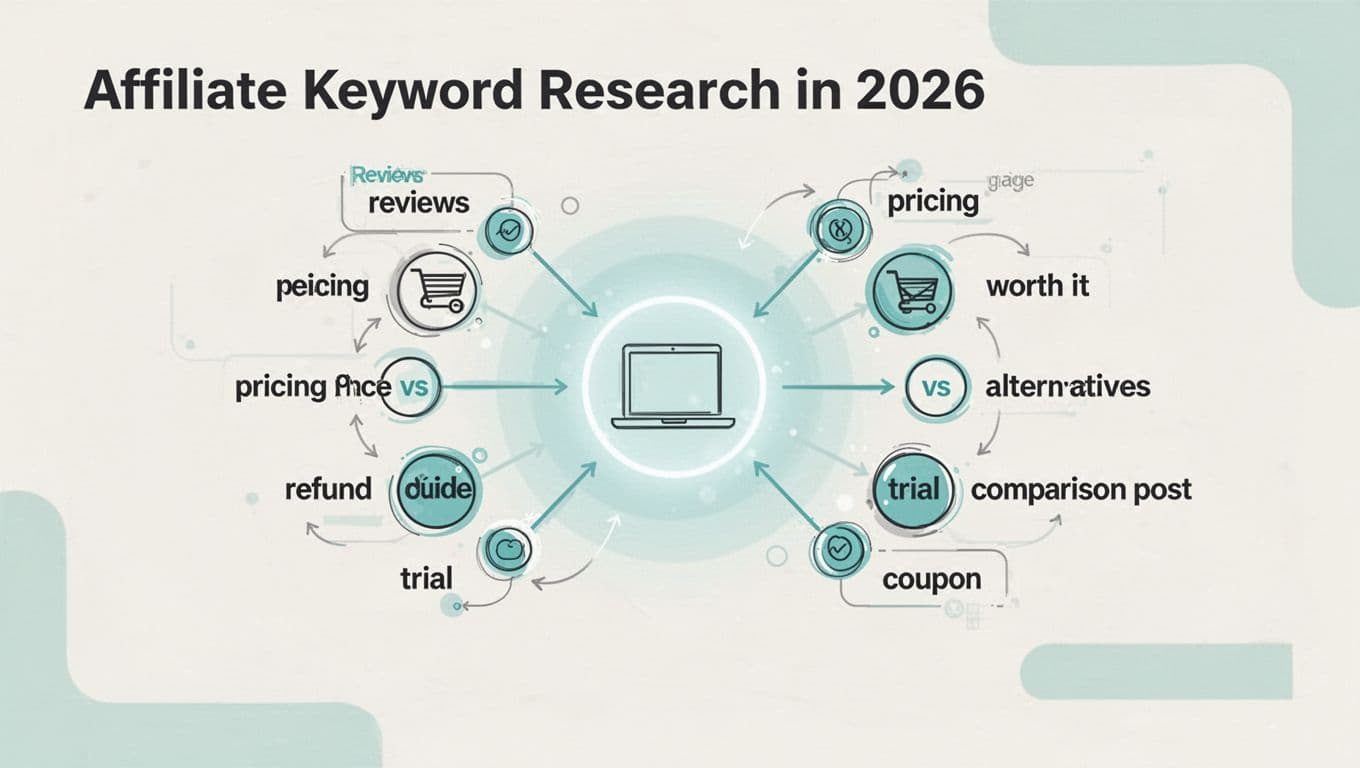
The fastest way to waste time is starting with modifiers before you have solid “seed products.” Start with products people already buy, then attach the right decision modifiers.
SOP 1: Find seed products (30 minutes)
Pick one niche, then use competitor analysis to list 20 to 50 items from these sources:
- “Integrations” pages (tools often list competitors and complements)
- Marketplaces (categories show what people actually buy)
- Forums and communities (look for repeated “Which one should I choose?” threads)
- Backlink database
If you’re still torn on niche direction, this guide to choosing affiliate niches helps you lock onto a clear audience and problem, so your keyword list doesn’t become random.
SOP 2: Expand modifiers (your “footprints”)
For each product seed, generate footprints to build topical authority and semantic relevance through keyword clusters, such as these bottom-of-funnel keywords:
[product] review,[product] reviews 2026,[product] pros and cons[product] pricing,[product] cost per month,[product] annual planis [product] worth it,[product] worth it for [persona][product] alternatives,[product] vs [competitor][product] refund,[product] cancellation,[product] free trial
This system helps generate marketing qualified leads. Once these keywords are selected, technical SEO and on-page optimization are required.
If you need a quick refresher on tool options for doing this at scale, see keyword research tools for affiliate marketers.
Regex-style patterns you can paste into tools
Use these as include filters (tight buyer intent):
- Include:
b(review|reviews|pricing|price|cost|plans|worth it|vs|versus|alternatives|refund|trial|coupon|discount)b
Use these as exclude filters (common research-only intent):
- Exclude:
b(free|torrent|crack|apk|mod|login|download|pdf|template|jobs|support|customer service|phone number)b
Mini SOP: Filter in tools, then manually validate SERPs (the “friction score” test)
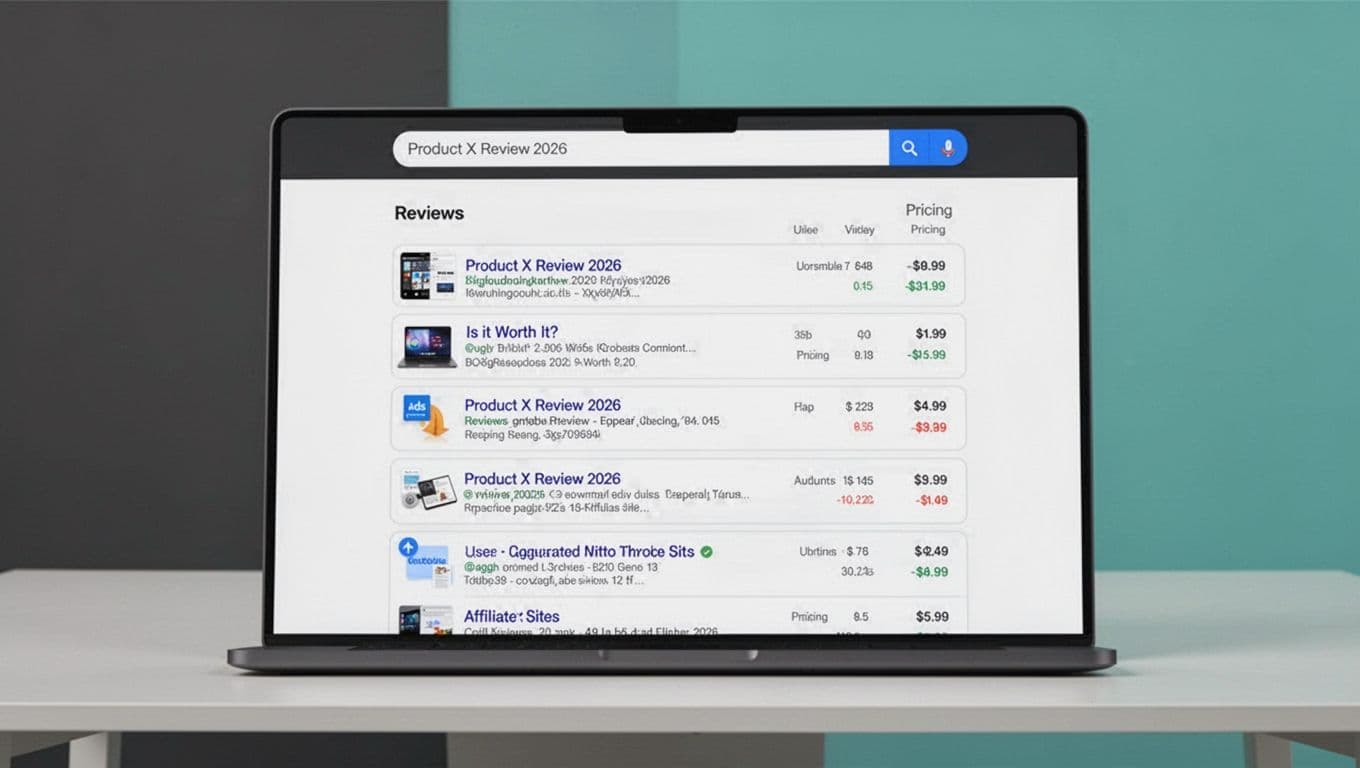
Tool filters get you a shortlist for low SERP friction opportunities. Manual SERP checks tell you what’s actually winnable.
SOP 3: Tool filtering that matches 2026 reality
Keep it simple:
- Prioritize keywords where you can write a page that answers the query in one sitting, while optimizing for AI search visibility and Generative Engine Optimization.
- Don’t over-trust Keyword difficulty. Treat it like a hint, not a rule.
- Create a “brand dominance” check: if the top results are mostly the vendor, app stores, and mega review sites, expect friction.
SOP 4: Manual SERP validation checklist (5 minutes per keyword)
Open an incognito window and score the results. These checks align with evolving search intent:
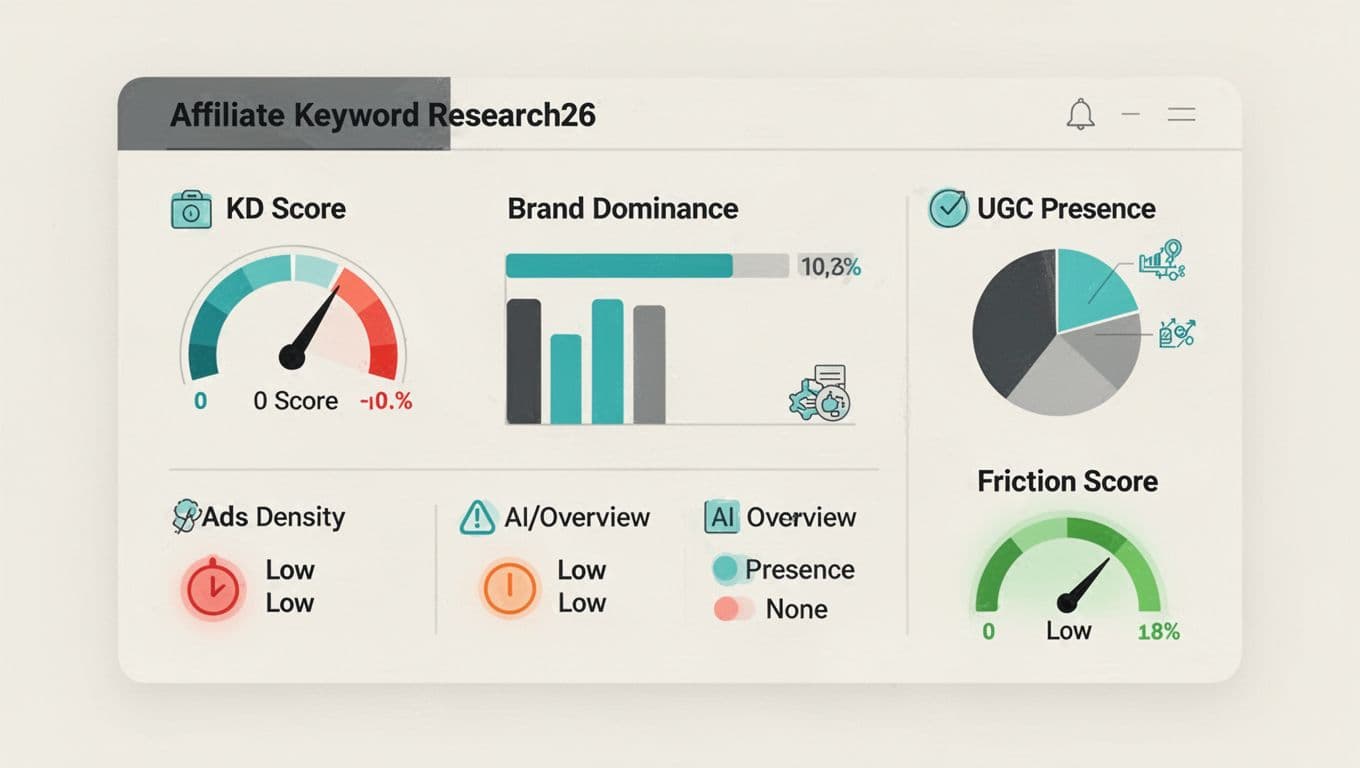
Use a 0 to 10 friction score (lower is better). Also check for mobile-first experience:
- Brand dominance (0 to 3): How many top 10 results are the vendor, Amazon, or huge publishers?
- SERP click stealers (0 to 3): AI overview, shopping block, “Popular products,” heavy ads.
- UGC presence (0 to 2): Forums and real discussions can be good, they show unresolved questions.
- Content weakness (0 to 2): Thin pages failing EEAT guidelines, missing Structured data, outdated dates, unclear pricing, no screenshots, no tradeoffs.
Decision rule: With solid Technical SEO and on-page optimization as prerequisites, publish when the friction score is 0 to 4, be cautious at 5 to 6, skip 7+ unless you have authority. After publishing, monitor performance with rank tracking. These steps align with evolving search intent.
Before you publish anything, vet the offer and rules, especially around coupons, claims, and traffic sources. This affiliate program vetting checklist helps you avoid promoting programs that reverse commissions or limit what you can say.
Conclusion: win by being the clearest answer, not the loudest
“Best” keywords reward size and volume. Affiliate keyword research in 2026 rewards Answer Engine Optimization through clarity, proof, and pages that help someone decide, blending search intent, technical SEO, and on-page optimization. Build seed lists from real products and product reviews, expand with “reviews,” “pricing,” and “worth it” footprints while assessing keyword difficulty through competitor analysis, then only write what passes your friction score. Track progress with rank tracking to boost organic search traffic, refine on-page optimization, and enhance conversion rate optimization for sustained organic search traffic growth.
Keep it honest with brand voice consistency: disclose affiliate relationships, don’t promise results you can’t prove, and call out who a product is not for. That trust is what turns rankings into income and drives more organic search traffic.