
If you produce product roundups within the affiliate marketing space, you’ve felt this fork in the road: do you target the big, broad phrase (best overall), or the sharper angle (best for X)?
It’s like walking into a store and asking, “What’s the best?” versus “What’s best for a small apartment?” The first question reflects a general interest, while the second highlights high commercial intent.
This post gives a quick, repeatable SERP method for affiliate keyword selection in 2026, plus a simple scoring table and ready-to-use title and H2 structures for both keyword types.
Best overall vs best for X: what the SERP is really asking you to publish
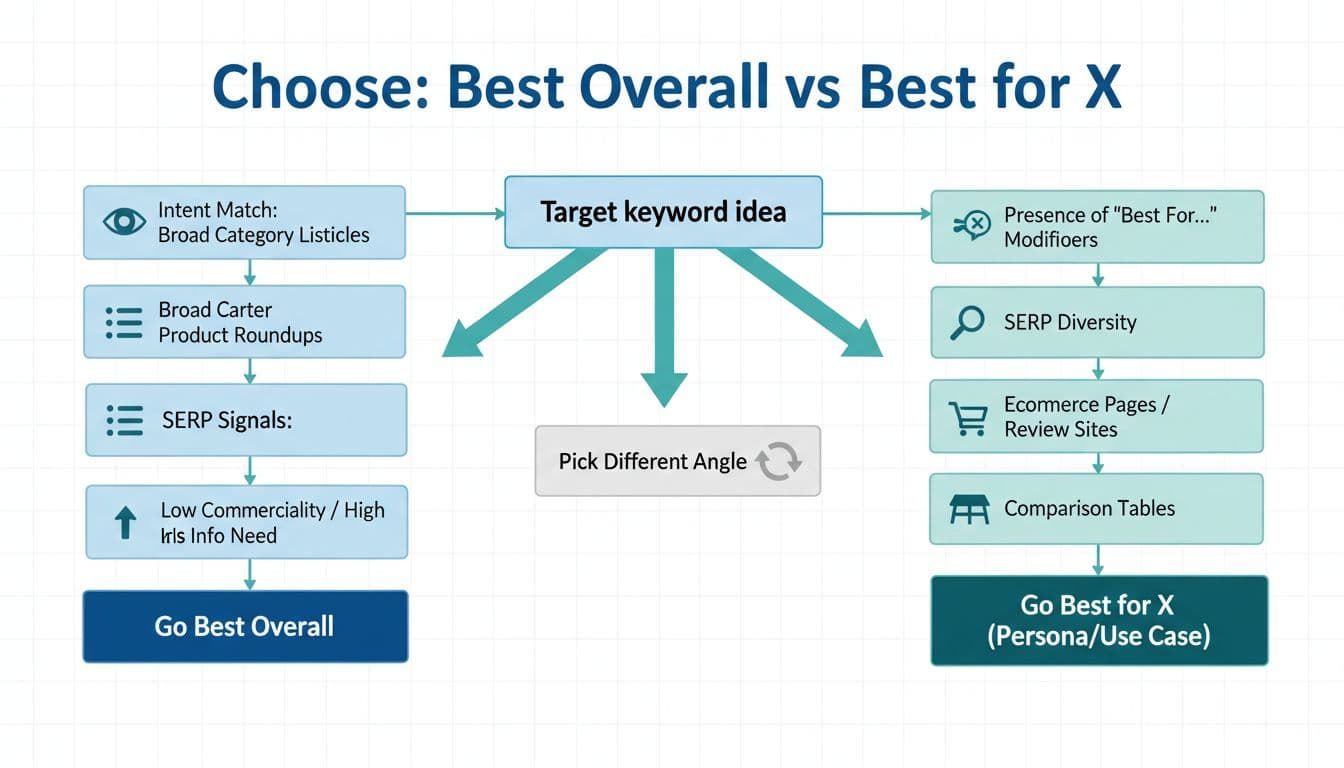
“Best overall” keywords usually want a single page that acts like a shelf display: a clear winner, a few strong alternatives, and a fast explanation of why. When Google shows lots of product listing pages and ecommerce sites at the top, it’s a sign the SERP accepts a broad roundup based on clear search intent.
“Best for X” keywords are different. They’re closer to a fitting room. The searcher already knows the product category, now they need the right match for a specific constraint (budget, body size, use case, skill level, space, speed, noise, travel).
In January 2026, SERPs also have more “shortcut” elements than most affiliates are used to. AI overview-style answers often satisfy informational intent for broad queries, PAAs pull out small decision points, forums show real-world edge cases, and video blocks appear when the query needs a demo. Those blocks change what wins:
- AI overview-style answers tend to reward broad, simple picks (often “best overall”), which can reduce clicks if your page looks like every other list.
- PAAs skew toward “for who?” and “for what?” questions, which is fuel for “best for X” angles and tight sections.
- Forums (and discussion-heavy search results) signal disagreement, nuance, or unusual constraints, all of which favor “best for X.”
- Video blocks hint the buyer wants to see and hear the product, which often pairs better with specific niche angles (because demos usually answer a specific worry). This transparency helps establish E-E-A-T signals that AI summaries often lack.
Before you choose, do a fast SERP read. If you need tools for quick checks, start with a shortlist of best SEO keyword research tools and stick to one workflow.
The 60-second SERP method for affiliate posts (fast, repeatable, hard to fool)
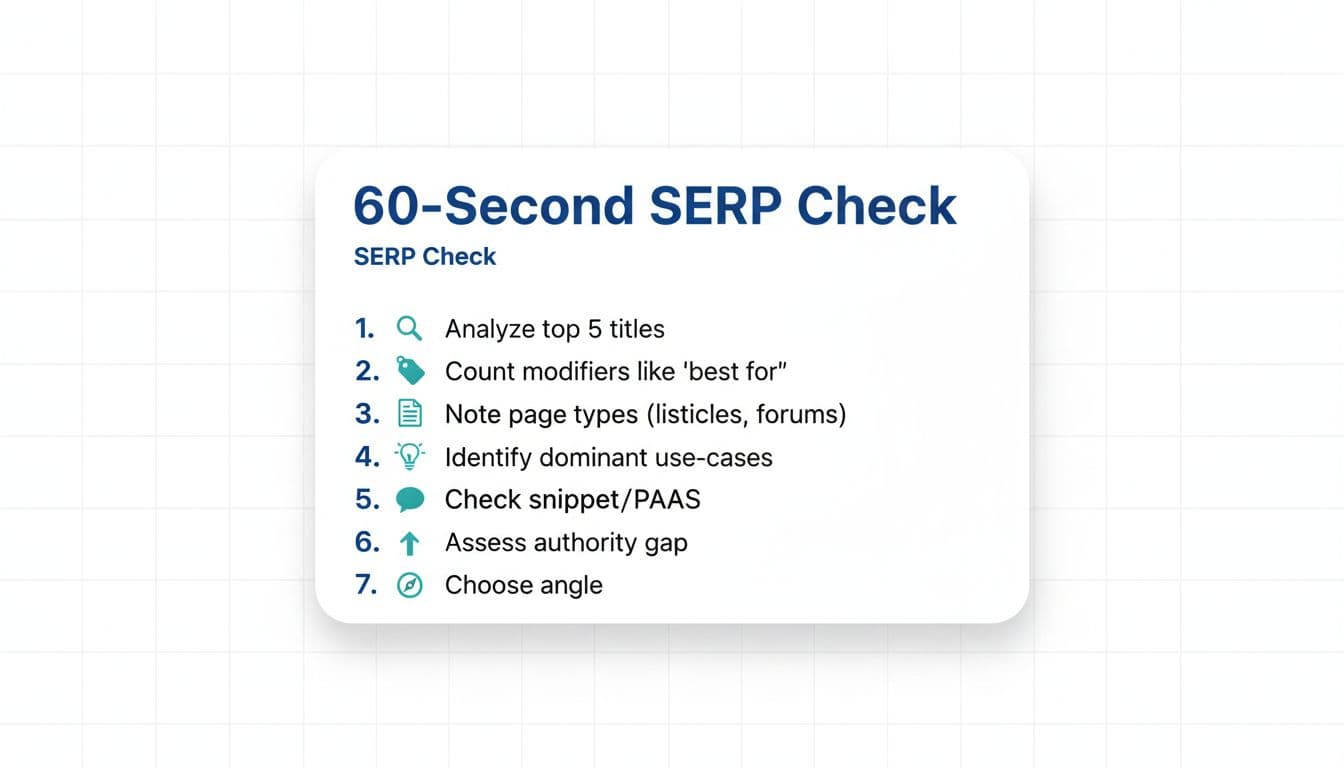
Open an incognito window, search your keyword, and scan only the top of the page. Don’t research for an hour. You’re trying to answer one question: “What type of page is Google already rewarding?”
Use this seven-step check:
- Read the top 5 titles out loud. Are they mostly “Best X (2026)” or are they packed with modifiers like “for apartments”, “for beginners”, “for back pain”?
- Count modifier patterns. If 3+ of the top results include a similar “for X” modifier, the SERP is already segmented. Your keyword research should already suggest these segmentations.
- Label each ranking page type. Affiliate listicle, brand review site, ecommerce category page, forum thread, or video-focused result. One type dominating is a strong hint.
- Look for a “default use case.” Even broad keywords often hide a default. Example: “best microphone” might lean podcasting, not stage vocals.
- Check SERP features quickly. AI overview-style answer, PAAs, “Popular products”, image packs, video blocks, forums. Look for ad variants to see how competitors are bidding on this intent. These are intent clues, not decoration.
- Assess the authority gap. Are the top results huge publishers and brands only, or do you see smaller niche sites ranking? If it’s all giants, broad “best overall” is often a slower climb.
- Decide your angle in one sentence. “This page helps [persona] pick [product] for [use case], and explains tradeoffs fast.”
If you’re building multiple pages around the same product category, topic clusters help you build high-performance content by organizing your site into logical topic clusters, avoiding writing five pages that compete with each other. A practical reference is this keyword clustering tools guide, especially when you’re deciding which “best for X” angles deserve their own page.
Use a simple scoring rubric (and steal these title + H2 structures)
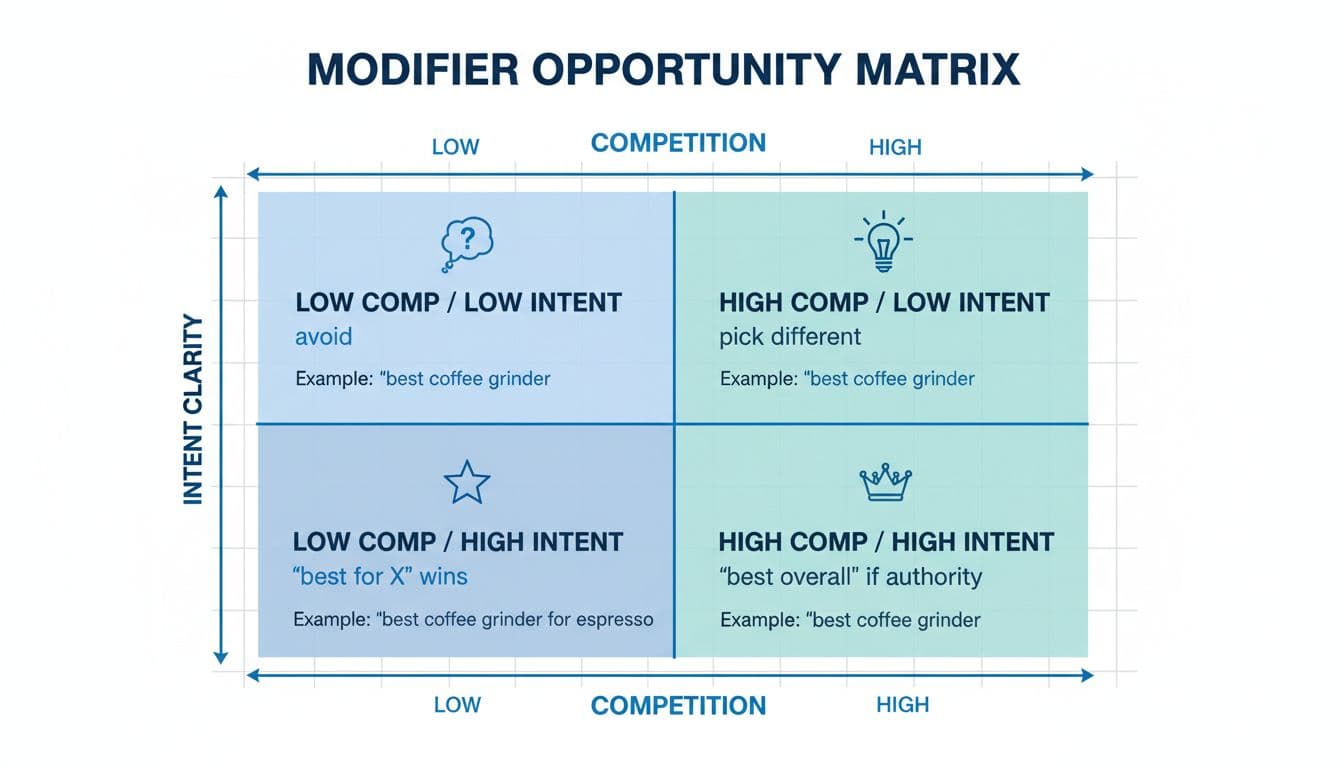
The goal isn’t to be clever. It’s to be consistent. Score the SERP signals below for the keyword you’re considering.
| SERP signal you can spot fast | Points to “Best Overall” | Points to “Best for X” | What it usually looks like |
|---|---|---|---|
| Top titles mostly broad (no modifier) | +2 | 0 | “Best X”, “Top X”, “X Reviews” |
| Top titles repeat the same modifier | 0 | +2 | “Best X for Y” shows up 3+ times |
| Comparison tables and quick picks dominate above the fold | +2 | +1 | Lists with tables and quick picks |
| Forums are in top 5, or forum module shows | 0 | +2 | Threads arguing about edge cases |
| Video block is prominent | +1 | +2 | “best for…” paired with demos/how-tos |
| Ecommerce category pages rank high | +2 | +1 | “Popular products”, filters, categories |
| AI overview-style answer is strong and generic | +1 | +2 | Overview gives broad picks, but leaves specifics unanswered |
| Clear “default persona” across results | +2 | +1 | Results assume one main use case |
Decision rule: if one side leads by 3+ points, pick it. If it’s close, newer sites usually do better with “best for X” because it narrows the fight and makes your angle obvious.
Now, plug that choice into your page structure. Here are concrete templates you can reuse.
If you choose “best overall”: make it fast, then prove it
Example title ideas
- Best Standing Desks in 2026 (Top Picks for Home Offices)
- Best Budget Laptops in 2026 (Performance Picks That Don’t Feel Cheap)
Example H2 structure
- How we picked the best overall options
- Quick comparison table (price, key feature, who it’s for)
- Best overall pick (pros, cons, who should buy)
- Runner-up picks (each with a clear “best for” micro-label inside the page)
- Buying guide: what matters most (2–4 decision factors)
- FAQs pulled from PAAs (short, direct answers)
This layout is designed to maximize on-page engagement by providing immediate answers.
This approach is a staple for Amazon Associates and large-scale reviewers. It works when the SERP rewards “one page to rule them all.” It’s also safer when the PAA questions are general (“what size”, “how much”, “is it worth it”), since those fit a broad buying guide.
For content quality, especially with AI overview-style answers on the page, focus on specifics that summaries can’t copy: your selection criteria, tradeoffs, and real-world constraints. If you need a framework for content optimization while ensuring your brand voice remains distinct, this comparison of SEO content optimization tools in 2026 is a useful baseline.
If you choose “best for X”: commit to the persona and the constraint
Example title ideas
- Best Office Chairs for Back Pain in 2026 (Support Without the Bulk)
- Best Espresso Grinders for Small Kitchens (Quiet, Compact Picks)
Example H2 structure
- Who this “best for X” list is for (and who should skip it)
- The 3 buying rules for this use case (simple, strict)
- Quick comparison table (only the specs that matter for X)
- Best overall for this use case (one clear winner)
- Best upgrade pick (if budget isn’t tight)
- Best value pick (if price matters most)
- FAQs from PAAs (answer the “will it work for me?” questions)
This format wins when you see forums, video blocks, and PAA questions that reveal anxiety (noise, comfort, fit, speed, space). It also protects you from broad SERPs where big publishers dominate, because you’re not trying to beat them on a generic promise. This specific product review format often leads to a higher conversion rate because it targets specific pain points.
Conclusion
Mastering this balance is essential for any modern affiliate marketing strategy. Choosing between “best overall” and “best for X” doesn’t need a long debate. Run the 60-second SERP check, score the page types and features, then commit to the angle the SERP is already rewarding. Choosing the right angle from the start improves your revenue speed by capturing the right traffic faster. The best part is that this approach makes affiliate keyword selection feel less like guessing and more like pattern recognition. By using strategic internal linking between your “best overall” and “best for X” posts, you create a web of helpful content that Google rewards. Next time you’re stuck, ask one simple question: is the SERP asking for a broad overview or specific buyer intent?