
Ever joined an affiliate program that looked perfect, then the rules showed up later like fine print on a gym contract? It happens. A program can look legit on the surface, but still waste your time with weak tracking, vague terms, or payouts that never seem to arrive.
This affiliate program checklist is a quick, repeatable way to screen a program before you build content, run ads, or send it to your email list. It’s not about being cynical. It’s about being picky with your time.
Start with legitimacy (so you don’t promote a mirage)

Before you look at commission rates, confirm the program is a real business with real support.
Here’s the fast screen:
Company details: Is there a legal business name, physical address (or at least a registered location), and clear ownership? A serious program won’t hide behind a generic contact form only.
Real contact info: Look for a working support email, affiliate manager contact, and response expectations. If you can’t tell who runs the program, you can’t fix issues later.
Reputation and complaints: Search the brand name plus “affiliate” plus “payout” or “reversal.” One bad review isn’t proof, but patterns matter. If you’re not sure what scams look like, this overview of common affiliate marketing scams and warning signs is a good refresher.
Product reality check: Does the product have normal pricing, clear terms, and a refund policy? If the offer feels like a magic trick (huge promises, fuzzy details), your audience will feel it too.
Confirm the offer fits your audience (and your content style)
A high commission doesn’t fix a bad match. Promoting the wrong product is like wearing shoes that don’t fit, you can walk, but you’ll hate every step.
Look at these basics:
Who buys this and why? If you can’t describe the buyer in one sentence, don’t join yet.
Sales cycle: Is it an impulse buy or a research-heavy decision? This affects cookie length, attribution, and how you write content.
Promo angles you’re allowed to use: Some programs restrict “reviews,” “best of” posts, bonuses, or certain claims. Ask for brand guidelines upfront.
Geographic restrictions: Many offers only pay for customers in certain countries, or they block traffic from specific regions. If your traffic is global, this matters a lot.
Tracking, attribution, and cookie terms (where money often leaks)
Most affiliate headaches come from one place: tracking you can’t verify. You don’t need to be technical, but you do need to be specific.
Cookie duration and attribution model
Cookie duration is the time window you get credit after a click. Attribution model is how credit is assigned when multiple channels touch the same buyer.
A few things to pin down in writing:
- Cookie duration: 24 hours, 7 days, 30 days, lifetime? Also ask if it’s shortened on mobile apps or in certain browsers.
- Attribution model: last click, first click, or something else. (Some programs also exclude affiliates if an email, paid search, or coupon site touches the sale later.)
If you want a plain-language overview of attribution options, this explainer on affiliate attribution models helps you know what to ask for.
Tracking reliability (and how you can sanity-check it)
Ask what platform runs the tracking (network, in-house, or partner software), and whether it supports cross-device or cookieless methods. Privacy changes have made tracking harder, so programs that invest here usually show it in their reporting.
Simple ways to sanity-check:
Test clicks: Click your own link, then confirm it appears in the dashboard quickly.
Conversion lag: Ask how long it takes conversions to show up. Some post fast, some batch daily.
Reporting detail: Do you see sub-IDs, landing pages, and order values, or is it just one number?
Reversal rates and the locking period (don’t ignore this)
Two terms matter more than most affiliates realize:
Reversal rate: the percentage of tracked transactions that get voided (refunds, fraud, canceled orders).
Locking period: the time before a commission becomes “locked” and payable.
A program can advertise a strong EPC but quietly reverse a big chunk of sales, or hold commissions for 60 to 120 days.
Ask for their typical reversal range and the standard locking period for your category.
Terms that can get you kicked out (even if you’re making sales)
This is where affiliates get surprised. Read the rules like you’re reading a lease, because one wrong move can mean withheld commissions.
Paid search, coupons, and brand bidding
Get clear answers on:
Paid search rules: Are you allowed to run Google ads or Bing ads? Can you direct-link? Are there keyword limits?
Brand bidding: Can you bid on the company name, product names, or misspellings? Many programs ban this.
Coupon and promo code policy: Are coupons allowed at all? If yes, can you use public coupons only, or can you create your own?
If you do email marketing, also check if the program bans certain traffic sources (incentives, pop-ups, toolbars, SMS, certain social platforms).
FTC disclosure requirements (you’re responsible, not the program)
Even if a program doesn’t mention it, you still need clear affiliate disclosures. The FTC expects disclosures to be obvious and close to the affiliate link, not hidden in a footer.
For examples and plain explanations, see FTC affiliate disclosure guidance and examples.
If a program pressures you to hide disclosures or use misleading claims, walk away.
Payout details: the part that decides if it’s worth it
A good dashboard is nice. A clean payout policy is better.
Check these items before you publish anything:
Commission structure: flat fee vs percentage, and whether there are tiers or performance bumps.
Minimum payout threshold: $10, $50, $100? High thresholds can trap small publishers for months.
Payout schedule: net-30, net-60, net-90? Tie this back to the locking period so you know real cash timing.
Payment method and fees: PayPal, ACH, wire, check, crypto. Ask if there are processing fees, currency conversion fees, or wire fees that reduce your payout.
Tax forms: For US affiliates, you may need to submit a W-9, or a W-8BEN if outside the US.
Questions to ask the affiliate manager (copy these)
Use these as quick, direct questions:
- “What’s your average reversal rate, and what usually causes reversals?”
- “How long is the locking period before commissions are approved?”
- “What attribution model do you use (last click, first click, or other), and are there channels that override affiliate credit?”
- “What’s the cookie duration, and does it change on mobile or in-app browsers?”
- “Are paid search and brand bidding allowed, and do you have a keyword list?”
- “What are your rules on coupons, promo codes, and deal sites?”
- “Any geo restrictions for traffic or for customers?”
- “Do you support sub-IDs so I can track placements?”
- “What are the payout threshold, payout schedule, and any payment fees?”
- “Who do I contact if tracking looks off, and what’s your typical response time?”
Copy and paste: Affiliate Program Vetting Mini Checklist
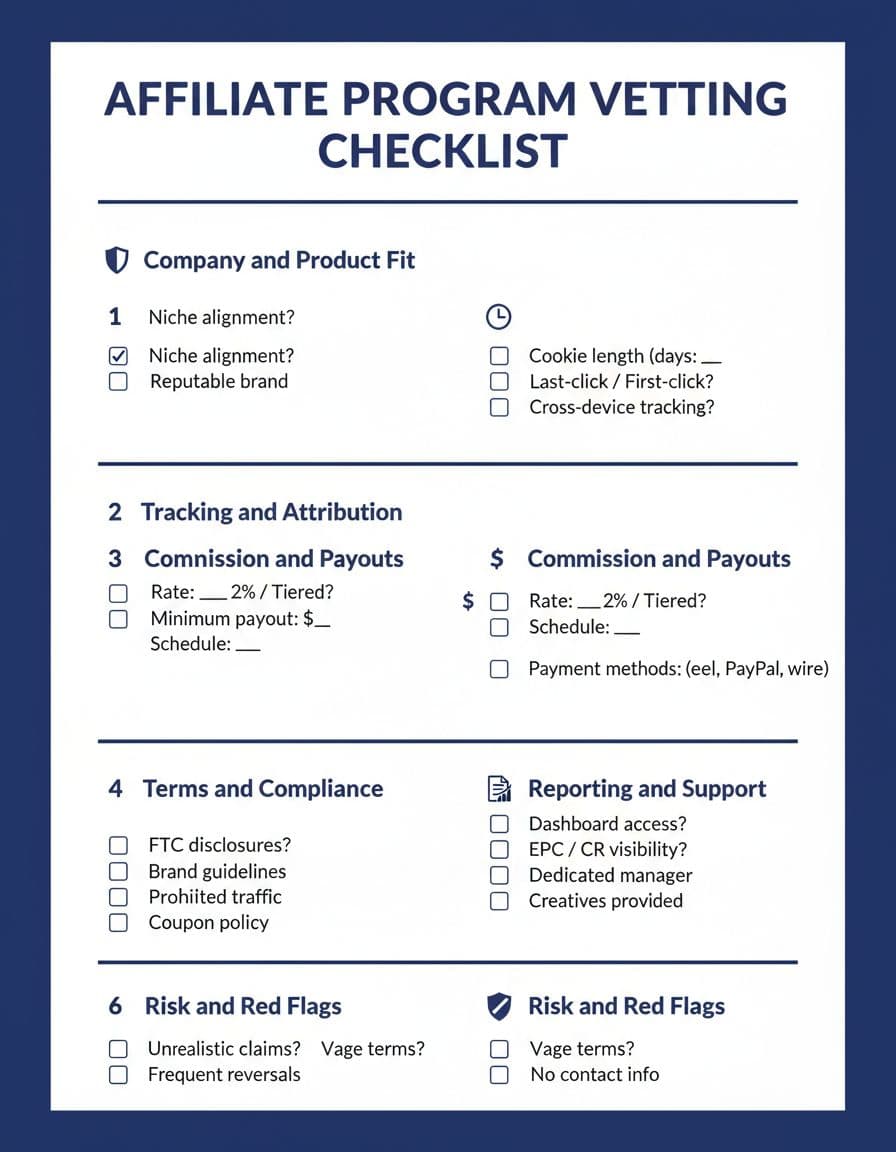
Save this and run it before you join:
- Company has clear legal name, site ownership, and real contact info
- Offer matches my audience, and I can promote it honestly
- Geo restrictions are clear (traffic and customer location)
- Cookie duration is confirmed in writing
- Attribution model is stated (last click, first click, or other)
- Tracking supports sub-IDs and shows enough reporting detail
- Locking period is reasonable and documented
- Typical reversal rate is shared (or at least explained)
- Paid search rules are clear (including brand bidding)
- Coupon and promo code rules are clear
- FTC disclosure expectations are clear, and I can comply
- Payout threshold, schedule, methods, and fees are acceptable
- Support path is clear (affiliate manager name, response time)
- No red flags (vague terms, unrealistic claims, missing company details)
Conclusion: join fewer programs, earn more from the right ones
A smart affiliate doesn’t join everything, they join programs they can trust and track. When you use an affiliate program checklist, you stop guessing and start choosing offers that pay reliably, fit your audience, and won’t punish you for invisible rule changes.
Pick one program you’re considering this week, run the checklist, then ask the manager the hard questions. If the answers are clear, you can promote with confidence. If they dodge, you just saved yourself months of frustration.