
If your affiliate site feels like a drawer full of loose batteries, you’re not alone. Random posts can get traffic, but they often fail to build topical authority fast enough to stack trust and win product clicks.
In 2026, affiliate topical clusters still work because they turn scattered articles into a connected content strategy. You publish one pillar page as the central point of the topic clusters approach, then 12 supporting posts that answer the exact follow-up questions buyers ask. The result is cleaner relevance, stronger internal links, and fewer “why didn’t this rank?” surprises.
Why affiliate topical clusters win in 2026 (and where people mess up)
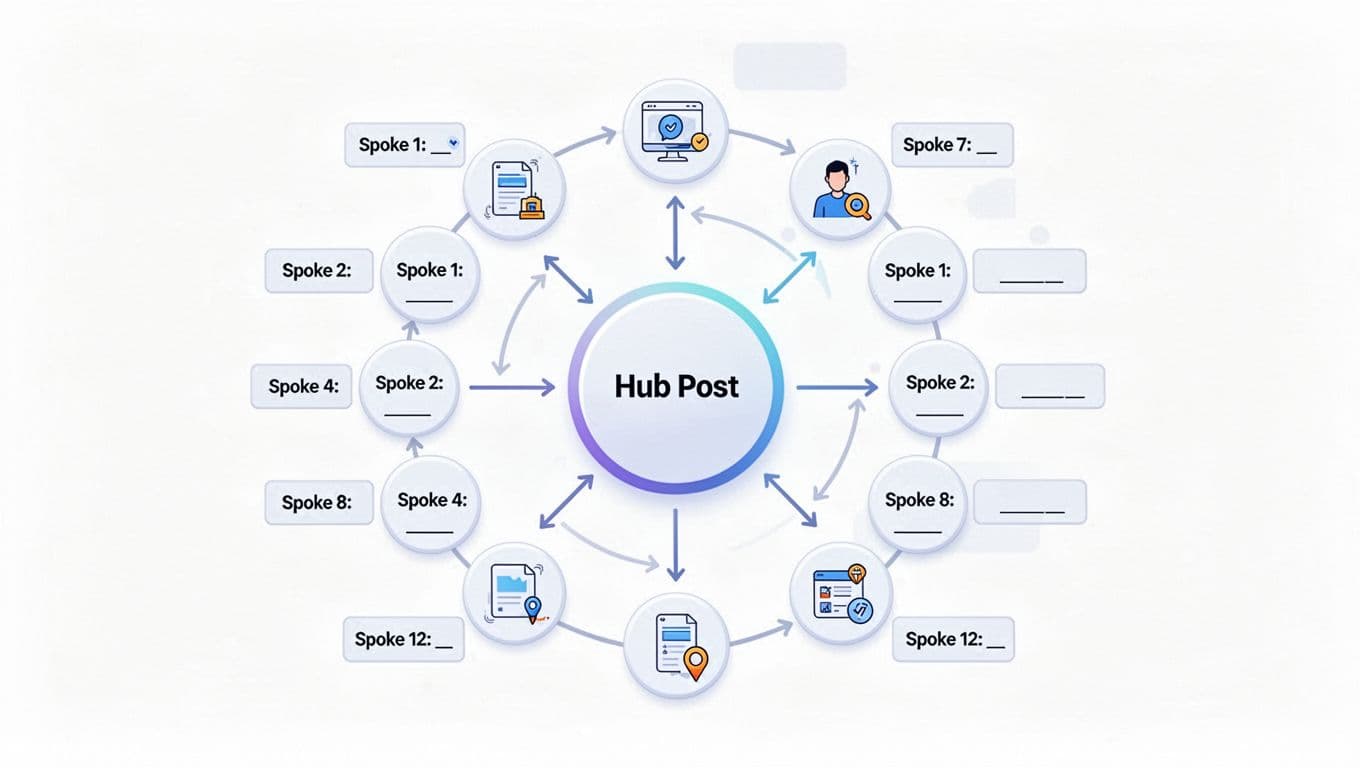
Google’s systems have gotten better at understanding topic relationships, not just matching exact phrases. That’s why clusters help. They make it obvious what your site covers, how subtopics connect, and which page is the “pillar page” for each intent (so you avoid keyword cannibalization).
What changes in 2026 is the search results page itself. Google AI Overviews and AI search engines, along with forums, video blocks, and “popular products” modules, lead to a rise in zero-click search and steal clicks from vague content. Topic clusters fight back by covering the buyer journey end-to-end, from first confusion to final comparison, which is essential for E-E-A-T and semantic relevance.
These topic clusters also provide a repeatable framework for a modern content strategy. Many sites stall because they chase new niches too early. Instead, build one cluster deep, then expand. If you want a broader view of how clusters support AI-cited visibility, skim topic cluster strategy basics. For a deeper content-architecture angle, see advanced content clustering concepts.
The fastest clusters don’t “cover everything.” They cover everything buyers need to decide.
The most common mistake is mixing intents on one page. For example, stuffing “best X,” “how to use X,” and “X pricing” into one post. That usually blurs relevance. A cluster fixes it by giving each intent its own page, then tying the set together with internal links.
Fill-in-the-blank 12-post cluster map (copy, paste, and fill)
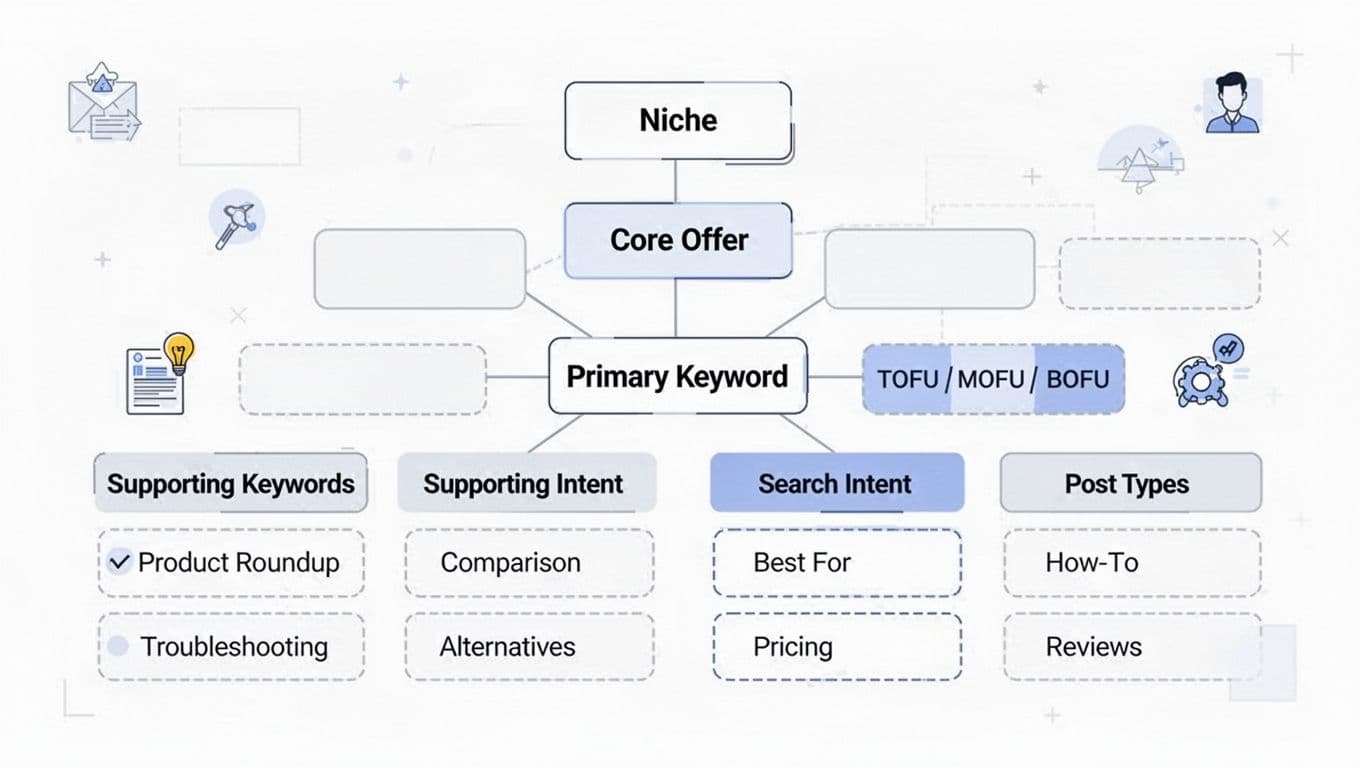
Before you write, pick one product category where you can publish 12 helpful posts without repeating yourself. If you’re still choosing, start with how to pick an affiliate niche, then lock your first cluster.
Use this table as your fill-in map. While the pillar page is broad, the cluster content focuses on specific long-tail keywords. Keep the pillar page broad, then make each spoke laser-focused on one search intent.
| Page | Working title (fill in the blanks) | Intent | Keyword type to target (search intent) | Suggested format | Must link to |
|---|---|---|---|---|---|
| Pillar Page | The Complete Guide to [TOPIC] (2026): Picks, Setups, Mistakes, FAQs | Mixed | Primary topic + “best” modifiers | Hub guide + table of contents | All spokes |
| Spoke 1 | Best [PRODUCT] for [USE CASE] | BOFU | “best for X” | Best-of (tight list) | Pillar Page + Spoke 2 + Spoke 3 |
| Spoke 2 | [PRODUCT] A vs [PRODUCT] B: Which should you buy? | BOFU | “X vs Y” | Versus comparison | Pillar Page + Spoke 1 + Spoke 4 |
| Spoke 3 | [PRODUCT] alternatives (cheaper and premium options) | MOFU | “alternatives” | Alternatives list | Pillar Page + Spoke 1 + Spoke 12 |
| Spoke 4 | [PRODUCT] review: what surprised me after [TIME] | BOFU | “review” | Hands-on review | Pillar Page + Spoke 2 + Spoke 9 |
| Spoke 5 | [PRODUCT] pricing: plans, add-ons, and real cost | BOFU | “pricing” | Pricing breakdown | Pillar Page + Spoke 4 + Spoke 12 |
| Spoke 6 | How to choose a [PRODUCT] (5 rules for [AUDIENCE]) | TOFU | “how to choose” | Buyer guide | Pillar Page + Spoke 1 + Spoke 2 |
| Spoke 7 | How to set up [PRODUCT] for [RESULT] | TOFU | “how to setup” | How-to | Pillar Page + Spoke 4 + Spoke 8 |
| Spoke 8 | [PRODUCT] troubleshooting: fix [TOP 7 ISSUES] | TOFU | “not working / fix” | Troubleshooting | Pillar Page + Spoke 7 + Spoke 9 |
| Spoke 9 | [PRODUCT] for beginners: what to buy first | MOFU | “for beginners” | Starter guide | Pillar Page + Spoke 1 + Spoke 4 |
| Spoke 10 | Best [ACCESSORY] for [PRODUCT] (what’s worth it) | MOFU | accessory “best” | Accessory roundup | Pillar Page + Spoke 1 + Spoke 7 |
| Spoke 11 | [PRODUCT] mistakes to avoid (save money, skip regret) | TOFU | “mistakes” | Mistakes post | Pillar Page + Spoke 6 + Spoke 12 |
| Spoke 12 | Is [PRODUCT] worth it for [AUDIENCE]? | MOFU | “worth it” | Verdict post | Pillar Page + Spoke 5 + Spoke 11 |
Keyword targets that fit this map tend to fall into a few buckets:
- Comparisons (“X vs Y”), alternatives, and best for posts (high buying intent)
- Pricing, worth it, and review pages (late-stage validation)
- Setup, troubleshooting, and mistakes posts (post-purchase and anxious-buyer intent)
These buckets support a healthy site structure and simplify internal linking across your topical map.
For tighter targeting, incorporate keyword research by using the same SERP read every time. The workflow in affiliate keyword selection 2026 pairs well with clusters.
Mini-example (quick): “Portable power stations for camping”
- Pillar page: Portable power stations for camping (sizes, safety, runtime)
- Cluster content: “Jackery vs EcoFlow for weekend trips” (BOFU)
- Cluster content: “Portable power station alternatives under $300” (MOFU)
If you want more mapping ideas, this guide on topical maps for affiliate sites can help you brainstorm spokes without drifting off-topic.
A fully worked 12-post example + a 4-week publishing sprint
Example niche: Home espresso on a budget (affiliate offers: grinders, espresso machines, scales, water filters, cleaning kits). This niche choice demonstrates building topical authority through comprehensive topic clusters.
Pillar page: “Budget Home Espresso (2026): What to Buy First, What to Skip, and Why”
| Cluster content | Filled-in title | Intent | Format | Lateral links (2 to 3) |
|---|---|---|---|---|
| 1 | Best espresso grinder under $200 (quiet, small kitchens) | BOFU | Best-of | 2, 10, 12 |
| 2 | Baratza Encore ESP vs 1Zpresso J-Ultra (taste, speed, mess) | BOFU | Versus | 1, 4, 6 |
| 3 | Espresso grinder alternatives to Encore ESP (budget and upgrade) | MOFU | Alternatives | 1, 2, 12 |
| 4 | Encore ESP review after 30 days (what I’d change) | BOFU | Review | 2, 5, 9 |
| 5 | Encore ESP pricing and must-have accessories | BOFU | Pricing | 4, 10, 12 |
| 6 | How to choose a grinder for espresso (burrs, retention, dialing-in) | TOFU | Buyer guide | 1, 2, 11 |
| 7 | How to dial in espresso at home (fast steps, fewer wasted shots) | TOFU | How-to | 8, 9, 11 |
| 8 | Espresso troubleshooting: sour shots, channeling, no crema | TOFU | Troubleshooting | 7, 9, 11 |
| 9 | Espresso setup for beginners (starter kit under $500) | MOFU | Starter guide | 1, 4, 7 |
| 10 | Best espresso accessories that actually help (scale, WDT, tamper) | MOFU | Roundup | 1, 5, 7 |
| 11 | Espresso mistakes that burn money (bad water, wrong grind, rush) | TOFU | Mistakes | 6, 7, 8 |
| 12 | Is a budget grinder worth it, or should you save for an upgrade? | MOFU | Verdict | 1, 3, 5 |
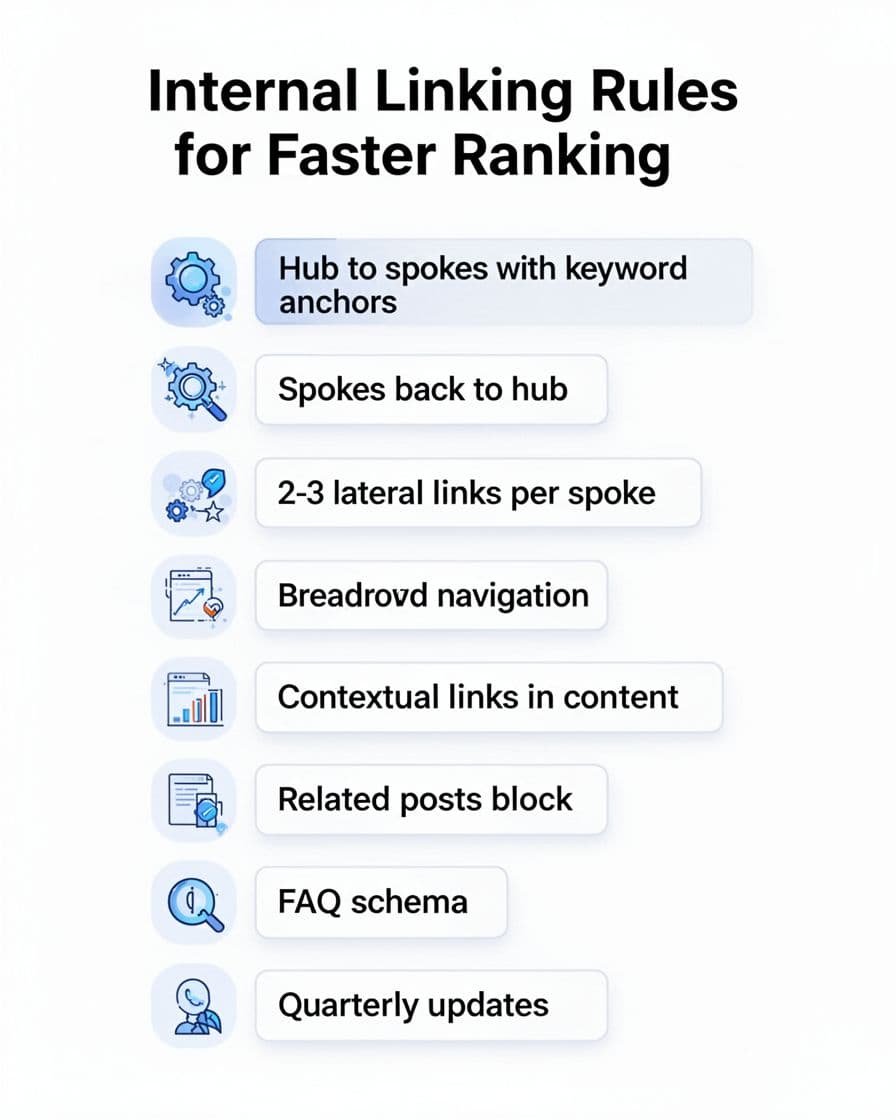
Internal link map (keep it simple): the pillar page links to all 12 cluster content posts in a “Start here” section, each cluster content post links back to the pillar page near the top, and each adds 2 to 3 lateral links (like the table shows). When you place affiliate links, match the click to the moment. The patterns in the affiliate link placement map help a lot here.
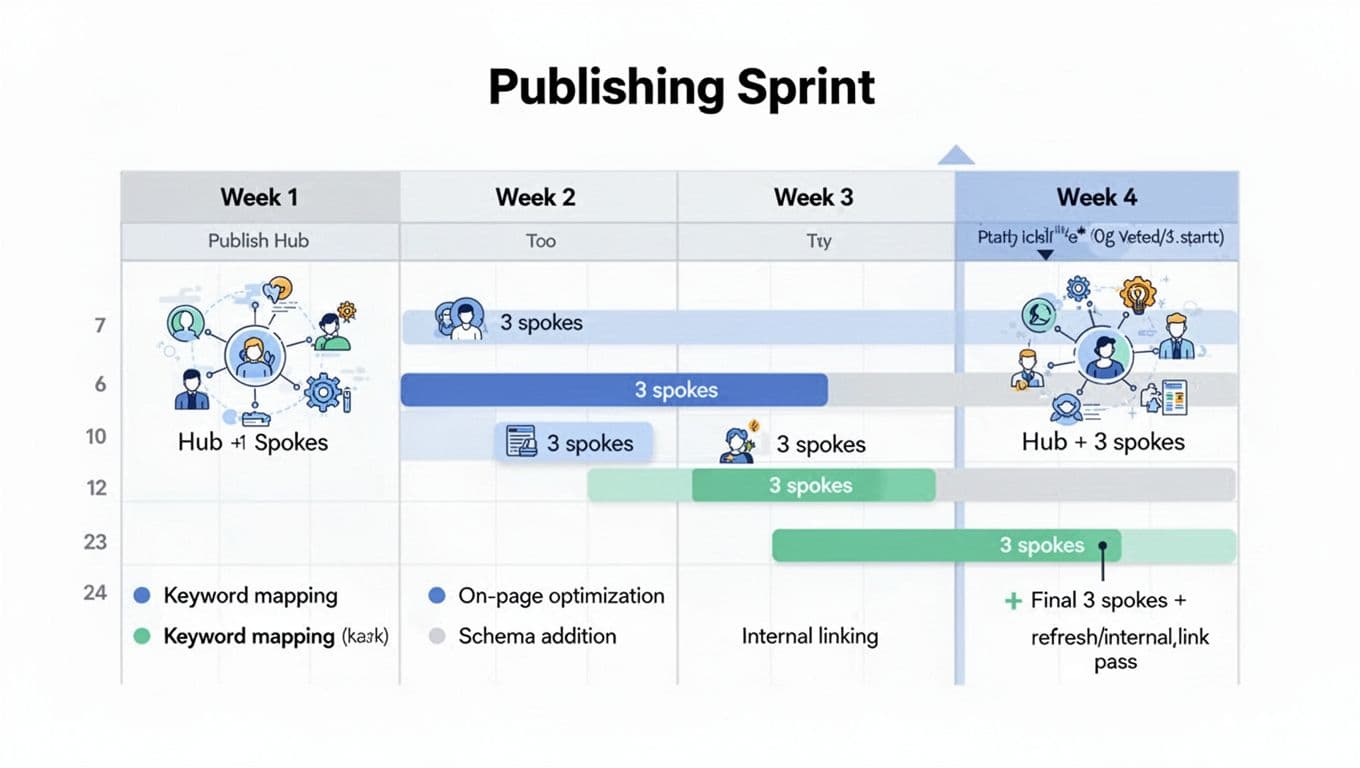
Sprint plan: publish the pillar page in week 1 with 3 cluster content posts (best for, how to choose, beginner kit). Then add three cluster content posts per week. In week 4, do one full internal linking pass, add FAQ sections to the pillar page and top cluster content posts, and refresh any prices or specs you mentioned. This approach drives organic traffic gains, lifts search rankings, and improves user experience.
One gotcha: don’t scale topic clusters around an offer you haven’t vetted. Use an affiliate program vetting checklist before you build 12 posts that point to a program with messy terms. Building entity SEO through these topic clusters also boosts visibility on LLM platforms and AI search engines.
Conclusion
A 12-post hub, serving as your pillar page, works because it turns one category into a connected library, not a pile of articles. Pick one clear niche, map 12 spokes by intent, publish on a short sprint, then tighten internal links. Most importantly, keep the content real, show your experience, and update it on a schedule. Build one strong affiliate topical cluster, then repeat the system for your next category. This approach is a cornerstone of successful digital marketing and content strategy in 2026, and it is the fastest way to boost search rankings, organic traffic, and topical authority for any new category.