
If your affiliate traffic feels choppier in 2026, it’s not your imagination. As Generative AI becomes standard, the rise of Zero-click searches is causing traffic volatility.
That doesn’t mean affiliate SEO is dead. It means the goal shifted. While Search Generative Experience paved the way, the current iteration of AI Overviews requires a dual strategy: getting cited in the AI answer, and building a page that still converts when the click happens.
Below is a practical playbook for “best X”, “X vs Y”, and “X review” posts, with structures that earn mentions, recover lost AI search traffic, and keep your money pages healthy.
AI Overviews in 2026: what changed for affiliate SERPs
In February 2026, AI Overviews power conversational search that’s more present across queries, and they’re more interactive. This differs from traditional organic search, as Google’s current rollout supports follow-up questions that feel like a mini chat, which keeps users on Google longer. At the same time, Google has made source links more noticeable, with link groups and preview-style cards on desktop in many results (still, verify what you see in your niche because these UI changes shift over time).
Early industry reporting points to fewer clicks overall, with a tilt toward larger brands. The practical takeaway is simple: your affiliate page needs to look like a source first, and a review second. For a sense of the trend and what it’s doing to traffic patterns, see early data on AI Overviews and traffic impact.
What tends to get pulled into AI Overviews
AI Overviews don’t “love” affiliates. They love clarity. Large Language Models prioritize pages that make it easy to extract a safe answer, where cited sources demonstrate strong Google E-E-A-T.
That usually means:
- A clear recommendation with a reason (not hype).
- Tight definitions and decision rules (who should buy what, and why).
- Facts that match the query constraint (budget, size, use case, compatibility).
- Consistent product naming and clean formatting.
- First-person reviews that build trust as a reliable source in AI Overviews.
Think of it like packing a suitcase for the AI. If your best information is buried, it won’t travel.
What this means for your content plan
Broad “best X” pages can still work, but smaller sites often win faster by narrowing the promise. Affiliate marketers should target specific informational queries to capture commercial intent before the user makes a final decision. When the AI Overview gives a generic answer, a sharper angle can earn the click and the citation.
If you need a quick way to pick the right angle, use these affiliate keyword selection strategies to decide between “best overall” and “best for X” with a fast SERP read.
Page structure that earns AI citations and keeps conversion paths open
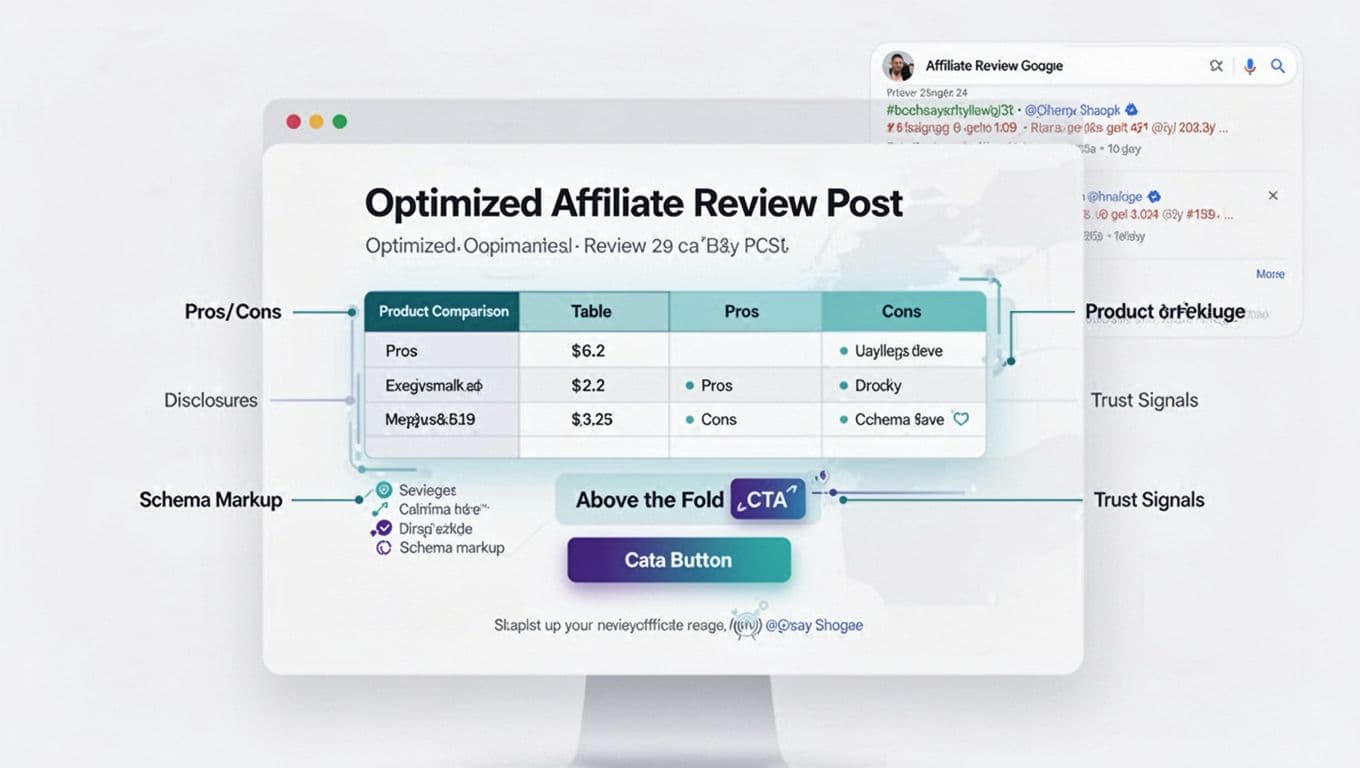
The highest-performing affiliate pages in 2026 read like a helpful salesperson, not a billboard. They answer fast, show proof, then offer a clean next step.
Here’s a structure that tends to work across “best”, “vs”, and review posts, designed for Answer Engine Optimization to help search engines parse the page:
- Above the fold: one-sentence verdict, who it’s for, and one primary CTA (button or text link).
- Trust block (short): affiliate disclosure, how you evaluated picks, update date, and key caveat.
- Comparison table: only the columns buyers care about for that query.
- Deep sections: product-by-product tradeoffs, not just features.
- FAQ: purchase-adjacent questions pulled from what people worry about.
To make the difference clear, here’s how each element can serve both AI Overviews and conversions. Featured snippets have evolved into these AI Overviews, impacting click-through rate. Using structured data and clear formatting in tables and lists helps retrieval-augmented generation systems find your content:
| Page element | Why AI Overviews use it | How it supports conversions |
|---|---|---|
| One-sentence verdict | Easy to quote and attribute | Reduces bounce from skimmers |
| Decision rules (3 to 5) | Safe, constraint-based guidance | Helps readers self-qualify |
| Tight comparison table | Quick extraction of differences | Moves readers to “shortlist” mode |
| Real drawbacks per pick | Increases trust and accuracy | Lowers refunds and buyer regret |
| Clear CTA placement | Drives post-click actions | Keeps the path obvious, boosting click-through rate |
For link placement, don’t guess. Use a consistent “decision moment” approach so you’re not sprinkling links everywhere. This affiliate link placement map lays out where links get clicked without making your post feel pushy.
Examples you can model (and why they work)
Targeting long-tail keywords remains vital for brand visibility.
“Best X” post example: “Best email marketing tools for beginners”
Lead with: best overall, best budget, best for automation. Add 2 to 3 decision rules like “If you need tagging, don’t choose option A.”
“X vs Y” post example: “ConvertKit vs MailerLite”
Open with: “Pick X if you value A, pick Y if you value B.” Then prove it with one small table and 2 real scenarios.
“X review” post example: “Systeme.io review”
Include who it’s not for, top alternatives, and what setup looks like in the first 10 minutes.
If you want more ideas on becoming a cited source, this perspective on winning organic AI citations in 2026 is a useful mental model.
Don’t trip the “thin affiliate” wire
Balancing conversion rate optimization with Google E-E-A-T is essential to avoid penalties.
Avoid these patterns, because they’re easy for both users and algorithms to dismiss:
- Near-duplicate reviews with swapped product names
- “Pros/cons” lists with no real tradeoffs
- Over-optimized anchors (“best cheap blue widgets”) repeated across the page
- Missing or hidden disclosures
Use plain affiliate disclosure language near the top, before the first link. Also, mark affiliate links with appropriate attributes (many sites default to sponsored).
A practical workflow: checklist plus a 30/60/90-day plan
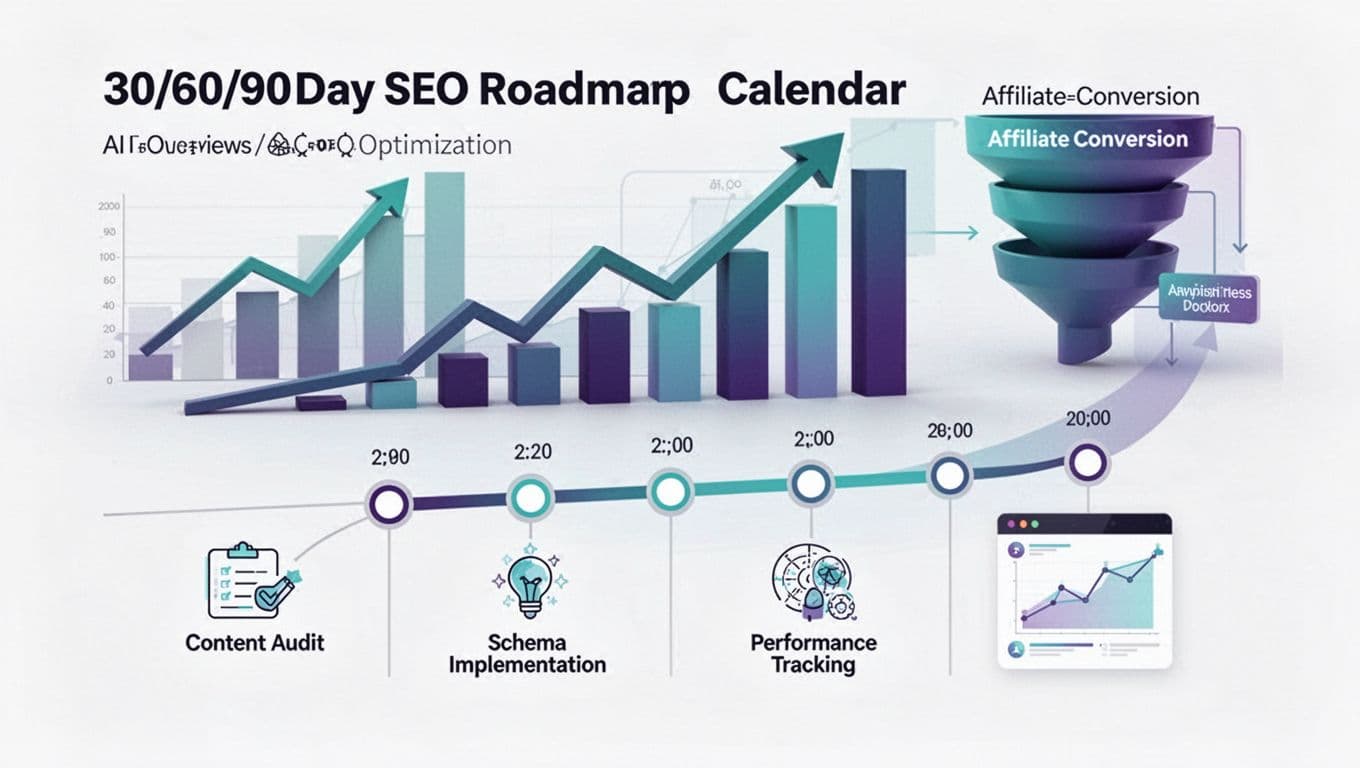
AI Overviews optimization, powered by Large Language Models and Generative AI, works best as a system, not a one-time rewrite. To maintain AI search traffic stability, start with pages that already rank or get impressions, then upgrade structure and trust.
The goal isn’t more words. It’s clearer decisions, stronger proof, and fewer dead ends.
Quick checklist for AI Overviews-ready affiliate posts
- Verdict first: 1 to 2 sentences that answer the query without fluff
- One primary CTA above the fold (plus a clear disclosure nearby)
- Comparison table that matches the query’s constraint (price, size, use case)
- Decision rules readers can apply in 10 seconds
- Unique experience (photos, tests, setup notes, data you gathered, or multimodal content)
- Obvious alternatives for different budgets or needs
- Freshness signals (last reviewed date, updated picks)
- No broken offers (remove or swap out-of-stock links quickly)
- Clean internal linking to related “best for X” or “vs” posts
- Post-update monitoring in Search Console (CTR, impressions, query mix, share of answer, brand mentions) alongside traditional organic search metrics
For safe monetization updates on existing pages, follow a controlled approach like this guide on how to add affiliate links to old posts, so you don’t accidentally change the page’s intent.
30/60/90-day implementation plan (built for affiliate teams)
Days 1 to 30 (foundation and triage)
Audit your top 20 money pages by impressions in Search Console for Google E-E-A-T signals and user behavior. Rewrite intros into verdict-first summaries, add one trust block, and tighten tables. Fix disclosures. Remove dead links and track clicks alongside traditional organic search metrics.
Days 31 to 60 (citation improvements)
Increase content velocity: add decision rules, expand FAQs, and improve “who it’s for” language with more cited sources through internal linking to informational queries. Validate structured data where it fits (and don’t mark up products you removed). Start building supporting posts that feed your money page for better AI Overviews performance.
Days 61 to 90 (scale and protect revenue)
Refresh inventory and availability across roundups, and standardize swap rules. Prepare for agentic commerce, the future of automated shopping, by optimizing long-tail keywords, especially if you’re in physical products with a repeatable process to handle out-of-stock affiliate products without breaking intent. Then publish 2 to 4 “best for X” spinoffs that target clearer constraints and boost your AI Overviews visibility.
For broader industry context on how affiliates are adapting this year, see 2026 SEO predictions for affiliate marketers. Use it as a sanity check, then validate what’s true in your own SERPs, tracking user behavior shifts in AI Overviews alongside traditional organic search metrics.
Final takeaways for affiliate sites in 2026
While zero-click searches pose a challenge for affiliate marketers, the shift toward generative AI offers new opportunities. AI Overviews are stealing some clicks, but they are also handing out a new kind of visibility through cited sources that can send high-intent traffic and improved brand visibility when your page earns trust. Winning in AI Overviews means treating AI Overviews SEO like a packaging problem; make your best answers easy to extract and keep your conversion path simple once the click lands. Maintain a presence in traditional organic search while improving click-through rate and outperforming old-style featured snippets for long-term success. Start with your pages that already get impressions, then upgrade structure, proof, and compliance one batch at a time.