
Ever watch two of your own affiliate posts swap rankings like they’re playing musical chairs? One day your “best” list wins, the next day your “review” steals the spot, and clicks stay flat.
That’s usually a sign you need a content cannibalization audit. Keyword cannibalization causes ranking fluctuations when search engines are confused about which of your pages to rank for the same search intent. The goal is simple: find pages competing for the same search intent, then choose one clear “winner” URL so Google (and readers) don’t have to guess. Resolving keyword cannibalization issues is critical for SEO performance and long-term growth.
Map your keyword cannibalization hotspots with keyword mapping (where affiliate sites get messy fast)
Conducting a content cannibalization audit to streamline your SEO strategy
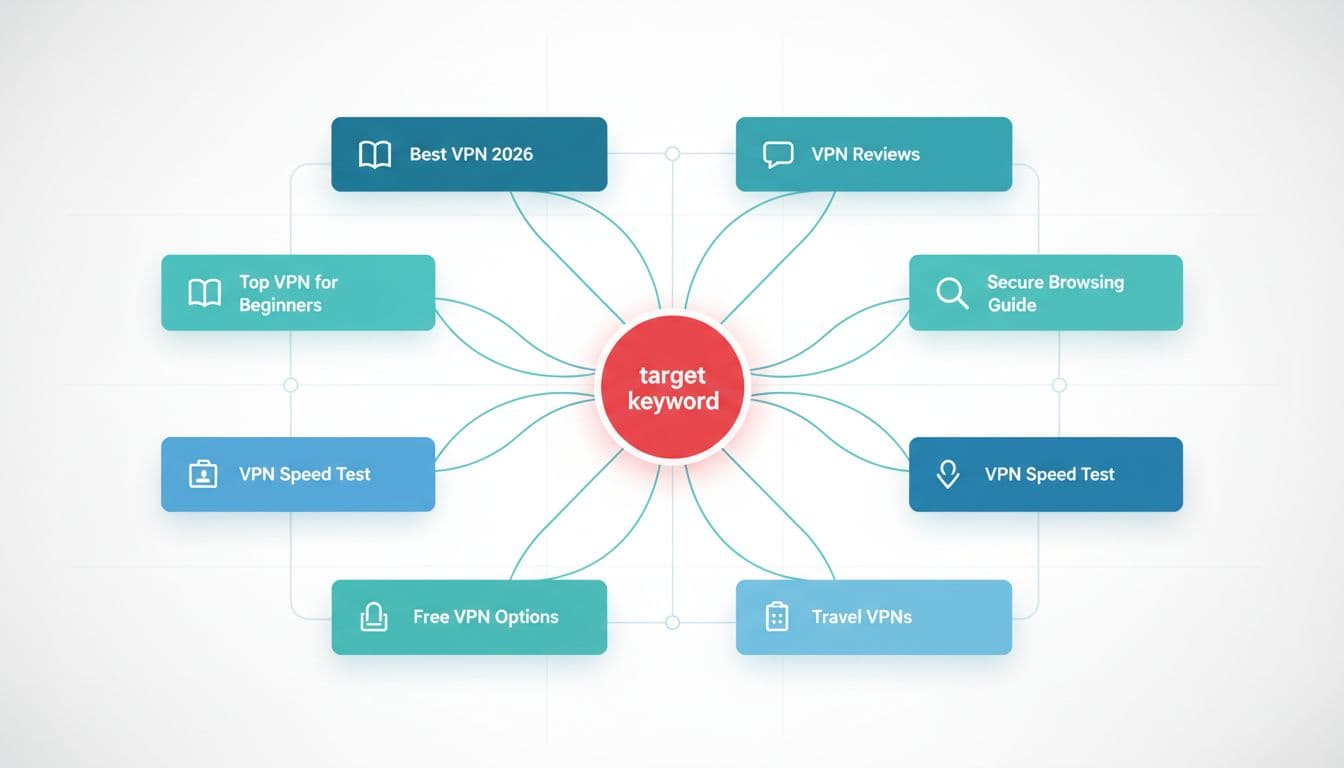
Affiliate sites are extra prone to keyword cannibalization because we publish multiple pages that feel “different enough” to us, but look identical to search engines: best lists, “for beginners,” “cheap,” comparisons, alternatives, and single reviews.
A quick definition helps: keyword cannibalization is when multiple pages on your site rank (or try to rank) for the same keyword and intent, splitting signals like clicks, links, and relevance. Multiple pages targeting the same keyword on affiliate sites can deplete your crawl budget. If you want a solid refresher on what it is and when it matters, this breakdown is clear and practical: Ahrefs’ guide to keyword cannibalization.
Fast discovery methods (free and paid options)
Use a mix of these so you don’t miss “quiet” conflicts where search engines struggle to prioritize between pages:
- Google Search Console (free): In Performance, pick a query, then check the Pages tab. Google Search Console shows if 2 to 5 URLs share impressions for the same query; flag it.
- GA4 (free): Look for landing pages that attract the same audience but convert differently, especially around “money pages.”
- Manual SERP check (free): Search your head term and a couple modifiers. Use the site search operator (site:yourdomain.com “keyword”) to spot multiple pages competing. If you see different pages showing up depending on the day or device, it’s often internal competition.
- Rank tracker (paid or free tier): Many tools now highlight cannibalization patterns. If you use Semrush, their report overview explains what it detects: Position Tracking Cannibalization Report.
- Crawling + spreadsheet (paid or free): Run a content audit with any crawler (or even a basic URL export) plus a spreadsheet to visualize internal competition and stay consistent.
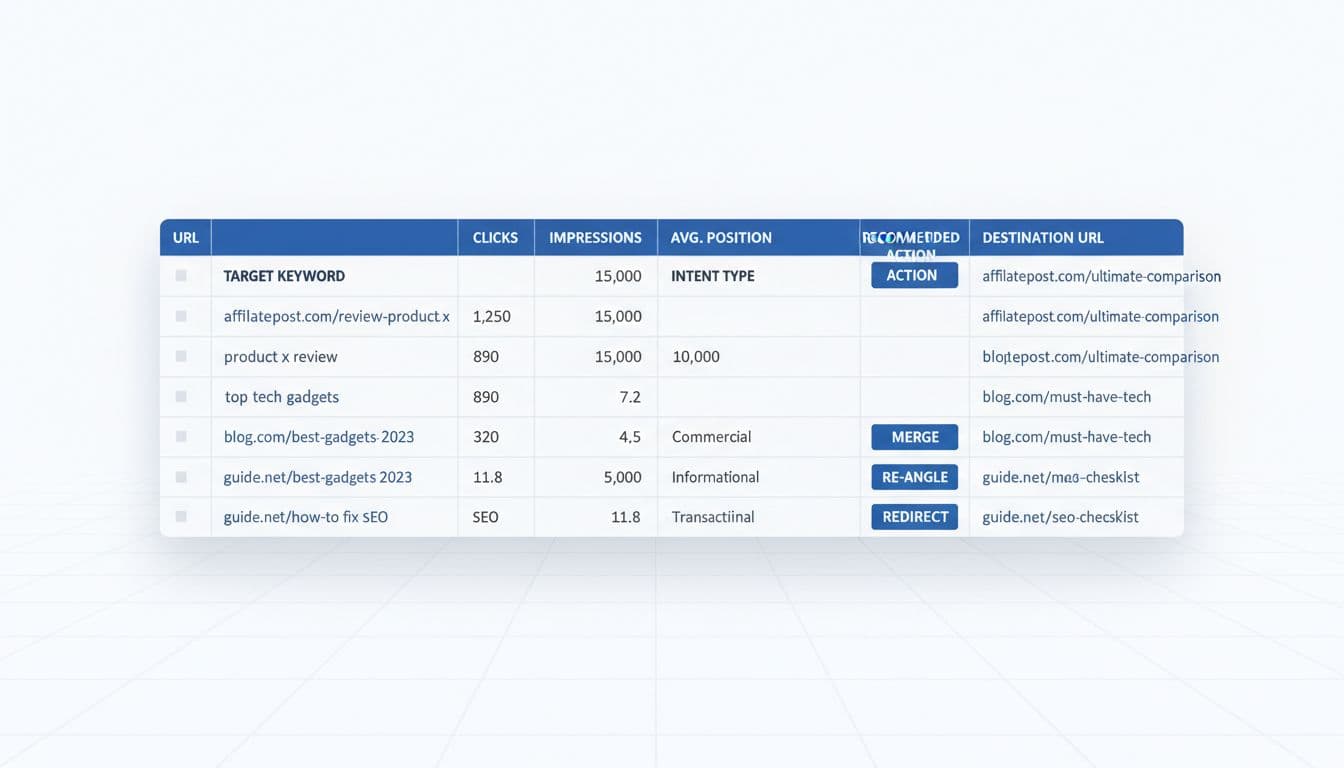
Simple content audit sheet template (copy the columns)
Keep the sheet boring on purpose. You’re trying to decide actions, not write a novel. Internal linking and search engines visibility data are key columns to track.
Columns to track: URL, primary query/topic, top secondary queries, internal linking (count), clicks, impressions, avg position, intent label, affiliate value (RPM/CVR), search engines visibility, backlinks (count), recommended action, destination URL.
Pick the primary URL with a scoring rubric (so decisions aren’t emotional)
When two posts compete for the same keyword in cases of keyword cannibalization, most site owners “feel” which one should win as the target URL. That’s risky, since choosing the right target URL is essential for consolidating page authority. Use a quick scoring rubric and let the numbers settle arguments.
Primary URL scoring rubric (0 to 100)
| Factor | How to score it | Points |
|---|---|---|
| Search intent match | Best matches what the query is trying to do | 30 |
| Current traction | Higher clicks and impressions for the target topic | 20 |
| Conversion and revenue | Higher affiliate CVR, EPC, or RPM (use what you track) | 20 |
| Backlink profile | More quality backlinks, stronger URL history | 15 |
| Content quality and freshness | More complete, updated, easier to improve | 10 |
| Technical cleanliness | Fast, indexable, not thin, not duplicated | 5 |
Rule of thumb: the highest score becomes the primary URL. If two are within 10 points, keep the one with stronger search intent match and conversions.
Affiliate-specific cannibalization scenarios (and the right fix)
Scenario A: “Best X 2026” vs “Best X for beginners”
If both pages basically list the same products with slightly different intros, merge. Keep one main “Best X” page, add a clear section for beginners, and use jump links. Re-angle the other page only if beginners truly need different picks, pricing, and objections.
Scenario B: “X vs Y” vs “X review”
These are different search intents: transactional intent drives chooser pages like X vs Y, while informational intent fits review pages as validators. If the vs post is thin and repeats the review, merge the best parts into the vs page and keep the review as a supporting article. Use your internal links to push readers down the right path, and keep your review layout consistent (this product review post outline for affiliates helps you standardize what “good” looks like).
Scenario C: “X alternatives” vs “Best X”
Often cannibalizes because both include the same “top picks.” If “alternatives” is really “competitors to X,” re-angle it around switching costs, feature gaps, and who should leave X. If it’s just another roundup, merge it.
Scenario D: Two “best” posts split by modifiers (cheap, budget, under $50)
This often involves long-tail keywords like ‘budget’ or ‘cheap’ being split across multiple pages, but if the products overlap heavily, keep one hub “Best X” and make budget content a tight supporting page that links back. Search engines prefer a single authoritative source for the same keyword rather than several thin pages, so don’t let five near-duplicates fight for the same buyer.
Implementation SOPs: Merge content, 301 redirects, re-angle, and canonicals (without breaking revenue)
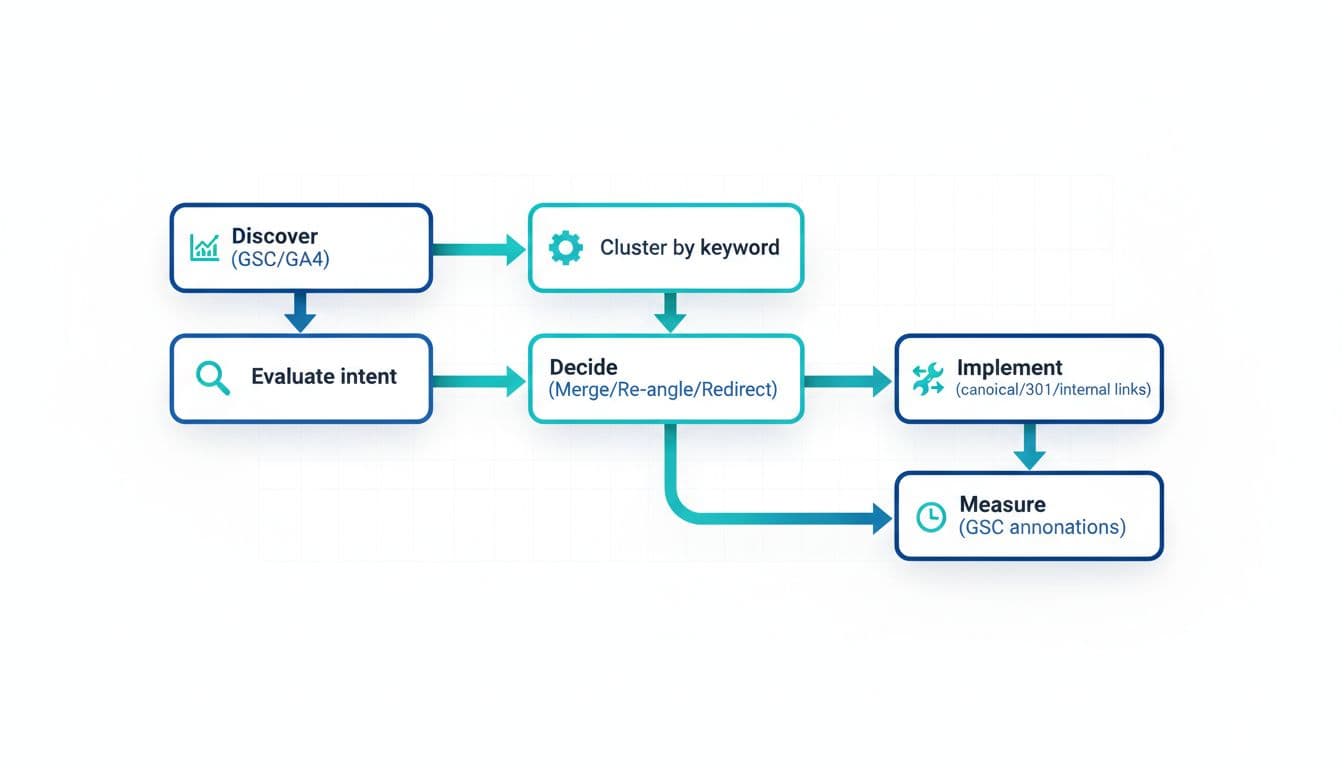
Organizing your content into topic clusters improves the user experience while consolidating authority around core subjects. Follow these SOPs for merge content, 301 redirects, re-angling, and canonical tags to streamline your site without losing revenue.
Merge content SOP (the safe way to combine affiliate posts)
- Lock the primary URL using the rubric, and write the final target outline (keep sections that win clicks and sales).
- Create a redirect map: old URL, new destination, note which sections move.
- Migrate content: paste only the best parts, rewrite transitions, remove repeated product blurbs, and unify your recommendation logic.
- Update affiliate links and your disclosure blocks (use copy-ready wording from affiliate disclosure examples that convert).
- Update internal linking: optimize anchor text to point old anchors to the primary URL, and adjust supporting articles (as part of your internal linking structure) to link into the right section.
- Handle comments: if the old post has valuable comments, consider moving them (or keep the old URL live temporarily and link to the new page), then redirect once you’ve preserved anything worth keeping.
- 301 redirect the merged URL(s) to the primary page, then request indexing.
If you want more background on common fixes and pitfalls like multiple pages competing for the same keyword, this is a solid reference: Backlinko’s keyword cannibalization fixes.
Re-angling SOP (keep the URL, change the job it does)
Re-angling works when two pages can coexist because they answer different intents.
- Choose a new intent: beginner setup, troubleshooting, “is it worth it,” or “best for (use case).”
- Add clear query modifiers: “for beginners,” “for small teams,” “under $X,” “for travel,” “no-subscription,” “privacy-first.”
- Rewrite title and H2s so the difference is obvious at a glance.
Example re-angle pairs that reduce overlap:
- Title: Best Email Marketing Tools (Beginners)
H2: “What to pick if you hate tech” - Title: Best Email Marketing Tools (Creators)
H2: “Automations that drive affiliate clicks” - Title: ConvertKit Review
H2: “Best for newsletters, weak for deep funnels” - Title: ConvertKit Alternatives
H2: “Cheaper options, and who should switch”
Tip for affiliates: if cookie length affects buying behavior, call it out and compare programs honestly. This plain-English guide on affiliate cookie windows helps you explain why timing matters.
Redirect vs canonical (quick guide)
- Use a 301 redirect when the old page is done forever and the new page fully replaces it.
- Use canonical tags to signal the master version to search engines when you must keep two pages live, but one is the main version (example: near-duplicate print pages, or tracking variants). Don’t use canonical tags as a band-aid for duplicate content issues; they do not fix duplicate content as effectively as a 301 redirect.
If you’re consolidating “money pages,” it’s also a good time to re-check whether you’re promoting the right offers. This affiliate program vetting checklist helps you avoid building a “winner” page around a weak program.
Mini KPI dashboard (track results after changes)
| Time after change | What to check | What “good” looks like |
|---|---|---|
| 7 days | Indexing, redirect hits, crawl errors, ranking volatility, search engines coverage | New URL indexed, old URLs dropping cleanly |
| 14 days | GSC clicks and impressions for the target topic, click-through rate (CTR) | One URL gaining share, fewer “split” pages, rising CTR |
| 30 days | Avg position, click-through rate (CTR), landing page performance, affiliate clicks, conversions | Rank stabilizes, clicks and EPC improve, stronger landing page metrics |
| 60 days | Revenue trend, assisted conversions, backlinks growth, clearer internal linking flow | Higher RPM and clearer internal linking flow |
</EXISTING_CONTENT>
Conclusion
A clean content cannibalization audit isn’t busywork; it’s the best way to protect your organic rankings and improve overall SEO performance. Solving keyword cannibalization ensures multiple pages don’t dilute search intent signals you send to ranking algorithms, stopping your own posts from stealing each other’s traffic. Map the competing URLs, pick one primary page with a rubric, then merge, re-angle, or redirect with a plan you can repeat. After you make changes, watch the 7/14/30/60 day checkpoints to track gains in organic rankings and SEO performance, letting data guide what to do next.