
Random publishing feels productive, until you look back and realize you built a pile of “pretty good” posts that don’t connect, without a solid content strategy attuned to search intent. In 2026, that’s a costly mistake because search results reward clear topic coverage, strong page intent, and clean internal linking.
A keyword mapping spreadsheet fixes that. It turns scattered ideas into a simple plan: one keyword, one primary page, supporting content that feeds it, a clear site structure, and a publish order that matches revenue goals.
What a keyword mapping spreadsheet is (and why it stops content chaos)
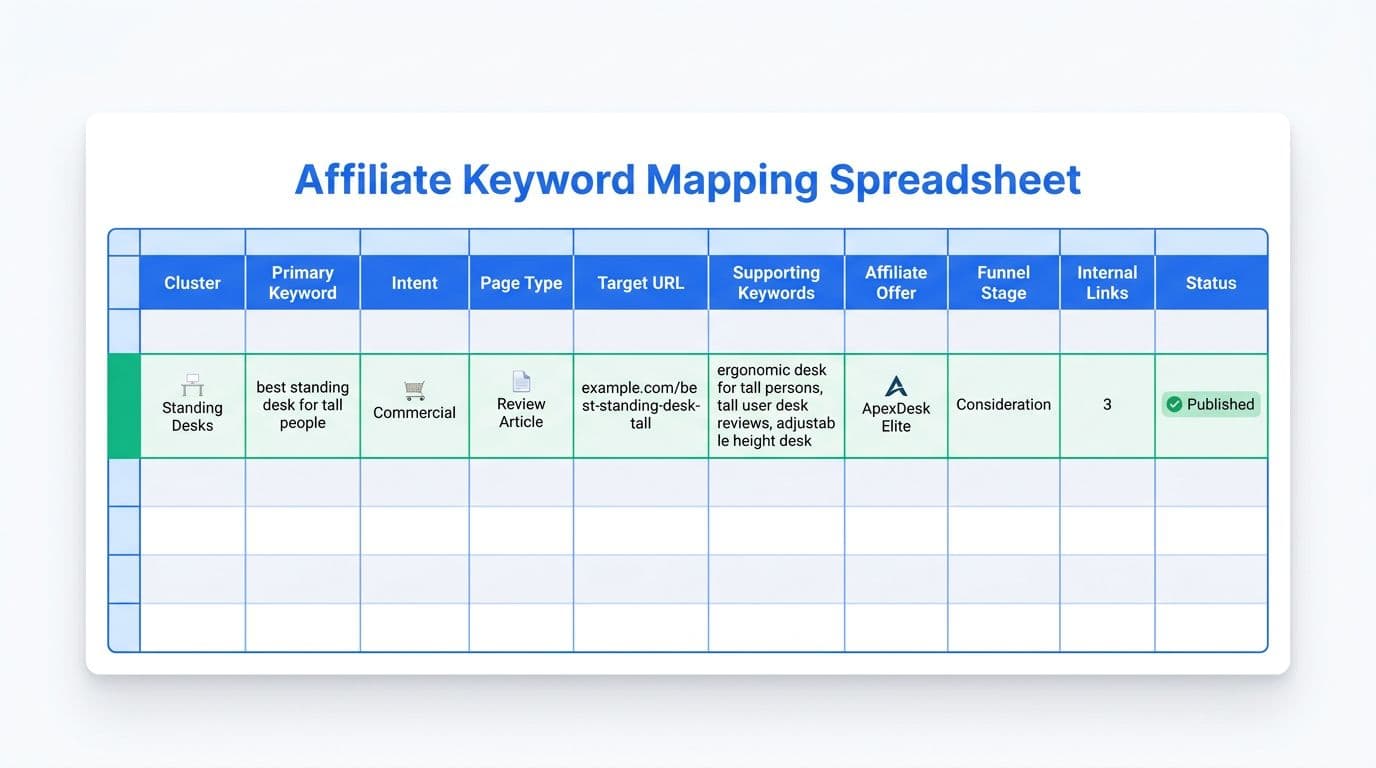
Think of your site like a bookstore. If you keep adding random books without considering user intent, customers still can’t find what they need. A keyword mapping spreadsheet, or keyword research template, is your shelving system. It decides where each “book” goes, and what should sit next to it.
The core rule is simple:
Each primary keyword gets one primary URL. Everything else supports that page, not competes with it.
This matters more now because AI answers and “quick picks” features can reduce clicks for vague content. You want fewer, stronger pillar pages that cover an intent fully, plus supporting pages that earn traffic from long-tail keywords, build topic clusters, and pass relevance through internal links.
If you want a deeper explanation of mapping concepts and avoiding overlap, see this step-by-step keyword mapping guide.
Copy-ready column list (use this as your header row)
Use these columns in Google Sheets or Excel to organize your target keywords, sourcing data from Search Console and other tools (add or remove based on your workflow):
Cluster, Primary Keyword, Search Intent, Funnel Stage (TOFU/MOFU/BOFU), Page Type (best/vs/review/alternatives/category hub), Target URL (planned path), Supporting Keywords, Affiliate Offer, SERP Fit Notes, Internal Links In (from), Internal Links Out (to), Cannibalization Risk (Y/N), Volume (1–5), Difficulty (1–5), Affiliate Value (1–5), SERP Fit (1–5), Priority Score, Status, Last Updated.
For a quick refresher on picking buyer-focused terms (without guessing), this affiliate keyword selection guide pairs well with the spreadsheet approach.
How to build the sheet in 45 minutes (and make it usable all year)
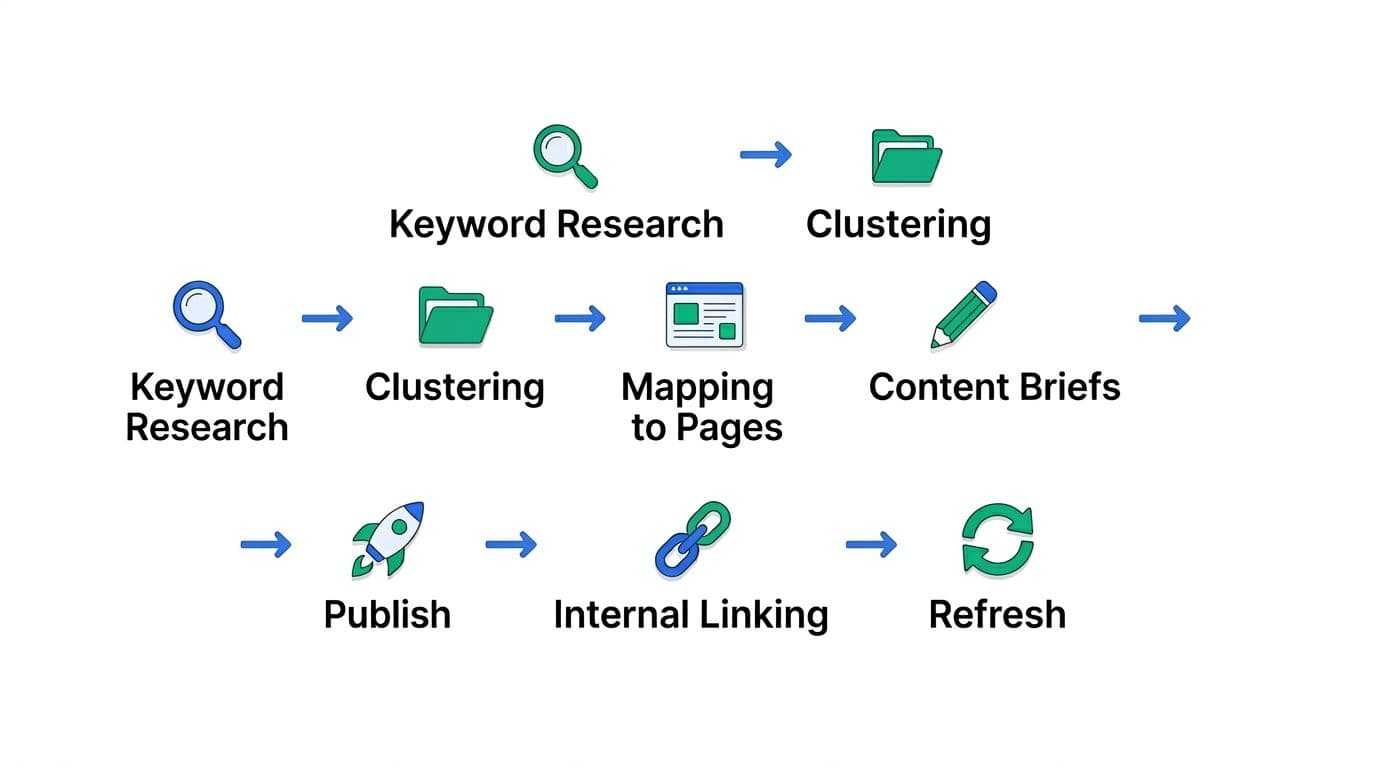
You don’t need a perfect system. You need one you’ll actually follow when you’re busy.
The fastest setup workflow
- Dump keywords into one tab (from your tool exports, Search Console, notes, competitor scans, and competition analysis).
- Cluster by topic, not just by shared words. Group terms into a keyword cluster that deserves one “main” page.
- Choose the primary keyword per cluster, then assign a single Target URL (a planned path is fine).
- Pick the page type based on what the results reward (category hub, best list, vs, review, alternatives).
- Add supporting keywords, and decide if they belong inside the main page or as separate support pages.
- Schedule internal links before you publish (so you don’t “forget” them later).
If you want a second opinion on what a complete template can include, compare your columns to this keyword mapping template guide for 2026.
A lightweight scoring model that makes prioritizing obvious
Use 1 to 5 scores for these SEO metrics (quick gut checks are fine):
- Search volume (1-5): traffic potential
- Keyword difficulty (1-5): ranking effort (higher is harder)
- Affiliate Value (1-5): payout, conversion, recurring options
- SERP Fit (1-5): how well your planned page matches what’s ranking
Then calculate:
Priority Score = (Search volume + Affiliate Value + SERP Fit) – Keyword difficulty
Next, sort the sheet by Priority Score (high to low), then by Funnel Stage (many sites like BOFU first for faster earnings, then MOFU, then TOFU to widen the moat).
One more practical rule: if two keywords could both be “the main page,” pick one, and demote the other to “supporting keyword” or a different angle (like “best for X” vs “best overall”).
This prioritization drives organic traffic by focusing on high-potential opportunities first.
Sample keyword mapping spreadsheet rows (TOFU, MOFU, BOFU, and page types)
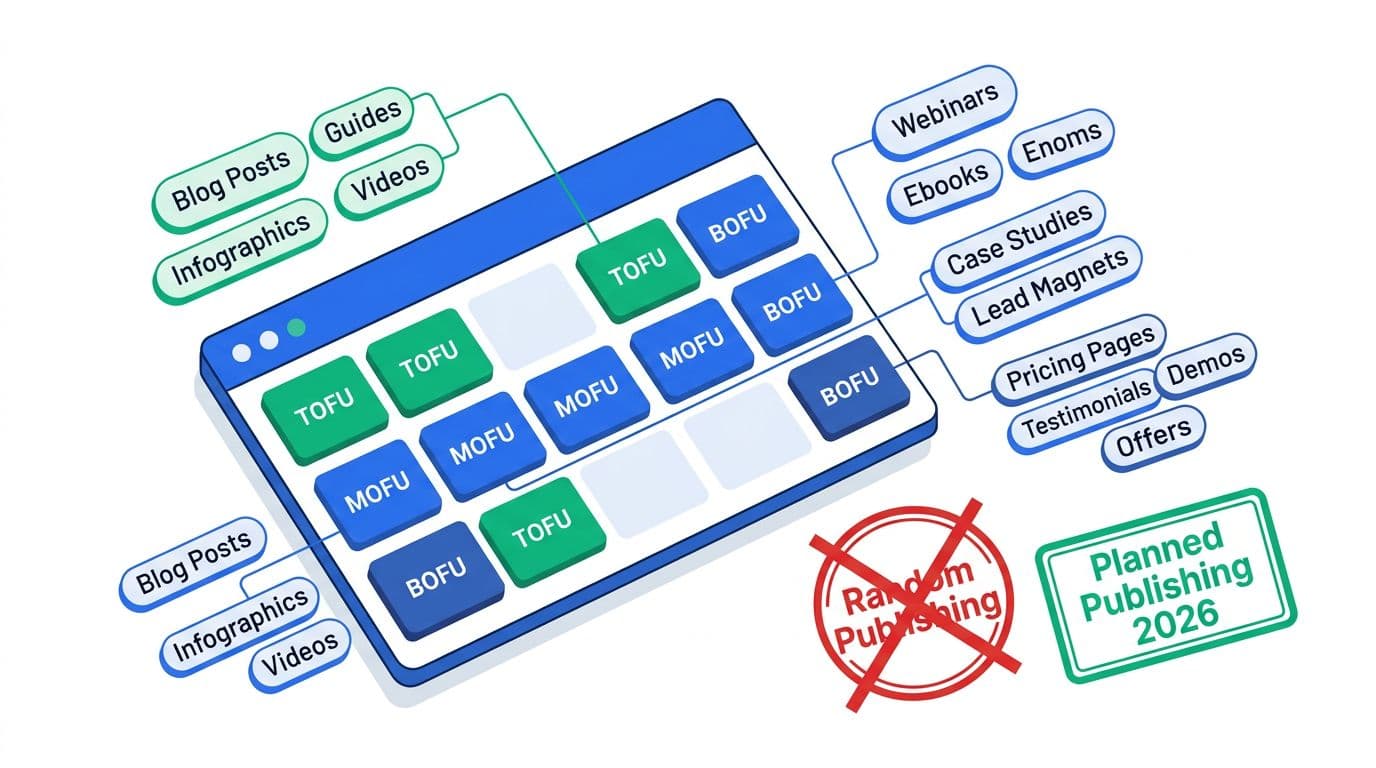
Below is a small, copy-ready example keyword URL map row set. Notice how each keyword gets one Target URL, and how the page types vary to cover the category without repeating yourself.
| Cluster | Primary Keyword | Intent | Funnel | Page Type | Target URL (path) | Supporting Keywords | Affiliate Offer | Monthly Search Volume | Diff | Aff Val | SERP Fit | Priority |
|---|---|---|---|---|---|---|---|---|---|---|---|---|
| Standing desks | best standing desk for tall people | commercial | BOFU | best | /standing-desks/tall-people/ | for 6ft+, height range, stability | desk brands | 4 | 3 | 4 | 5 | 10 |
| Standing desks | uplift vs fully | comparison | BOFU | vs | /standing-desks/uplift-vs-fully/ | warranty, wobble test, motors | desk brands | 3 | 3 | 4 | 4 | 8 |
| Standing desks | fully jarvis review | review | BOFU | review | /standing-desks/fully-jarvis-review/ | pros cons, who it’s for | desk brand | 3 | 2 | 4 | 4 | 9 |
| Standing desks | standing desk alternatives | commercial | MOFU | alternatives | /standing-desks/alternatives/ | desk converters, budget picks | converters | 3 | 2 | 3 | 4 | 8 |
| Home office | home office setup essentials | informational | TOFU | category hub | /home-office/setup-essentials/ | checklist, ergonomics basics | mixed | 4 | 4 | 2 | 4 | 6 |
| Email marketing | best email marketing for beginners | commercial | BOFU | best | /email-marketing/beginners/ | free plan, automation, deliverability | ESP tools | 4 | 3 | 5 | 4 | 10 |
| SEO tools | best keyword research tool for affiliates | commercial | BOFU | best | /seo/keyword-research-tools-affiliates/ | cheap tools, long-tail | SaaS tools | 5 | 4 | 4 | 4 | 9 |
| Blogging | how to choose an affiliate niche | informational | TOFU | category hub | /affiliate-marketing/choose-niche/ | niche scoring, examples | training | 4 | 3 | 3 | 5 | 9 |
Internal linking anchors that feel natural (and avoid cannibalization)
Treat internal links like signposts, not ads. Use anchor text that explains the destination in plain language, such as “standing desk stability tips” or “Uplift vs Fully comparison.”
To prevent cannibalization, add these guardrails to your sheet:
- One primary URL per keyword: if a new draft targets an existing term, change the angle or merge it.
- Different page types for the same cluster: a “best” list and a “review” can coexist, but they must target different primary queries with intent-matching as seen in SERPs.
- Track title tags and meta descriptions in the sheet: monitor these elements to prevent keyword cannibalization across pages.
- Link direction is intentional: TOFU pages should point to MOFU and BOFU pages, while BOFU pages can link back to hubs for context.
When you update older posts to add monetized links, keep intent steady. This walkthrough on how to add affiliate links to old posts without losing rankings is a good process to follow.
Brief affiliate compliance note for 2026 (don’t skip this)
Add a clear disclosure near the top, and again before the first affiliate link if needed. Keep it simple, for example: “I may earn a commission if you buy through links in this post, at no extra cost to you.” Also, mark affiliate links with appropriate attributes (commonly sponsored, often paired with nofollow) based on your platform setup.
Conclusion
Random publishing is like cooking without a recipe. You might get dinner, but you won’t get consistency. A keyword mapping spreadsheet gives you one owner per topic, a clear publish order, and internal links that build trust and rankings over time. This keyword mapping process also helps identify content gaps that would otherwise be missed. Start with one cluster this week, map it end to end, and publish the first two pages in sequence. Then keep going until your site feels planned, not noisy. The spreadsheet serves as an essential tool for long-term on-page SEO success.