
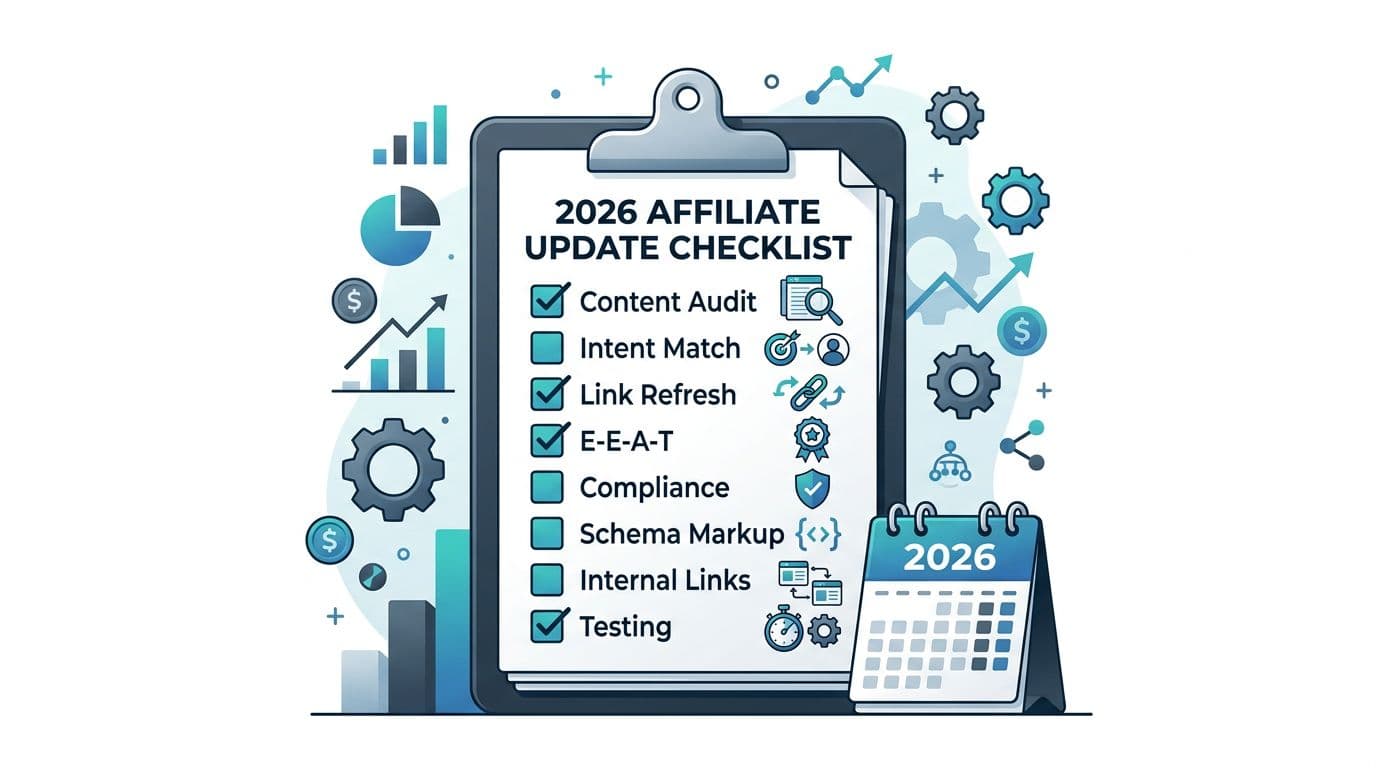
Updating a money page for search engine optimization in affiliate marketing can feel like repainting a house while people still live in it. One wrong move, and your search engine rankings can tumble overnight, with the whole place looking different to Google.
A safe affiliate content update in 2026, as part of your digital marketing strategy, is less about “freshening” everything, and more about protecting what already works: intent, structure, links, and trust signals. This approach is crucial for long-term stability. You’ll get more upside by making controlled edits, then measuring them, instead of pushing a full rewrite and hoping.
1) Audit first, then decide what you’re allowed to change

Start every update with a content audit to establish a baseline. If you can’t explain what changed, you can’t debug a drop.
In early 2026, following the Google algorithm update and helpful content update, Google continued rewarding content that stays current, while filtering out shallow affiliate pages, especially in surfaces like Discover (where clickbait style updates can backfire). So your “freshness” signal needs to come from real improvements, not cosmetic edits. Monitor E-E-A-T signals and organic traffic as key factors during the refresh.
Safe refresh guardrails (keep these boring on purpose):
- Keep the same URL unless the page is truly mis-targeted.
- Don’t change the H1 topic (example: “Best Budget Laptops” should not become “Best Laptops”).
- Avoid huge intro rewrites if you already rank, adjust the first 2 to 3 sentences only.
- Update in batches, not site-wide, so you can spot patterns fast.
- Maintain consistent internal linking to avoid disruptions.
- If you use an “updated on” date, make sure the update is meaningful and visible.
Use this quick audit table to choose what to touch first, particularly for niche-specific keywords and current intent match:
| Field to capture | Where to pull it | What it tells you | Safe action |
|---|---|---|---|
| Top queries and pages | Google Search Console | Current intent match | Preserve matching sections, expand gaps |
| CTR by query | Search Console | Snippet is weak or stale | Update title and meta, keep angle |
| Rank distribution (1-3, 4-10, 11-20) | Rank tracker or GSC | How fragile the page is | Be extra conservative in top 3 |
| Affiliate click rate | Your tracking | Monetization friction | Improve placement and clarity, not link count |
| Last real product check | Your notes | Accuracy risk | Refresh pricing language, availability, specs |
| Competitor changes | Manual SERP scan | What shifted on page 1 | Add missing comparison points, not fluff |
If the SERP has moved toward “best for X” angles, fix the mismatch before adding more products. This is where a fast SERP check helps, see the 60-second SERP keyword method and apply it before you touch headings.
For planning larger refresh waves, a topical map can keep updates from turning into random edits. This guide on topical maps for affiliate sites is a useful reference.
2) Update by page type, so you don’t accidentally change intent

Different affiliate pages break in different ways. Treat them like separate templates.
Product reviews (single product)
Keep the core verdict stable. Then update what readers use to decide.
- Add a “What’s new since last update” paragraph with real deltas (new model revision, policy change, feature changes, pricing approach).
- Replace vague claims with proof points you can stand behind (photos, tests, setup notes, or clear experience statements).
- Refresh alternatives, but don’t turn a single review into a full roundup.
If you need to add new affiliate links during the refresh, such as from programs like Amazon Associates, don’t sprinkle them everywhere. Map them to decision moments to improve conversion rates. This internal guide on where to position affiliate links for clicks helps keep link density reasonable.
Best-of lists and roundups
Roundups drop when they feel stale or when the table lies.
- Update the comparison table first, because it drives most clicks and powers high-converting content.
- Keep your category logic consistent (budget pick stays budget).
- Swap in-stock alternatives without rewriting the entire post.
Out-of-stock is a common “panic edit” trigger. Instead of deleting chunks, follow a repeatable swap rule, see SEO-safe handling for out-of-stock affiliate products.
Vs and comparison pages
These pages are fragile because they rank for tight intent.
- Keep the same “A vs B” framing, and add one section that answers “Who should not buy either?”
- Update specs and policies, then align the conclusion with the new facts.
- Avoid adding three extra competitors, that can dilute the page.
Compliance also belongs in the template. Use a clear disclosure near the top, before the first affiliate link. Keep it plain, and avoid legal promises. For a practical “human-first” checklist that fits AI-heavy SERPs dominated by AI-generated content, where prioritizing user experience helps you stand out, this affiliate review content checklist is a solid reference.
3) QA, publish, and monitor like a release (with a rollback plan)

Most ranking drops happen after “small” edits pile up: new links, new headings, a new intro, a new date, and a new CTA, all at once. Don’t ship blind, steering clear of site reputation abuse while adapting to zero-click results in modern SERPs.
If you can’t revert in 10 minutes, you changed too much.
Change log template (copy into a sheet)
One row per update is enough:
| Date | URL | What changed | Why | Risk level | Revert trigger |
|---|---|---|---|---|---|
| Mar 2026 | /your-page | Table updated, 2 links swapped, disclosure moved above fold | Accuracy and clarity | Medium | CTR or clicks down 20% for 7 days |
Pre-publish QA (fast, but strict)
Run this before you hit update:
- Intent check: first screen still matches the query.
- Link check: every affiliate link works, no redirect chains, no broken links.
- Disclosure check: visible before the first affiliate link, also near heavy call-to-action blocks.
- On-page check: no keyword-stuffed headings, no repeated exact-match anchors.
- Technical check: canonical unchanged, indexable, no accidental URL change, Core Web Vitals stable, technical performance solid.
- Schema check (if you use it): removed products are not still marked up.
For another quick pre-publish sanity list, compare your process to these things to check before publishing affiliate content.
Monitoring dashboard (what to watch for 14 days)
Track a short window first, because that’s when mistakes show up.
| Metric | Tool | What “bad” looks like | First fix to try |
|---|---|---|---|
| Clicks by query | Search Console | Drops on 1 to 3 key queries | Restore old intro and headings |
| CTR | Search Console | Down while impressions stable | Rework title, meta, and call-to-action only |
| Avg position | GSC or rank tracker | Broad slide across terms | Roll back big section changes |
| Affiliate clicks | Tracking | Down while traffic stable | Fix call-to-action placement and wording, verify attribution models |
| User engagement metrics | Analytics | Bounce up, scroll down | Tighten above-the-fold answer |
When do you revert? If your top queries slide hard and stay down for a full week, roll back the highest-risk change first (often the intro, headings, or table order). Save link swaps for later, unless you broke a destination.
If your update plan includes adding monetization to older posts, keep it controlled. This walkthrough on updating old articles with affiliates safely pairs well with the QA and monitoring approach above. For a structured refresh cadence, you can also borrow ideas from this affiliate content refresh system and adapt it to your own batch size, especially for programmatic SEO.
Conclusion
A careful affiliate content update in 2026, essentially repurposing old content smartly, looks more like maintenance than renovation. This approach maintains value through affiliate marketing while prioritizing search engine optimization for sustainable results. Audit first, change less than you want to, and measure what happened. Most importantly, keep intent steady, because that’s what protects rankings when you refresh monetized pages. It’s also a smart way of repurposing old content to ensure long-term performance. Pick 5 pages this week, update them in two batches, and keep a rollback plan ready before you publish. These controlled updates protect your passive income streams heading into 2026.