
Effective pagination SEO is vital for affiliate review sites, as poor implementation can leave your primary pages struggling while the rest of your site becomes crawl noise. On a roundup or category archive, bad pagination leads to issues with duplicate content, weakened internal linking, and lost opportunities to rank for valuable long tail queries.
In 2026, a successful strategy relies on ensuring each page has its own stable URL, a distinct purpose, and a clean path for both users and search engine crawlers. The following sections detail how to optimize your site structure without sacrificing the performance of your best money pages.
Key Takeaways
- Ensure every paginated page has a unique URL to help search engines differentiate between your archive segments.
- Use a self-referencing canonical tag on page 2 and all subsequent pages to signal to Google that each page is distinct and intentional.
- Use crawlable HTML anchor links for pagination navigation because Google no longer uses the deprecated rel=next and rel=prev attributes to understand paginated series.
- Keep page 1 focused on your most important content, then allow later pages to expand your site coverage rather than repeating your primary introduction.
- Manage query parameters consistently and block or deindex faceted or sort-generated duplicates to prevent them from wasting your crawl budget.
Why pagination still matters on affiliate review sites
Affiliate review sites create long lists by design. Best-of roundups, comparison pages, product archives, and review libraries all require more space than a single screen can provide. If you try to squeeze every product or review into one massive URL, the page becomes heavy, the copy becomes vague, and the internal linking becomes disorganized. By breaking content into smaller segments, you can significantly improve your page speed, which is a critical factor for both rankings and visitor retention.
Google’s current pagination and incremental page loading guidance still emphasizes the use of crawlable URLs and clear navigation rather than script-only tricks. This is essential because search engine crawlers need to actively discover the rest of your collection, rather than guessing that your valuable content is hidden behind a button or infinite scroll.
For affiliate sites, the stakes are practical. A well-designed site structure allows a main “best of” page to rank for high-volume head terms, while subsequent pages can capture traffic from more specific searches around individual product names or niche use cases. Furthermore, a thoughtfully paginated library enhances the overall user experience, ensuring that readers can navigate your archive intuitively.
Ultimately, pagination is not just a background technical setting. It defines your site structure, dictates how your internal linking directs authority, and ensures that every piece of your content is accessible to both humans and bots.
Build URLs that search engines can trust
A paginated sequence needs a pattern that never changes. Pick one format and use it everywhere to ensure every segment of your site has a unique URL. A path-based setup like /best-running-shoes/page/2/ is easy to read. A query-string setup like /best-running-shoes?page=2 also works if your CMS prefers it, provided you manage your query parameters carefully to avoid indexing duplicate variations. The problem starts when different templates invent their own version.
Keep fragments out of the equation. A URL like /best-running-shoes#page=2 may look neat to users, but it gives search engine crawlers less to work with. It also makes analytics and canonical logic harder to maintain.
Here is the test I use:
| Good pattern | Weak pattern | Why it matters |
|---|---|---|
/best-running-shoes/page/2/ | /best-running-shoes#page=2 | Fragments are not stable crawl targets. |
/reviews?page=2 | /reviews?page=2&session=abc123 | Query parameters like session noise create duplicate URLs. |
/category/page/3/ | JavaScript-only page switcher | Crawlers need real links in the HTML. |
Incorporate page numbers into your title tags and H1 headings when the page has enough unique content to stand on its own. A format like “Best Budget Espresso Machines, Page 2” is far clearer than a repeated title that forces Google to infer the difference between results.
Keep the page response at 200 OK. If page 4 exists, it should load as a real page, not redirect back to page 1 just because the template is simpler. Maintaining a consistent URL structure is the most reliable way to help bots navigate your affiliate site effectively.
Canonicals and index signals that keep pages separate
Pagination becomes much more manageable when every page provides consistent and clear indexing signals to search engines. Each page should feature a self-referencing canonical tag; page 1 points to page 1, page 2 points to page 2, and so on. This remains the cleanest way to signal that every page represents a unique slice of your affiliate archive.
While Google officially retired its support for rel=next and rel=prev, you can still keep these attributes in your code if other parts of your technical stack rely on them. However, do not treat them as a shortcut for search rankings, as they no longer influence Google in the way they once did. The real heavy lifting for your SEO performance relies on stable URL structures, accurate canonical tags, and clean, crawlable links.
If a paginated page adds real inventory, it needs its own URL and its own canonical. If it only repeats the same list in a new order, it probably shouldn’t be indexed.
Use the noindex tag with caution to avoid losing valuable traffic. It makes sense for low-value sort variants, empty filters, or messy parameters that create duplicate content issues without offering search value. However, it is rarely the right move for page 2 and beyond if those pages contain unique product comparisons or distinct affiliate recommendations. If a deeper page provides unique value, let it remain indexable.
Finally, ensure your title tags and meta descriptions are unique for every page in the sequence. These meta descriptions should differ enough that a searcher can distinguish page 2 from page 1 at a glance. Generic or duplicate metadata makes your paginated pages appear as copies in search results, even when the actual content is distinct.
Let readers and crawlers move through the archive
A pagination system fails when it obscures the path. Readers need obvious navigation, and search engine crawlers need reliable anchor links they can follow without guessing. This means you must provide real HTML links for page numbers, next, and previous buttons, and ideally include first and last page options for larger archives.
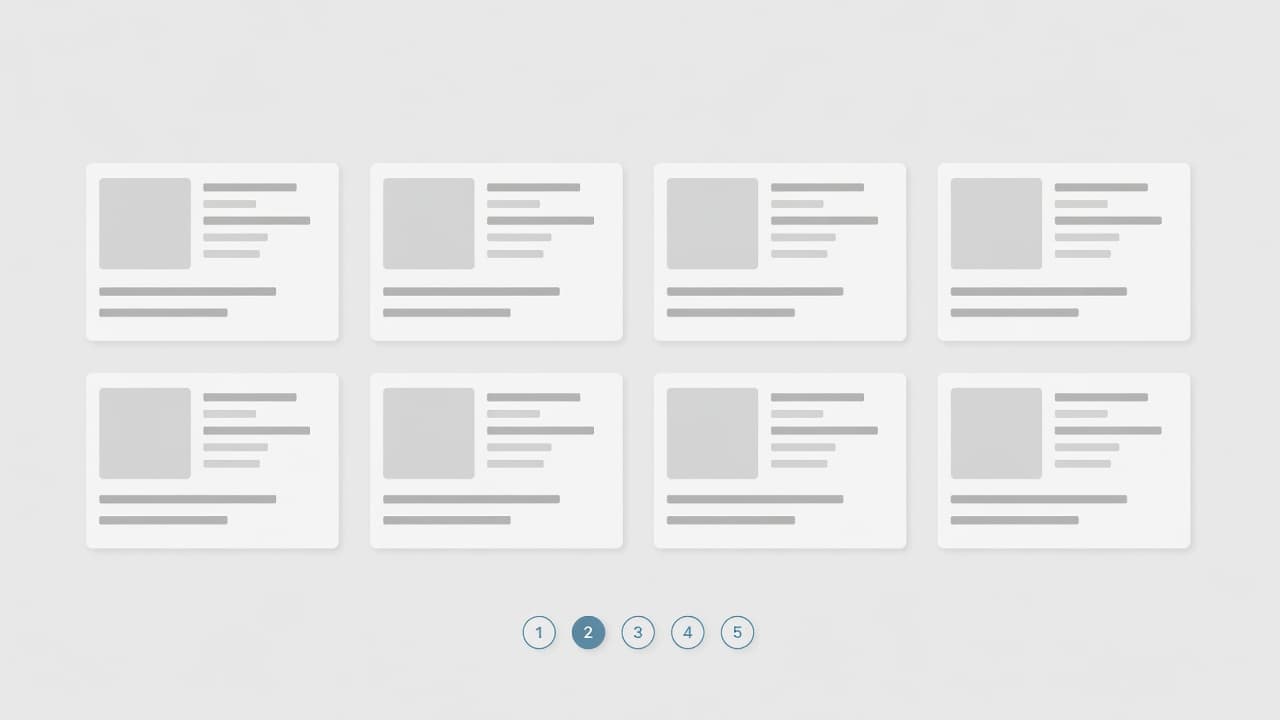
Server-rendered links matter far more than complex interface tricks. A button that only functions after JavaScript executes is a weak signal. A plain link provides a clear destination for discovery and ensures a seamless user experience, even when scripts lag or fail.
For long affiliate archives, place navigation controls both above and below the list. On mobile, the bottom control is vital because that is where users naturally finish reading. On desktop, the top control helps with scanning and quick jump-ahead use cases.
While infinite scroll or load more buttons can create a modern feel, they should only be implemented as a hybrid. Google still requires a crawlable path behind these experiences. If your archive loads content dynamically without stable, indexable URLs, you make it harder for search engine crawlers to discover your content.
Whether you are managing large product hubs or category pages, the same logic applies. The layout can be stylish and modern, but the crawl path must remain transparent and robust to ensure every page is properly indexed.
Make page 1 a real hub
Page 1 should not try to be the whole archive. It should act like the front door. That means a short intro, the strongest recommendations, and enough context for someone to know where to click next.
For a best X page, page 1 should lead with the top contenders and the clearest differences. If the list has 30 items, page 1 should not repeat every product in the same order with three extra paragraphs of filler. The opening section should tell the reader what changed, why the winners matter, and how to move deeper if they need more options.
Strategic internal linking is essential here. By effectively linking from page 1 to subsequent paginated pages, you distribute PageRank throughout your site, which helps maintain visibility for secondary review items that would otherwise be ignored. When a paginated page keeps bringing in clicks or conversions, feed it into a larger content plan. A good next step is to expand the surrounding topic cluster with supporting reviews, comparisons, and related intents. If one page keeps winning, fold it into an affiliate content sprint plan and build more assets around that intent.
This is where a lot of affiliate sites leave money on the table. They optimize the first page, then let the rest of the archive sit there untouched. A better setup treats each strong paginated URL as a signal about what readers want next, using your site architecture to ensure every high-value review gets the exposure it deserves.
Match the structure to the page type
Different page types serve distinct roles. A roundup, a category archive, and a review library should not all behave the same way. When setting these up, ensure every section of your site utilizes a unique URL for its paginated results to prevent search engines from flagging your content as duplicate content.
| Page type | Page 1 should do | Later pages should do | Main risk |
|---|---|---|---|
| Best X roundup | Surface the strongest picks and brief verdicts | Expand lower-priority options or edge cases | Repeating intro text and duplicate content |
| Category archive | Group related topics by intent | Keep older but relevant posts reachable | Thin category pages |
| Review library | Guide users by brand, use case, or score | Support long-tail discovery | Filter explosion and lack of a unique URL |
Best X roundups
Roundups work best when page 1 handles the main decision. Put the highest-value items first, then let page 2 and page 3 cover secondary options. If the ordering is random, or if every page starts with the same top pick, the archive feels mechanical. Searchers notice that quickly, and it can lead to confusion regarding which page holds the primary authority.
Category archives
Category archives need a clear theme. Budget tools, beginner guides, or high-ticket software are better than a generic pile of posts. By carefully organizing your category pages, you provide a thematic hub that helps search engines understand your topical authority. Add a short category summary, then link to the most relevant reviews and comparisons to keep visitors engaged.
Review libraries
Large review libraries need a balance between structure and restraint. Filters are useful, but not every filter combination deserves an indexable URL. Keep the main library crawlable, then use dedicated landing pages for combinations that have real search demand. If your library leans toward software, memberships, or creator tools, a beginner affiliate networks guide can help you decide which offers deserve prominent placement near the front of the archive.
The big idea is simple. Page type should drive page purpose. Once that is clear, pagination stops looking like a technical nuisance and starts working like an editorial system that helps you manage your site structure effectively.
Keep duplicate filters and sort orders out of the index
Most crawl budget issues on affiliate sites stem from endless parameter combinations rather than the core paginated pages themselves. When users sort by price or popularity, or filter by brand, rating, and features, the total number of unique URLs can climb rapidly.
That does not mean every parameter is inherently bad. Some filter pages deserve their own landing pages if there is genuine search demand and the content can support it. Most of them do not. The trick is to separate useful search targets from machine-generated clutter by managing query parameters effectively.
You could consider a view all page as an alternative, but for most affiliate sites, a more practical approach is to handle low-value variants with a noindex tag. This prevents duplicate content from diluting your site authority. Start by protecting the main paginated series, as you should never block page 2 or page 3 just because they reside deeper than the first page. Use robots.txt only for true junk rather than as a blanket fix for everything containing a question mark.
If your review site depends on category filters, keep the path simple and consistent. A clean category page with a few indexable subpages is easier to manage than hundreds of combinations that never earn a click. The same approach applies to large archives and product comparison hubs, which is why pagination on category pages is still worth studying even outside eCommerce.
One more caution helps here. If a filtered page has no unique value, do not try to rescue it with a canonical that points somewhere else and then expect the problem to disappear. Always fix the source of the duplication first.
Measure the pages that actually earn
A paginated archive needs its own reporting, or the results blur together. Page 1 often gets the most impressions, but the deeper pages can pull in better click-through rates, longer visits, or more conversions.
Track the page URL, clicks, sessions, conversions, revenue, and EPC for each important paginated section. If paid traffic ever lands on those pages, keep ROAS and cost in the same view. That gives you a clear read on whether the archive is helping sales or just collecting visits.
Google Search Console is useful, but it only shows part of the picture. Server logs tell you how often Googlebot reaches page 2, page 5, or page 10, helping you analyze the crawl depth of your site to ensure important content remains accessible. Analytics tells you where users actually go after landing. Together, those views show whether pagination is discoverable and provides a high-quality user experience for your audience.
Pay attention to mobile behavior as well. If page 2 gets impressions but no clicks, the issue might be the title. If users click but do not continue, the navigation or page depth may be the problem. If a page gets traffic and sales, promote it more often inside the archive and across related posts.
A clean dashboard beats a crowded one. When you can see which paginated page is earning, which one is only attracting clicks, and which one is wasting crawl effort, the next edit becomes obvious.
Frequently Asked Questions
Does Google still use rel=next and rel=prev for pagination?
No, Google officially retired support for these attributes several years ago. While you can keep them in your code for legacy reasons or other technical requirements, they no longer influence how Google crawls or indexes your paginated series.
Should I use noindex tags on my paginated pages?
Generally, you should not use noindex on valid paginated pages like page 2 or page 3, as these often contain unique content or niche product recommendations that can rank. Reserve the noindex tag only for low-value, machine-generated filters or duplicate sort-order variations that provide no unique search value.
Is it better to use query parameters or subdirectories for pagination?
Both methods are acceptable as long as you maintain a consistent pattern and ensure every page has a unique, stable URL. The most important factor is avoiding fragments (like #page-2) and ensuring that your CMS does not generate session-based or redundant noise in the URL string.
Conclusion
A successful approach to pagination SEO relies on keeping things simple. Stable URLs, a self-referencing canonical tag on every page, and clear HTML anchor links give Google a reliable path through your site, while ensuring your readers can easily find more content when a single page is not enough.
For affiliate review sites, the true competitive advantage lies in your site structure. Page 1 should serve as a high-authority hub, subsequent pages should provide necessary depth, and filtered or sorted views should remain excluded from the index to prevent bloat. By maintaining this balance, you ensure your archive remains both crawlable and user-friendly.
When your paginated sections begin to generate revenue, view these pages as important performance indicators. The strongest assets in your archive deserve consistent internal linking, high-quality summaries, and a prominent place in your future content strategy.