
A profitable-looking affiliate dashboard can hide a weak business. Pending commissions, reversals, paid traffic, software subscriptions, and contractor invoices can shrink your affiliate profit margin long after a sale appears in a report.
The number that matters is what remains after approved revenue and every operating cost. Once you track it consistently, you can stop guessing which offers, pages, and traffic sources deserve more of your budget.
Key Takeaways
- Use paid or approved commissions, not pending dashboard totals, to calculate monthly operating profit.
- Separate gross commissions, refunds, fees, and operating expenses before calculating your margin.
- Treat taxes and owner compensation separately from operating profit, unless your legal business structure records owner pay as payroll.
- Review profit by offer and traffic source, because a high-commission program can still lose money after ad spend and reversals.
- Track attribution rules and self-referrals closely, since missing or misattributed conversions can distort results.
What This Margin Actually Measures
This margin shows the percentage of recognized affiliate revenue left after the costs required to earn it. For a blogger or content creator, that revenue is usually commissions received from merchants and networks.
A merchant running an affiliate program uses a different calculation. The merchant starts with product revenue, then subtracts cost of goods sold (COGS), commissions, platform fees, and program management costs.
For merchants, contribution margin is revenue remaining after variable, order-level costs such as COGS, fulfillment, payment processing, support, commissions, and returns. It excludes fixed operating expenses.
Gross commission revenue is not profit
Your network may report a $1,000 commission total. That figure can include sales still within a return window. It may also exclude payout fees and later reversals.
Gross profit margin is revenue minus applicable direct costs, divided by revenue. A publisher earning commissions may not have traditional product costs, so recognized affiliate revenue isn’t automatically gross profit margin.
For example, if a network records $1,000 in gross commissions, then reverses $100 and charges a $30 payout fee, your recognized commission revenue is $870. Keep the gross amount, reversal, fee, and final deposit in separate columns.
A practical affiliate marketing bookkeeping spreadsheet makes these status changes visible instead of burying them in one earnings total.
Operating profit and net profit are different
Operating profit margin shows what remains after normal operating expenses such as content, hosting, advertising, software, and labor. It tells you whether the business activity itself makes money.
Net profit margin is calculated after operating costs and may also include interest, financing charges, and income taxes. Taxes aren’t operating expenses, and owner draws are generally separate for a sole proprietor or partnership. However, wages paid to an owner through a corporation’s payroll may count as an operating expense.
Pending commissions are useful for forecasting, but they are not confirmed monthly profit.
The Operating Profit Formula After Operating Costs
Use recognized revenue as the starting point. Don’t divide profit by clicks, sales, or gross commissions that might disappear after refunds.
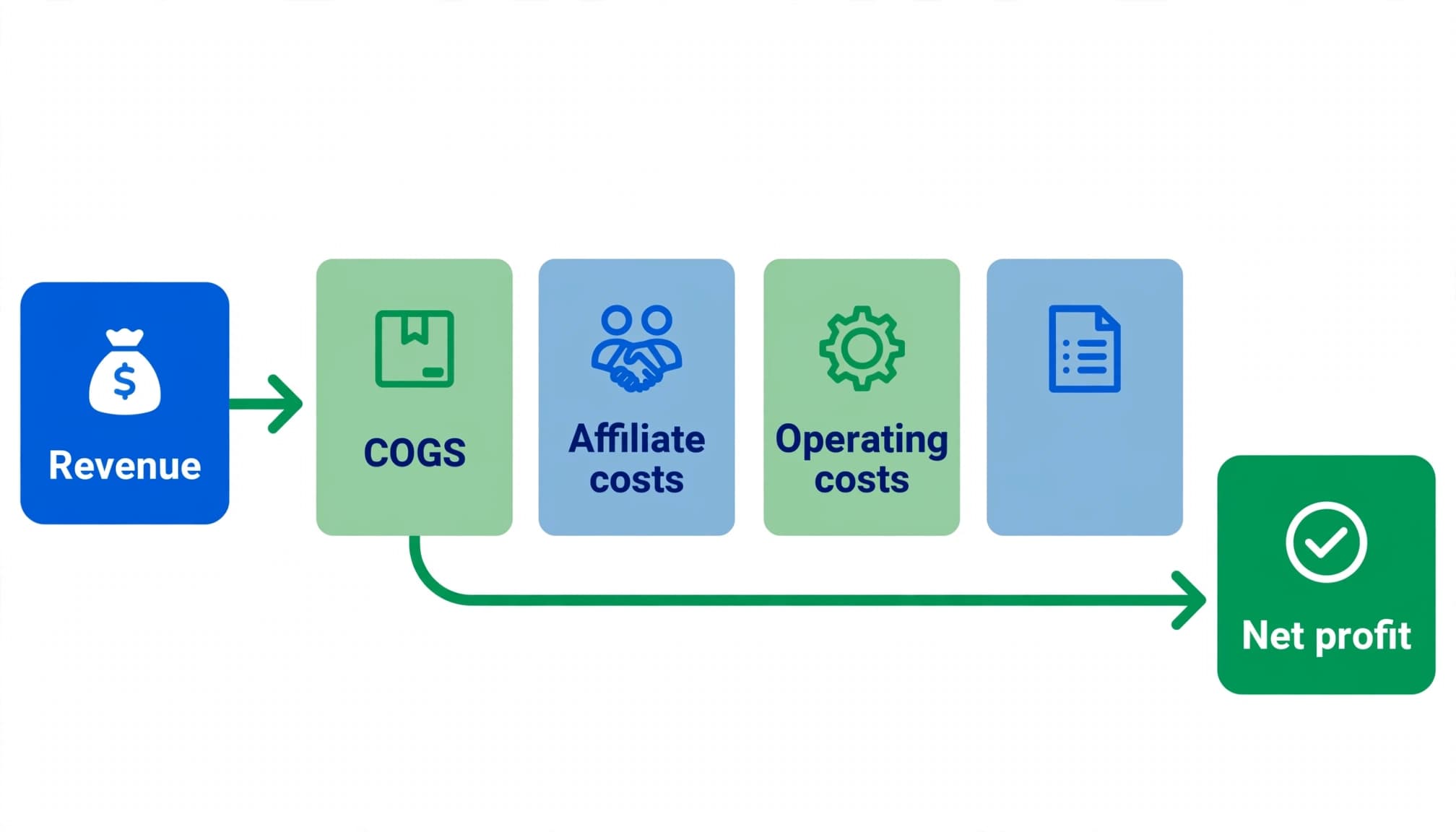
Calculate recognized affiliate revenue first
Start with this formula:
Recognized affiliate revenue = Gross commissions – refunds and reversals – network or payout fees
Then calculate your operating profit:
Operating profit = Recognized affiliate revenue – operating expenses
Finally, calculate your operating profit margin:
Operating profit margin = Operating profit / recognized affiliate revenue x 100
Use the same period for every input. If you calculate April profit, include April’s revenue and April’s expenses. Don’t mix a full quarter of software costs with one month of commissions.
| Measure | Formula | What it shows |
|---|---|---|
| Recognized revenue | Gross commissions – reversals – fees | Revenue you can reasonably count |
| Operating profit | Recognized revenue – operating expenses | Profit before taxes and owner draws |
| Operating margin | Operating profit / recognized affiliate revenue x 100 | Percentage retained after running costs |
A positive margin means the business generated more than it spent. A negative margin means something needs attention, even if the affiliate dashboard shows revenue growth.
Include COGS only when it applies
Most affiliate publishers don’t have COGS because they earn a commission rather than sell inventory. Their direct costs are content, paid traffic, tools, and labor.
If you sell your own product through affiliates, COGS belongs in the calculation. Include product manufacturing, wholesale costs, packaging, shipping subsidies, payment processing, and return-related costs where relevant.
That distinction prevents a common mistake: using a merchant’s product margin formula for a publisher’s commission-based business.
Audit Every Operating Cost Before You Scale
Small recurring charges can lower your margin more than a single expensive tool. Review them monthly, then tag each cost as fixed, variable, or mixed.

Fixed and recurring costs
Fixed costs stay fairly stable even when traffic changes. They can include web hosting, domain renewals, email platforms, keyword tools, accounting software, link-management subscriptions, and baseline contractor retainers.
List annual expenses as monthly amounts. A $120 annual domain renewal is a $10 monthly cost for planning purposes, even though the cash leaves your account once a year.
Variable costs need source-level tracking
Variable costs rise when you publish, promote, or sell more. These include freelance writers, editors, video production, design work, paid clicks, sponsored placements, and transaction fees.
Media buying can earn commissions and still lose money after cost per click, agency fees, refunds, and delayed approvals. Customer acquisition cost is the relevant acquisition spend, such as ad spend, placement fees, and agency costs, divided by acquired customers or approved conversions. Compare it with recognized commission revenue or contribution profit, not optimistic pending commissions.
Calculate True ROI for an Affiliate Program
If you run a merchant’s affiliate marketing program, profit margin alone doesn’t show whether affiliate spending beats other customer acquisition channels. Calculate return on investment using affiliate-attributed sales and all program costs.
Use a complete program-cost formula
A useful merchant formula is:
True affiliate ROI = (Affiliate-attributed revenue – COGS – total affiliate program costs) / total affiliate program costs x 100
Total program costs include commissions, network fees, tracking software, partner bonuses, creative production, fraud losses, account management, media buying, influencer partnerships, and affiliate-specific paid placements.
Before calculating affiliate marketing ROI, define how affiliate-attributed revenue is credited. Your attribution models should specify which partner receives credit when multiple marketing interactions influence one purchase.
An affiliate platform must connect a partner click to a purchase before a merchant can calculate a credible payout. This affiliate program tracking overview outlines why that attribution layer matters.
Contribution margin and ROI answer different questions. Contribution margin per order is revenue after variable costs, including COGS, fulfillment, payment processing, support, returns, and the affiliate payout. ROI compares attributed revenue with the full program-cost base. Commissions belong in both calculations for their respective purposes, but don’t subtract the same commission twice within one calculation.
Find the break-even point
For a publisher, break-even orders equal monthly operating expenses divided by net commission per approved sale. If you earn $25 per approved sale and spend $500 per month, you need 20 approved sales to cover costs.
For merchants, forecast contribution profit per affiliate order using average order value, expected conversion rates, and variable order costs before setting a payout. ROI can change when attribution models use last-click, first-click, or another crediting rule.
A strong headline commission is useless if returns, payment fees, and support costs erase the remaining contribution margin.
Set Commission Rates That Keep the Business Healthy
An affiliate marketing program should reward quality partners without turning each additional sale into a loss. Its affiliate commission structure should reflect product economics and partner quality. Use attribution models and verified tracking data to evaluate channels such as influencer partnerships.
Match the payout to the offer economics
Physical products often leave less room for affiliate commissions because inventory, fulfillment, returns, and card fees consume revenue. Digital products can support a different payout model, but customer support, refunds, onboarding, and churn still affect profitability.
Avoid treating broad industry affiliate commission rates as a pricing rule. Calculate what your product or offer can afford after its actual costs, and let your pricing strategy follow those economics. Compare affiliate acquisition with media buying before setting the payout. A practical affiliate marketing business plan can help you map expected clicks, conversion rates, average order value, payout per sale, and break-even volume.
Use a tiered commission structure only after the base rate works
A tiered commission structure can motivate high-performing partners. For example, a merchant might offer a base rate, then raise it after a partner reaches a monthly volume threshold.
However, test the higher tier against refunds, support costs, discount stacking, and recurring eligibility before adopting a tiered commission structure. For recurring commissions, also model trial conversion, renewal behavior, cancellation, customer lifetime value, and the maximum number of eligible billing periods.
Reconcile Attribution, Tracking, and Fraud
Affiliate tracking is a financial control, not only a marketing report. When tracking is incomplete, you can pay the wrong partner, miss valid commissions, or misjudge an offer’s profitability.
Compare network reports with analytics
Affiliate networks commonly use last-click attribution models. Meanwhile, GA4 may apply data-driven attribution and multi-touch attribution, splitting credit across several channels. If a purchase happens on a merchant’s site, your analytics may only see the outbound click.
Use tagged links, placement labels, and SubIDs in affiliate tracking software to connect clicks with downstream activity. Label articles, emails, social posts, and influencer partnerships consistently. This affiliate link tracking guide explains how consistent tags reveal which placements send qualified visitors.
Your payout terms should identify the attribution models used by the program. They should also explain how network and analytics credit can differ.
Accurate UTM parameters matter because attribution systems only work with the campaign data they receive. Multi-touch attribution and inconsistent attribution models can produce conflicting reports, so reconcile clicks, orders, and approved commissions before paying partners. Affilae’s GA4 affiliate marketing breakdown is a helpful reference when reports disagree.
Block self-referrals and duplicate credit
Use affiliate fraud prevention controls to check for self-referrals, duplicate conversions, invalid leads, unusual conversion spikes, coupon-code leakage, and purchases sharing billing or device details. Review outliers before approving commissions.
Set clear rules for personal purchases, employee orders, trademark bidding, discount sites, and browser extensions. A Rewardful fraud detection plan offers practical controls for spotting suspicious affiliate activity.
Also account for disclosure and privacy compliance work in your program budget. Partner terms and data handling rules can create real administrative costs, as outlined in this affiliate compliance guide.
Run a Monthly Profit-Margin Audit
Close each month with one finance view and one performance view. The finance view should reconcile paid commissions, fees, reversals, operating expenses, taxes set aside, actual bank deposits, and the attribution models used for credited commissions.
The performance view can include pending commissions, clicks, conversion rates, average order value, refund rate, and earnings per click. An affiliate revenue audit helps separate traffic behavior from confirmed earnings. Compare each offer’s average order value with recognized commission and refunds.
First, compare approved and paid commissions against the previous month. Next, inspect cost increases from media buying and other paid campaigns. Then review individual offers and pages under different attribution models, especially those with high clicks but low net commission. Before setting aside taxes, compare recognized revenue with operating expenses to calculate your operating profit margin.
Keep source documents for invoices, payout statements, refunds, and ad receipts. Clear records make tax preparation easier and give you evidence when a network report changes later.
FAQ
What is the difference between gross profit margin and net profit margin in affiliate marketing?
For an affiliate publisher, gross profit margin measures profit after direct costs, not gross commission revenue alone. Operating profit margin subtracts recurring and variable operating costs. Net profit margin is measured after operating costs and may also reflect financing costs and taxes.
Should I include taxes and owner compensation in affiliate profit margin?
Track taxes separately from operating expenses for management reporting, so you can see whether the business itself is profitable. Set aside money for taxes each month, but ask a qualified tax professional how your entity treats owner compensation. Owner draws usually differ from payroll wages.
How does multi-touch attribution affect affiliate earnings?
A buyer may read a review, click an email, return through a search ad, and use a coupon before purchasing. Last-click and multi-touch attribution models can assign different credit to the same buyer journey. Ask each program about cookie duration, overwrites, cross-device tracking, and deduplication before you project earnings.
Build Decisions Around Net, Not Dashboard Revenue
A reliable operating profit margin starts with revenue that has survived reversals and fees. Then it accounts for every cost required to earn that revenue.
Review the numbers every month, not only when a campaign fails. Net operating profit gives you a clearer basis for choosing offers, setting budgets, and growing without spending past your real earnings.