
Most review posts lose readers before the real review starts. The problem usually isn’t the product. It’s the opening.
A strong affiliate review template intro gives people a fast answer, a reason to trust you, and a clear sense of what’s coming. When that happens, scroll depth improves because readers feel oriented, not sold to.
What a review intro needs on the first screen
Readers land on a review with quiet doubts. Is this honest? Is this for me? Is the writer hiding the downside? Your opening should calm those doubts fast.
Curiosity still matters, but it has to be useful curiosity. Promise clarity, not suspense. If you make readers work to find your basic opinion, many will leave.

This simple framework keeps the intro focused:
| Part | What it does | Ideal length |
|---|---|---|
| Hook | Names the reader’s problem or goal | 1 sentence |
| Quick verdict | Gives your plain first take | 1 to 2 sentences |
| Reader fit | Says who should keep reading | 1 sentence |
| Credibility line | Explains your basis for the review | 1 sentence |
| Disclosure | States the affiliate relationship clearly | 1 sentence |
The point is speed. A good intro answers the first mental questions without turning into a wall of text. If you need help shaping the rest of the article around that opening, this structured product review format is a solid next step.
Your intro should reduce uncertainty, not create more of it.
That also means skipping vague hype. Don’t open with “This tool changed everything” unless you can prove it. A better line sounds like a human: “This is a good fit for beginners, but advanced users may outgrow it.”
A ready-to-copy affiliate review intro template
A reusable template helps because it removes guesswork. You stop staring at a blank page and start filling in clear slots.
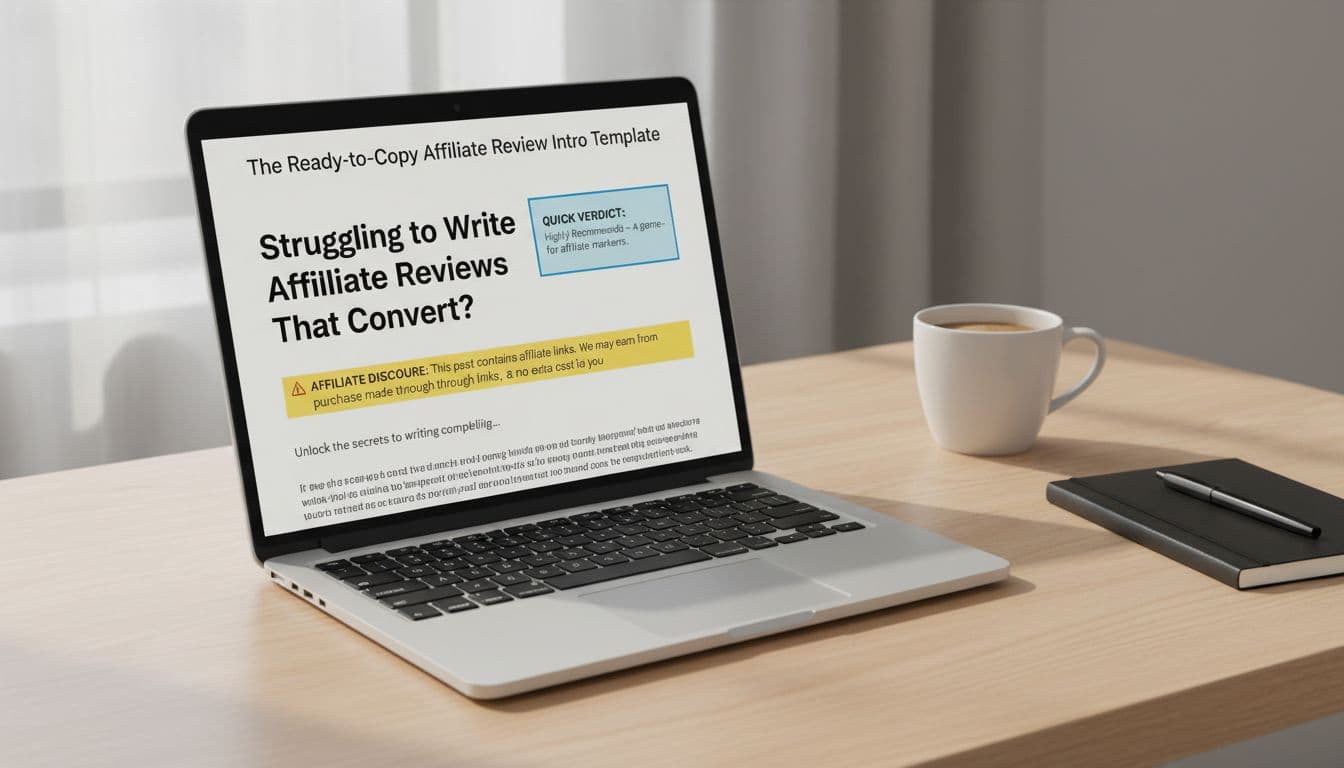
Use this at the top of your next review:
Disclosure: This review contains affiliate links. If you buy through them, I may earn a commission at no extra cost to you.
If you’re looking for [product type], [product name] is a strong option for [reader type] because [main benefit]. It’s less appealing if you need [main drawback or dealbreaker]. I based this review on [testing method, research process, or real use]. Below, I’ll show where it performs well, where it falls short, and whether it’s worth the price for your situation.
This template works because it balances three things well.
First, it creates curiosity with a promise of proof. You say there’s more to learn, but you don’t hide the verdict.
Next, it builds credibility. Even a short line such as “I compared pricing, support, and setup time” makes the review feel grounded.
Finally, it handles transparency early. For current placement basics, this FTC disclosure checklist is a helpful refresher. In practice, the rule is simple: use plain language, put it near the top, and place it before the first affiliate link. If you want wording you can adapt, these affiliate disclosure examples make the phrasing easier.
One more tip: match the tone of the product. A budget hosting review can sound direct and practical. A premium software review can feel a bit more polished. The structure stays the same either way.
Swipe-style examples for different review niches
Once you have the framework, you can adjust the wording to fit the niche. The shape stays steady, but the proof point changes.

SaaS tool review
“If you want an email platform that is easy to learn, [Tool Name] is a strong pick for small creators. It’s weaker if you need deep reporting or advanced team features. I reviewed it based on setup speed, automation options, and pricing, and I’ll show where it delivers value.”
Web hosting review
“For new bloggers, [Hosting Brand] is a good option when ease of setup matters more than server control. It may not suit developers who want more flexibility. I compared uptime promises, dashboard simplicity, backups, and support response before recommending it.”
Physical product review
“If you’re choosing a desk chair for long workdays, [Product Name] stands out for comfort and adjustability. The higher price may be a dealbreaker for some buyers. I looked at build quality, comfort over time, and warranty details before writing this review.”
These examples work because they give the reader a fast “yes, maybe, or no.” That honesty keeps people reading. It also filters out the wrong buyer, which can reduce bad clicks and refunds later.
If your review compares several options after the intro, a clean comparison table template helps readers scan choices without feeling pushed.
Final thoughts
The best affiliate review intro doesn’t try to sound clever. It gets useful fast. Readers keep scrolling when they understand your verdict, your basis, and your relationship to the product within seconds.
That is the real job of an affiliate review template. It gives you a repeatable opening that feels honest on every post, even when the niche changes.
When the first screen feels clear and fair, the rest of the review has room to do its work.