
Recurring affiliate commissions can look modest at first, but a single subscriber may produce revenue for months or years. Customer lifetime value shows what that referral is likely to earn over its full eligible subscription period.
That estimate helps you compare monthly and annual plans, set traffic budgets, and avoid choosing an offer based only on its headline commission. The calculation becomes useful when it includes trial conversions, churn, refunds, reversals, and commission limits.
What customer lifetime value means for affiliate commissions
In ecommerce, customer lifetime value usually measures the revenue or profit a buyer generates over time. For an affiliate marketer, the useful version measures net commission per referred customer, not the merchant’s total sales revenue.
A customer who pays $50 per month may be worth far less to you than the merchant if the affiliate program pays only 20% for the first three months. Your model must follow the program’s actual payout rules.
Revenue is not your commission
Suppose a software subscription costs $40 per month and pays affiliates 25% recurring commission. Your gross commission is $10 per eligible billing event.
If the customer stays for 10 eligible months, the gross affiliate value is $100. However, that figure can fall after refunds, failed payments, reversals, or a commission duration limit.
When the rate is percentage-based, calculate the commission per billing event this way:
Commission per billing event = eligible customer payment x commission rate
Use the payment amount that the program actually includes. Some programs exclude taxes, discounts, setup fees, add-ons, or payment processing charges.
One sale can hide the real value
A one-time earnings-per-sale figure often makes recurring offers look weaker than they are. A program paying $15 per month may be more valuable than one paying $100 once, depending on retention and commission terms.
However, recurring income isn’t automatically better. A subscription with high churn may produce less than a larger one-time payout. Goho Money’s guide to recurring and high-ticket affiliate programs offers a useful comparison of both payout models.
A recurring commission is only valuable when the customer stays subscribed and the program continues crediting your account.
The customer lifetime value formula for affiliate offers
The cleanest approach is to calculate value separately for each plan, then blend the results based on the percentage of customers choosing each plan.
Net affiliate CLV per plan = commission per billing event x eligible billing events x (1 – refund and reversal rate)
For a free-trial offer, add the trial-to-paid conversion rate:
CLV per trial signup = trial-to-paid rate x blended net affiliate CLV
The variables have simple meanings:
- Commission per billing event is the amount you receive for one eligible monthly or annual charge.
- Eligible billing events are the payments that qualify for commission before the program’s duration limit.
- Refund and reversal rate is the share of recorded commissions you expect to lose.
- Trial-to-paid rate is the percentage of trial users who complete the first paid charge.
- Blended net affiliate CLV combines monthly and annual plan values according to their customer mix.
A conventional CLV model often uses average purchase value, purchase frequency, and customer lifespan. You can review Medallia’s customer lifetime value formula for that broader business definition. Affiliate modeling changes the inputs because your income depends on commission rules rather than the full customer payment.
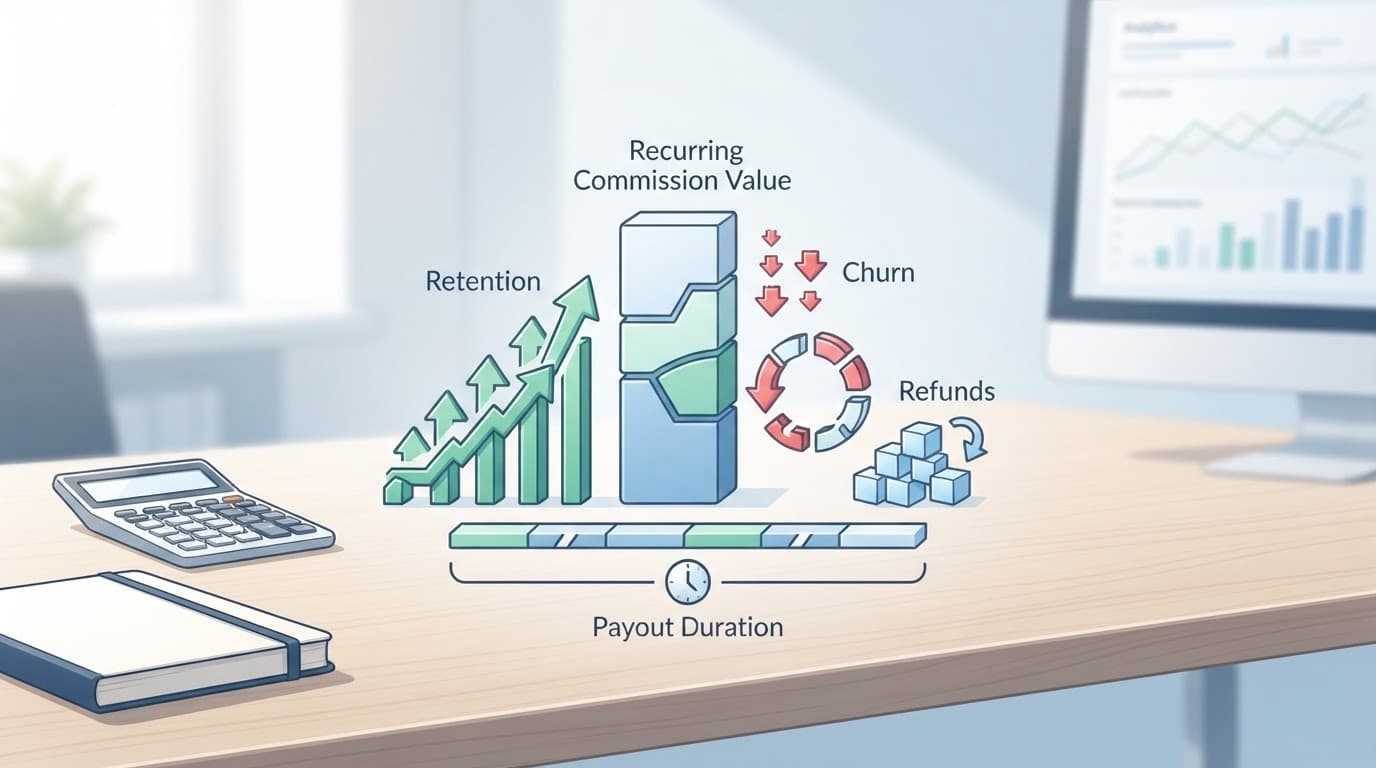
Estimate billing events with churn
For a monthly plan, a basic lifespan estimate is:
Expected paid months = 1 / monthly churn rate
At 8% monthly churn, the rough expected lifespan is 12.5 months. If the program pays commissions for only 12 months, use 12 eligible months instead.
Eligible paid months = the lower of expected paid months or the commission cap
Churn measures cancellations among active subscriptions. The subscription churn explanation from Freemius provides useful context on measuring that rate correctly.
For annual plans, use the annual churn rate and annual billing events. If annual churn is 25%, the rough expected lifespan is four annual billing cycles. A program that pays for only two annual charges must use two, not four.
A worked monthly versus annual example
Consider a software offer with a 14-day free trial. The program pays recurring commissions after the first successful payment.

The offer’s assumptions look like this:
| Plan | Paid customer share | Commission per billing event | Churn | Commission cap | Reversal rate |
|---|---|---|---|---|---|
| Monthly | 70% | $20 | 8% monthly | 12 months | 10% |
| Annual | 30% | $120 | 25% annually | 2 billings | 5% |
For the monthly plan, the expected lifespan is 1 / 0.08, or 12.5 months. The cap reduces that to 12 eligible billing events.
Monthly net CLV = $20 x 12 x (1 – 0.10) = $216
For the annual plan, 1 / 0.25 equals four expected annual billings. The commission cap reduces that number to two.
Annual net CLV = $120 x 2 x (1 – 0.05) = $228
Now blend those plan values:
Blended net CLV = (0.70 x $216) + (0.30 x $228) = $219.60
Only 35% of trial users become paying customers, so the value of each trial signup is:
CLV per trial signup = 0.35 x $219.60 = $76.86
This means 100 trial signups have an estimated affiliate value of $7,686 before traffic and content costs. The estimate isn’t a guarantee. It is a working baseline that you can compare with later cohorts.
If the program pays the annual commission once at signup and never pays renewal commissions, set annual eligible billing events to one. Don’t treat an annual subscription as 12 monthly commissions unless the program’s terms say that it pays that way.
Account for trials, refunds, and commission limits
Small changes in your assumptions can create large differences in projected earnings. Model every stage separately instead of placing one optimistic conversion rate in a spreadsheet.
Separate trial conversion from sale conversion
Track these events as different rates:
- Affiliate click to trial signup.
- Trial signup to first successful payment.
- First payment to second billing event.
- Later billing events that remain approved.
A 10% click-to-trial rate doesn’t mean 10% of clicks become paying customers. If only 35% of trials convert, the combined click-to-paid rate is 3.5%.
Direct-purchase offers work differently. If the customer pays immediately, the trial-to-paid rate is 100%, subject to refunds and reversals.
Use net commissions, not reported commissions
A network may show a commission when the transaction first appears, but that amount can remain pending. Refunds, canceled subscriptions, duplicate orders, invalid traffic, and tracking corrections can remove it later.
Keep separate columns for pending, approved, reversed, and paid commissions. Pending revenue is a forecast input, not confirmed profit. Approved commissions are stronger evidence, but they may still wait for a payment threshold or scheduled payout.
You can use an affiliate commission calculator to check the arithmetic around recurring payouts, refunds, and net earnings. Your spreadsheet still needs the specific terms of each program.
Commission duration deserves its own column. A 30% recurring rate may apply for 12 months, while another offer may pay for the customer’s entire subscription. Those programs shouldn’t share the same lifetime assumption.
Validate your assumptions with real cohorts
Start with the affiliate network’s reporting, merchant documentation, and your own traffic data. Ask the program manager for details when the terms leave room for interpretation.
Record the following for each offer:
- The date of the original referral.
- The customer’s plan and billing frequency.
- Trial start and first paid charge.
- Commission amount and status.
- Refund or reversal date and reason.
- The number of paid billing events.
- The traffic source, page, device, and campaign.
Group customers by signup month or quarter. Then compare how much each cohort earned after 30, 60, 90, and 180 days. Early results can help estimate first-month value, but they often understate longer-term commissions.
Your website analytics can show clicks and pre-click behavior, while the affiliate network usually holds the purchase and payout data. Use a consistent naming system and compare both views with a conversion lag. Goho Money’s guide to GA4 affiliate tracking setup covers UTMs, events, attribution differences, and network reporting.
Also separate traffic sources. Search visitors, email subscribers, social audiences, and paid clicks may produce different trial conversion and retention rates. A broad average can hide the fact that one content topic produces customers who cancel quickly.
Place a clear affiliate disclosure near the first relevant affiliate link. If you publish earnings examples, label them as estimates and base them on terms readers can verify.
Compare offers using CLV and EPC
Customer lifetime value gives you the value of a referred customer. Earnings per click translates that value into a traffic-level number.
Expected EPC = click-to-trial rate x CLV per trial signup
For a direct-purchase offer, use:
Expected EPC = click-to-paid rate x net CLV per paid customer
Using the example above, if 8% of affiliate clicks become trial signups:
Expected EPC = 0.08 x $76.86 = $6.15
An organic content page producing 1,000 clicks could generate about $6,150 in modeled commission value under those assumptions. A paid campaign buying clicks at $2 would have an estimated $4.15 gross margin per click before ad management, content, and software costs.
The affiliate EPC spreadsheet can help organize this calculation. For paid traffic, keep your maximum CPC below expected EPC after including your other costs.
Score the offer beyond its payout
Two programs can show the same CLV while carrying different levels of risk. Compare the following before choosing one:
- Approval and reversal rates.
- Cookie duration and attribution rules.
- Commission payment timing.
- Renewal billing reliability.
- Merchant onboarding and customer support.
- Price changes and plan mix.
- Audience fit and sales-cycle length.
- Whether the program can cap or change commissions.
Run low, base, and high scenarios instead of relying on one average. For example, model monthly churn at 6%, 8%, and 10%. If the offer remains profitable in the high-churn case, your decision has more room for error.
The strongest offer is the one with reliable net value after retention, reversals, attribution, and traffic costs.
Conclusion
Recurring affiliate offers deserve analysis beyond the first commission. Calculate plan-level value, cap eligible billing events, apply trial conversion and reversal rates, then compare the result with EPC and acquisition costs.
The most useful customer lifetime value estimate comes from real cohorts, not a merchant’s headline claim. Track what becomes approved and paid, watch how customers retain, and update your assumptions as new billing data arrives. That process turns recurring commissions into a measurable business model rather than a hopeful projection.