
A review site can show higher clicks and conversions while earning less money from partner marketing. Affiliate Click Fraud Detection helps you separate genuine buyer activity from affiliate fraud, bots, forced attribution, and fake leads.
The hardest partner marketing cases often look healthy in basic analytics. A partner may produce normal conversion rates in a partner marketing campaign while inserting an affiliate touchpoint seconds before checkout. Cloaked affiliate links and redirect chains can hide attribution hijacking and tracking abuse. Review-site owners need evidence at every stage, not only a last-click report.
The following YouTube video offers a useful introduction to affiliate marketing, fraud prevention, and partner marketing:
Key Takeaways
- Affiliate click fraud includes automated clicks, cookie stuffing, click injection, fake leads, unauthorized brand bidding, and other tactics that manipulate attribution without creating legitimate value.
- Reliable detection requires a complete click record, redirect-chain analysis, server-side postback validation, behavioral baselines, and reconciliation with approved commissions, refunds, reversals, and lead acceptance.
- No single signal proves fraud. Shared IPs, VPNs, privacy tools, fast conversions, and unusual device patterns can be legitimate, so suspicious events should be held for review rather than rejected automatically.
- Privacy-conscious fraud prevention uses the least invasive useful signals, limits retention, separates marketing consent from fraud controls, and provides a way to correct mistaken blocks.
- Clear evidence tied to event IDs helps review teams dispute fraudulent commissions, pause affected sources, and improve affiliate program terms and tracking rules.
What affiliate click fraud means on a review site
Affiliate fraud happens when a partner manipulates tracking, traffic, leads, or attribution in partner marketing to collect commissions without creating legitimate value. Click fraud is one part of that problem. It includes automated clicks, click farms, and repeated interactions designed to inflate partner performance.
Invalid traffic isn’t always malicious. Duplicate or misconfigured tracking cookies can create misleading records without a partner deliberately committing fraud. Your investigation should therefore distinguish fraud, technical errors, and legitimate unusual behavior.
Review sites face a particular risk because the conversion path for affiliate programs often spans partner marketing and several tracking systems:
- A visitor arrives through organic search, email, or social media.
- The visitor reads a comparison or product review.
- The visitor clicks an affiliate link.
- A network redirects the visitor to a merchant.
- The merchant records a sale and sends a postback.
- The network uses click attribution to assign the commission.
Any weak point can distort the result. A partner might claim credit after the visitor already made a decision. A bot might trigger the affiliate URL without reading the page. A duplicate postback might create two commission records for one order.
The commercial impact is larger than a few incorrect commission payouts. Fraud can corrupt EPC calculations, make poor content look successful, weaken trust in partner marketing, and cause an affiliate network to suspend an honest publisher.
That makes clean measurement part of your business model. When evaluating affiliate marketing in 2026, compare final approved commissions with qualified clicks, refunds, reversals, and assisted conversions from partner marketing.

How bad actors steal affiliate attribution
Bad actors use technical tricks and misleading promotion to capture credit in partner marketing. Together, these tactics can constitute affiliate fraud, distort reporting, and make legitimate referrals harder to evaluate.
Cookie stuffing and forced tracking
Cookie stuffing drops an affiliate tracking cookie without a genuine affiliate click. Older methods used hidden iframes, invisible images, pop-ups, or automatic redirects that create tracking cookies as visitors browse normally. The partner’s identifier then remains available when a purchase occurs. In partner marketing, approved links should be clear, unlike cloaked affiliate links that conceal the tracking path.
A more subtle variation uses a coupon page, browser extension, toolbar, or cashback site. The user may click a discount button near checkout, allowing that partner to replace an earlier referral. The interaction looks real in a network report, but it may add little or no incremental value.
Review publishers should watch for unusual affiliate sessions with almost no page engagement. A partner that sends a large number of clicks but produces no meaningful landing-page activity may be generating tracking events rather than interested visitors.
Bots, click farms, and automated browsing
Bot traffic is a form of fraudulent traffic. Bots can load review pages, trigger JavaScript tags, and create fake clicks on affiliate links. Repeating that sequence too quickly for a normal reader is click fraud.
Some use data-center infrastructure. Others use residential proxies or emulated mobile devices to blend into ordinary traffic.
Human fraud farms create a harder problem. Workers follow scripted steps, use real browsers, and may produce lower bounce rates than a basic bot. Their activity can still show repeated devices, synchronized timing, shared infrastructure, or identical navigation paths.
A high click-through rate doesn’t prove traffic quality. In affiliate marketing, bots can click every link, while human fraud farms can create convincing sessions without a valuable purchase. Publishers should assess partner marketing traffic beyond the click count.
Redirect chains and click injection
A normal affiliate link may pass through one tracking domain before reaching the merchant. Last-click reporting can make click attribution look valid, even when partner marketing traffic follows an uncertain path. Suspicious redirect chains can involve several domains, parameter changes, and a final affiliate identifier absent at the first click.
Click injection is common when a tracking event appears immediately before a conversion. A partner may inject its identifier during registration, checkout, or app installation, then claim last-click credit. Some fraudulent conversions result from attribution hijacking immediately before the sale. TrafficGuard’s published affiliate materials describe patterns such as rapid paid-to-affiliate handoffs, repeated postbacks, inconsistent timestamps, and clicks clustering immediately before conversion.
Traditional tracking pixels often miss this activity. A pixel can show that a browser loaded a page, but it usually can’t prove that the user intentionally clicked an affiliate link. It also struggles to explain what happened between redirects or whether the conversion event matches an earlier click.
Fake leads and unauthorized brand bidding
Pay-per-lead campaigns in performance marketing attract fraudulent leads, duplicate records, disposable email addresses, impossible locations, and leads that never respond. Some bad actors use stolen or recycled information. Others submit forms through automation and sell the same lead to multiple buyers.
Paid search creates another exposure within partner marketing. A partner may bid on your brand name or use a confusing display URL. It may copy your ad wording or send visitors through a tracking link that claims the sale. This brand bidding can become ad hijacking, increasing costs while shifting credit away from approved campaigns.
Search monitoring tools such as BrandVerity are built to detect unauthorized paid-search activity. Promo code monitoring can help investigate undisclosed coupon or cashback activity. Your agreement should state whether trademark bidding, direct linking, typo keywords, and coupon terms are allowed. Then monitor actual search results rather than trusting a partner’s declaration.
Warning signs that deserve investigation
No single signal proves affiliate fraud or click fraud. VPN users, shared office networks, mobile carrier IPs, privacy browsers, and fast repeat purchases can all create legitimate anomalies. Use multiple signals and compare them with the partner’s normal baseline and the wider partner marketing mix.
Common warning patterns include:
- Conversions arrive within seconds of the affiliate click, even though other partners show longer decision times.
- Several conversions come from the same IP addresses, device pattern, or hosting provider.
- Postbacks arrive without a matching click ID in your records.
- One partner’s clicks cluster immediately before conversions, while its earlier traffic shows little engagement.
- A traffic source changes country, device mix, browser profile, or time zone without a clear campaign reason.
- Coupon codes associated with a partner appear on sites the partner never disclosed, or paid-search activity suggests undisclosed brand bidding.
- The same customer, email pattern, payment token, or lead data appears repeatedly, subject to lawful data handling.
- Clicks rise while session duration, scroll depth, merchant engagement, or approved revenue falls, suggesting fraudulent traffic or poor traffic quality.
- A partner’s conversion rate jumps after a campaign, tracking update, or merchant promotion.
- Timestamp sequences show a click, redirect, conversion, and duplicate postback in an impossible order.
Treat these as review triggers rather than automatic rejection rules. A conversion that arrives quickly after a click can be genuine, especially for low-cost products. The concern grows when the same timing pattern repeats across hundreds of events.
Separate fraud signals from SEO crawler noise
Review sites often create tracking parameters, filter URLs, comparison paths, and session variations. Googlebot may request some of these URLs, but bot traffic and fake clicks aren’t interchangeable with SEO crawler requests. A crawl isn’t an affiliate click and doesn’t show purchase intent.
Keep your SEO crawl audit separate from your affiliate traffic report. Search Console, server logs, and analytics can show whether Google spends time on duplicate or low-value URLs. In partner marketing, affiliate logs should show whether a real click produced a valid partner event, not invalid traffic.
A clean site structure helps both systems and keeps partner marketing reports easier to interpret. Keep canonical, useful review pages in your sitemap and out of unnecessary parameter paths. Use noindex, canonical tags, AJAX filters, or carefully tested robots rules for low-value variations. Don’t block a page in robots.txt before Google can read a noindex directive if removing that URL from the index is your goal.
Connect crawl data with revenue data before deleting pages. A page with modest organic traffic may still produce assisted sales, email signups, or high EPC. That value matters in affiliate marketing and partner marketing, so technical cleanup should remove waste, not erase useful commercial content.
Build an affiliate click fraud detection workflow
A reliable process combines browser events, server records, network data, and conversion outcomes. This workflow supports fraud prevention by identifying affiliate fraud in a partner marketing program. Your thresholds should reflect your traffic, products, consent requirements, and affiliate agreements.
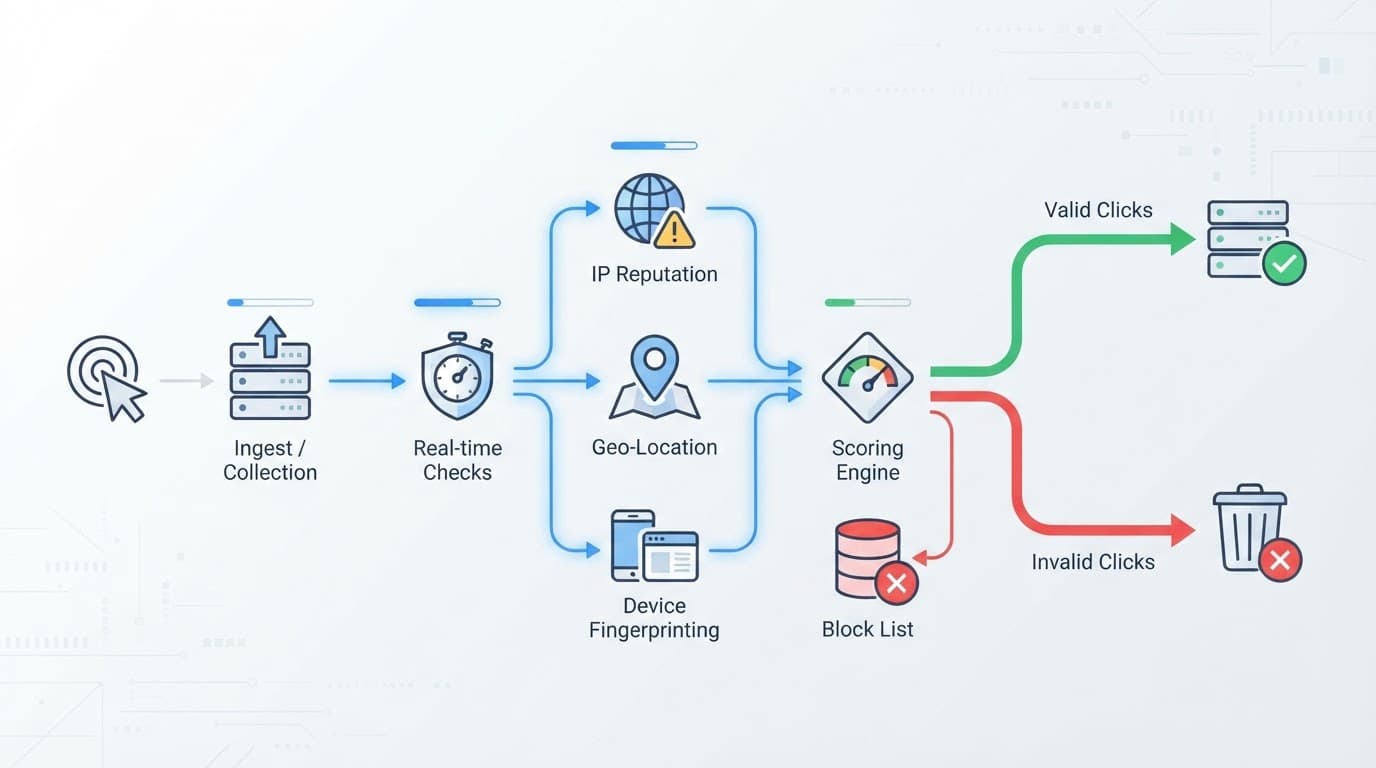
1. Create a complete click record
Give every outbound click a unique event ID. In affiliate marketing, that ID makes partner marketing reporting easier to reconcile.
A useful record might include:
click_idpartner_idpage_slugplacement_iddestination_domaintimestamp- coarse device category
- country or region at an appropriate level
- consent or processing-basis status
Keep the data needed to reconcile a commission. Avoid collecting names, email addresses, full browsing histories, or unnecessary device details.
Your own event ID should travel through the approved tracking process. If the network later reports a conversion without that ID, place the event in a review queue instead of treating it as automatically valid.
2. Capture the complete redirect chain
Don’t inspect only the final affiliate URL. Use server-side request logging or a controlled test environment to record the full redirect chains.
For every hop, capture the source host, destination host, HTTP status, time difference, and query parameters added or removed. Compare the chain across desktop, mobile, logged-in, and logged-out sessions where those tests are lawful and relevant.
Look for:
- an unexpected tracking domain
- a partner ID added late in the chain
- parameters that disappear before the merchant
- repeated redirects with intervals of only a few milliseconds
- different destinations based on country, referrer, or user agent
- a click event that fires without an intentional link interaction
Don’t assume every multi-hop chain is fraudulent. Networks often use redirects for tracking, routing, or regional offers. The important question is whether the chain matches the approved program design.
3. Validate postbacks on the server
A conversion postback should match a known click and an approved partner in the partner marketing workflow. Server-side validation should confirm the partner is active under the relevant affiliate programs. It should also verify that the associated partner marketing account is authorized.
Use a signed request, shared secret, or HMAC where the network supports it. Reject unsigned or malformed events. Treat unmatched or duplicate postbacks as possible fraudulent conversions.
Your validation rules should check whether:
- The
click_idexists. - The partner is active and authorized for the offer.
- The conversion event hasn’t appeared before.
- The order or lead ID is unique.
- The timestamp falls within a reasonable attribution window.
- The currency, commission, product, and status match the network record.
- The event hasn’t already been reversed, refunded, or cancelled.
Use idempotency keys so a retry doesn’t create a second conversion. Record the reason for every rejected or held event. This makes later disputes easier and prevents your team from relying on memory.
4. Score behavior against a baseline
A useful score combines several weak signals rather than relying on one hard rule. Score each partner in the partner marketing program against its own history. Compare partners by traffic source, device category, country, product, article, and time period.
Investigate possible fraudulent traffic when traffic quality falls below baseline. Look closer if conversion lag moves from a normal multi-minute pattern to near-instant attribution, especially with minimal affiliate engagement. Review another partner when its postback count rises but the matching click count stays flat.
Build alerts around changes in your own history. A sudden traffic spike, a sharp drop in post-click engagement, or a new concentration of conversions from one network deserves attention. Avoid copying a universal threshold from another company because product prices and buying cycles differ.
5. Hold and review suspicious commissions
Don’t delete suspicious records. Place them in a pending state and preserve the raw event, normalized event, network report, and investigation notes.
Sample both accepted and rejected traffic. If you inspect only the suspicious group, you may confirm your own assumptions without measuring false positives. A small manual sample can reveal whether the issue comes from a partner, a duplicate tag, a redirect bug, or a merchant-side reporting delay.
When a pattern is clear, pause the affected sub-ID or traffic source before suspending the entire partner. This limits damage while preserving legitimate placements.
6. Reconcile the final outcome
A click is not the same as a sale, and a reported conversion is not always an approved commission. Compare network data with merchant status, refunds, chargebacks, lead acceptance, and reversal dates.
Your weekly report should show gross clicks, validated clicks, conversions, approved conversions, reversals, EPC, and held commissions. That view shows whether a partner creates revenue or only produces top-line activity, helping separate invalid traffic before commission payouts.
Privacy-conscious tracking for fraud prevention
A privacy-conscious approach to affiliate fraud prevention in partner marketing can become excessive if it collects every possible identifier. Device fingerprinting and IP reputation scoring can help identify repeat abuse, but neither should decide a commission on its own.
For partner marketing, use the least invasive signal that answers the question. A coarse region may be enough for a geo mismatch. A rotating hash of an IP address may support short-term abuse detection without retaining the raw address. Keep salts, identifiers, and access permissions separate, and set a short retention period for investigation data.
Tell visitors what tracking takes place through a clear privacy notice. Where consent is required, don’t quietly repurpose tracking cookies or a marketing tag for a fraud profile. For affiliate marketing and partner marketing, keep consent for marketing tags separate from fraud controls. Review local obligations under laws such as the GDPR, UK GDPR, and applicable US state privacy rules before deployment.
A privacy-conscious setup should also:
- avoid storing full URLs that contain personal information
- exclude email addresses and form contents from analytics events
- restrict raw logs to staff who need them
- document retention and deletion rules
- provide a way to correct a mistaken block
- test whether consent refusal breaks legitimate affiliate attribution
IP addresses linked to many orders may indicate a shared household, office, mobile carrier, or fraud ring. Device similarity may reflect a family computer or a browser with limited entropy. A shared device or privacy tool can produce a suspicious record that resembles invalid traffic, without proving abuse. In partner marketing, these signals should prioritize investigation, not replace human review.
Choosing tools for affiliate fraud prevention
The right stack for partner marketing depends on traffic volume, partner count, and paid acquisition. It also depends on the cost of a false positive in fraud prevention. A small review site can start with event records, network reconciliation, and a traffic quality review. A larger review operation may need specialized fraud detection software.
The main options for partner marketing differ by purpose:
| Tool layer | Examples | Best use |
|---|---|---|
| Affiliate management platform | impact.com, FirstPromoter | Partner links, offers, payouts, and affiliate programs |
| Full-funnel fraud detection | TrafficGuard | Real-time checks across clicks, conversions, attribution, and postbacks |
| Standalone traffic screening | Anura | Bot traffic, malware, click-farm, and lead-quality checks through API or tag |
| Search compliance monitoring | BrandVerity | Brand bidding, ad hijacking, and search monitoring |
| Custom reporting layer | Server logs, analytics, network exports | Low-cost reconciliation and partner-level investigations |
Verified guidance: TrafficGuard’s published product material says it monitors clicks and conversions in real time, addressing affiliate fraud, click fraud, misattribution, and lead fraud. For partner marketing teams, Anura describes real-time detection for bots, malware, and human-based fraud. Technical signals, including device fingerprinting, should support review, not replace it. These are vendor-reported capabilities, not independent proof that every event will be classified correctly.
Current buyer guides published in 2026 list indicative pricing around $500 per month for some Anura entry plans. Other sources describe per-check pricing between $0.001 and $0.005. One guide lists TrafficGuard enterprise affiliate protection from $1,500 per month for larger partner marketing programs. Pricing, limits, integrations, and contract terms can change, so request a current quote before comparing vendors.
For a small site, begin with essential affiliate marketing tools and a focused set of affiliate programs. Use server-side click IDs, sub-ID reporting, and a weekly review as part of broader partner marketing and performance marketing operations. Add a specialized system when manual reconciliation costs more than the fraud you can reasonably recover.

How to document and dispute fraudulent clicks
Affiliate marketing teams are more likely to investigate a clear affiliate fraud evidence package than a complaint based on a sudden revenue drop. Tie each finding to event IDs so partner marketing contacts can review it quickly.
Your dispute file should give the partner marketing team a complete, factual record:
- the partner ID, sub-ID, article, and placement
- click and conversion timestamps in one time zone
- matching and unmatched event counts
- redirect-chain captures
- postback payloads and duplicate-event records
- traffic-source, device, region, and engagement comparisons, including records of suspected fraudulent leads
- screenshots or exports from search monitoring showing unauthorized search activity, including brand bidding or ad hijacking, with personal information removed
- the commission status, refund status, and requested action
Start with a short finding for the partner marketing team. For example: “The partner reported 240 conversions during the review period. Our logs contain 188 matching click IDs. The remaining 52 postbacks may be fraudulent conversions. They repeat existing order IDs or lack a click record, potentially indicating attribution hijacking.”
Ask the network to hold the affected commission payouts while it investigates. Don’t accuse a partner based on one IP address or a single fast conversion. State which rule, tracking requirement, or attribution condition within the relevant affiliate programs the event appears to violate.
After resolution, record the outcome. A confirmed issue may require a new sub-ID, a blocked source, revised terms, or a server-side validation rule. These changes give partner marketing teams a practical path to stronger fraud prevention. A false alarm may show that your attribution window, consent flow, or redirect logging needs correction.
Frequently Asked Questions
What is affiliate click fraud?
Affiliate click fraud occurs when a partner generates or manipulates clicks, tracking events, or attribution to earn commissions without creating legitimate buyer value. It can involve bots, click farms, cookie stuffing, click injection, forced tracking, or fake leads.
How can a review site detect fraudulent affiliate clicks?
Record each outbound click with a unique ID, inspect the complete redirect chain, and validate conversion postbacks against known clicks and authorized partners. Compare conversion timing, engagement, devices, regions, and traffic sources with normal baselines before holding or rejecting commissions.
Does a fast conversion prove affiliate fraud?
No. Low-cost products and returning visitors can produce genuine conversions shortly after a click. Fast attribution becomes more concerning when it repeats at scale alongside weak engagement, missing click IDs, duplicate postbacks, or unusual traffic patterns.
What should a site do with suspicious affiliate commissions?
Place questionable commissions in a pending state and preserve the raw events, network reports, redirect records, and investigation notes. Pause the affected sub-ID or traffic source, request an investigation, and avoid suspending an entire partner unless the evidence supports broader action.
Can affiliate fraud detection respect visitor privacy?
Yes. Use the least invasive signal that answers the fraud-prevention question, such as coarse regions or short-lived hashed identifiers, and avoid collecting unnecessary personal data. Document retention rules, separate fraud controls from marketing consent, and comply with applicable privacy requirements.
Conclusion
Affiliate fraud in partner marketing is best handled as an evidence trail, not a single pixel or dashboard number. Record each click, inspect redirects, validate postbacks, and compare behavior with a baseline when investigating click fraud. Hold questionable commissions until click attribution connects each partner marketing click to a genuine outcome.
Partner marketing teams also need restraint. Privacy-conscious signals and careful manual review support fraud prevention without blocking legitimate buyers in affiliate marketing. With this broader performance marketing approach, partner marketing reports become useful again when every approved commission traces to a valid click and real outcome.