
A long comparison page can leave a reader with more open tabs than answers. Product selector quizzes give product quizzes a clearer focus. They ask about goals, preferences, budget, and constraints before presenting a relevant recommendation.
For affiliate marketers, an interactive quiz can function as a product recommendation quiz or product finder quiz. Instead of sending every visitor to one product list, it matches goals, preferences, budget, and constraints with a relevant offer. That guided selling path explains the match and lets you measure each affiliate click.
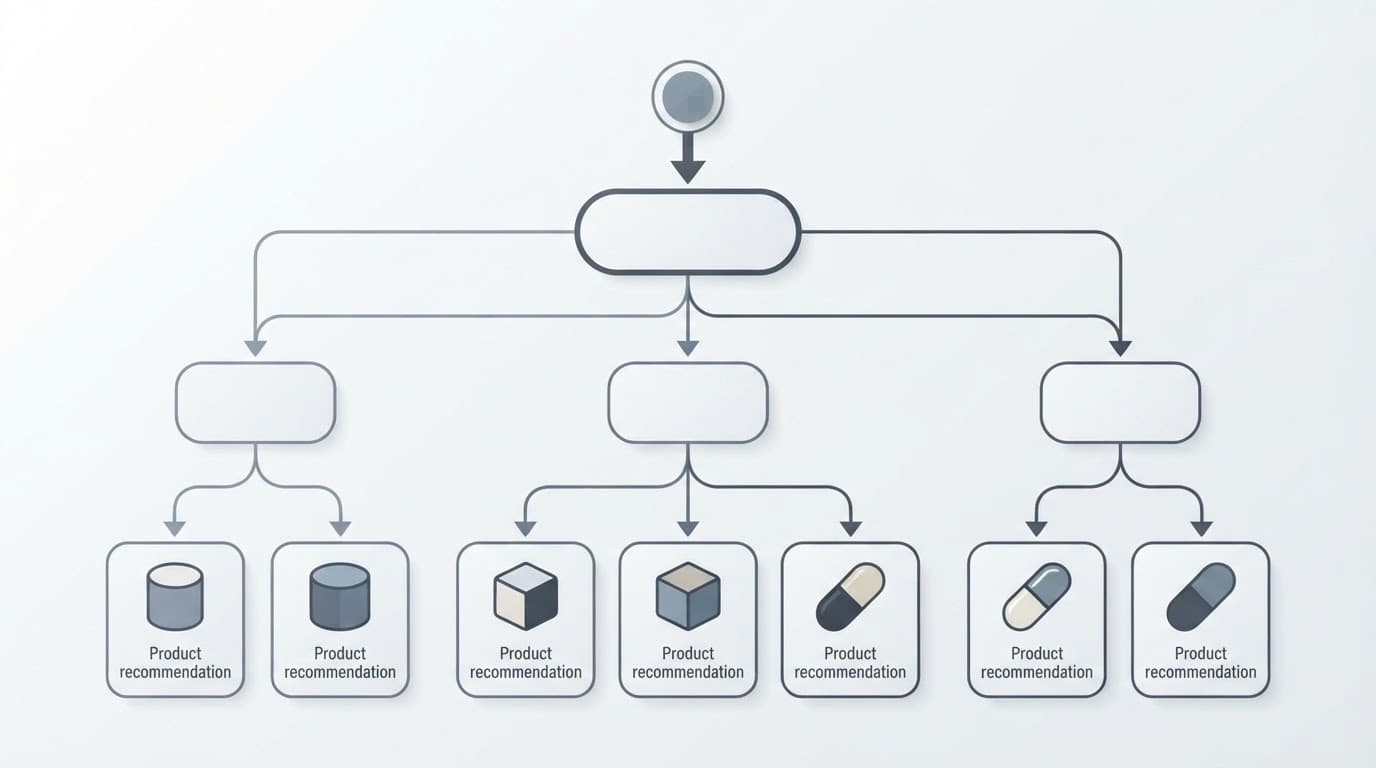
Here’s a practical visual example of this quiz flow:
Key Takeaways
- Focus each product selector quiz on one clear buying decision, with a small catalog of products that genuinely fit the audience and use case.
- Use questions that reveal meaningful preferences, conditional branching to remove irrelevant steps, and filters or weighted scores to match visitors with suitable products.
- Make the results page useful and credible by explaining why a product fits, acknowledging tradeoffs, showing current information, and offering a relevant next step.
- Support the quiz with compliant affiliate disclosures, accurate tracking, responsible handling of zero-party data, and regular catalog maintenance.
- Measure the full funnel from quiz view through affiliate click and merchant conversion, then test and improve weak points instead of relying on assumed conversion lifts.
How quizzes guide a buying decision
A product finder quiz is a short, interactive questionnaire that connects user answers with products in a catalog. The visitor answers questions, follows a conditional path, and receives one or more recommendations at the end.
A product recommendation quiz usually has three parts:
- Questions that identify the shopper’s needs.
- Logic that filters or scores available products.
- A results page that explains the best match and provides a next step.
The quiz doesn’t need to understand every detail about a visitor. It only needs enough reliable information to separate suitable products from poor fits.
Rules-based quizzes versus AI recommendation tools
A rules-based recommendation system follows decisions you define. If someone selects “beginner-friendly” and “low monthly cost,” the system adds points to products that meet those conditions. You can inspect the logic, change it, and explain the result to the reader.
An AI recommendation system may analyze larger data sets, browsing behavior, purchase history, or product similarities. That can help when a store has thousands of products and complex customer behavior. However, AI recommendations also require better data, testing, monitoring, and controls.
For many affiliate sites, a structured quiz is the more practical starting point. A niche site often promotes a small collection of products, so transparent scoring can produce useful recommendations without a large training data set.
A search bar also has limits. It works when visitors already know the product name or feature they want. A shopping quiz helps uncertain shoppers who know their problem but not the product name, making product discovery easier.
The useful output isn’t a personality label. It’s a short, credible explanation of why a product fits the visitor’s stated needs.
Choice overload is reduced when the quiz removes irrelevant options before the visitor reaches the result. A reader comparing eight email platforms may not need a full feature list for all eight. They may only need to know which platform supports their contact volume, skill level, and preferred automation.
Start with one affiliate buying decision
The strongest quizzes focus on one decision. A quiz that recommends hosting, design software, website builders, and online courses in one session will produce vague results.
Define the quiz brief before choosing a platform:
- The audience is a specific type of reader, such as a beginner affiliate marketer.
- The decision is narrow, such as choosing an email marketing platform.
- The result includes a small number of products that genuinely fit the use case.
- The visitor can reach a relevant merchant page without unnecessary steps.
This brief defines the catalog and gives a product finder quiz defensible inputs.
A focused quiz also makes search optimization easier. You can build a landing page around a clear topic, link to it from related guides, and explain the quiz in terms your audience already uses.
Build a product catalog you can defend
Start with products you would feel comfortable recommending in a normal article. Check the official feature pages, pricing details, refund policy, customer support information, and affiliate program terms. If you haven’t personally tested a product, don’t imply that you have.
When an e-commerce store publishes relevant business context, record its average order value separately from shopper-fit criteria. That figure shouldn’t override an honest recommendation or be presented as an affiliate-site guarantee.
A short methodology statement helps keep the recommendations honest:
Recommendations are based on official product documentation, published pricing and policies, product demonstrations, and current customer feedback. Personal testing wasn’t performed unless stated on the page.
The quiz should still make sense if every affiliate link disappears. Include enough original explanation for the reader to understand the category, tradeoffs, and decision criteria.
Affiliate programs also affect your catalog. Before publishing, confirm the commission structure, cookie duration, payment rules, reversal policy, and permitted traffic sources. Some programs restrict email promotion, paid search, brand bidding, coupon use, or direct linking.
You can find supporting software for your site in this guide to best affiliate marketing tools, but the quiz itself should remain useful regardless of which builder you choose.
Create a simple product matrix
Record the attributes that distinguish your products and correspond to meaningful customer preferences. For the example quiz, the matrix could include:
| Product attribute | Why it matters |
|---|---|
| Beginner setup | Helps readers with limited technical experience |
| Contact limits | Prevents a recommendation that becomes expensive too quickly |
| Automation features | Separates basic newsletters from advanced sequences |
| Ecommerce support | Identifies tools suited to online stores |
| Integration options | Matches the reader’s existing website and sales tools |
| Affiliate status | Confirms whether you can promote the product compliantly |
This matrix becomes the foundation for consistent product quizzes and scoring. It also prevents you from writing questions that sound useful but don’t change the recommendation.
Design questions that reveal useful preferences
Most product quizzes work best with roughly four to seven questions. Some need only three, while more complex catalogs may need eight. Completion usually suffers when every minor preference becomes a separate step.
Ask about information that changes the result. A product finder quiz shouldn’t collect details simply because the builder makes them easy to add.
A strong sequence often follows this pattern:
- Identify the visitor’s main goal.
- Ask about experience or technical comfort.
- Apply a hard constraint, such as budget or platform compatibility.
- Ask about one or two important preferences.
- Show the recommendation or request an optional email address.
This sequence supports guided selling by progressively narrowing the decision instead of collecting every possible preference.
The first question should feel easy. “What are you trying to accomplish?” is less intimidating than a question about API support or advanced automation.
Use answer choices that sound like your audience’s language. A shopping quiz should reflect customer preferences, not force visitors to interpret technical labels. For a website builder quiz, choices might include “I need a simple site for articles,” “I want to sell digital products,” or “I need more control over design.” These answers reveal intent better than a list of technical features.
Use visual questions when the choice is visual
Image choice questions can improve mobile usability when visitors need to compare appearances. A fashion quiz may show clothing styles. A home decor quiz may show room designs. A skincare shade match quiz may show shade families, provided the images are accurate and responsibly presented.
Visual cards reduce reading effort, but they still need text labels for accessibility. Keep each card large enough to tap comfortably. Use compressed images, descriptive alt text, and a clear selected state.
Avoid using images for choices that are easier to understand as words. A budget range, contact limit, or preferred integration is usually faster to scan in a text-based option.

Use conditional branching to remove irrelevant questions
Conditional logic determines which question appears next based on the previous answer. A visitor who selects “I have never built a website” may see a setup and support question. Someone who selects “I manage an existing online store” may see questions about integrations and product feeds instead.
Good branching reduces friction because visitors don’t answer questions that have no bearing on their result. It also lets one quiz serve different segments without becoming a long questionnaire.
Use branching for meaningful differences, not every small preference. Too many branches become difficult to test and maintain. Map the paths on paper before building them.
A simple branch might look like this:
- A visitor chooses a beginner use case.
- The quiz asks about desired support and setup time.
- The result filters out products designed for technical teams.
- A visitor chooses an advanced use case.
- The quiz asks about integrations, automation, or customization.
- The result gives more weight to professional features.
Include an exit path when no product meets a hard requirement. It is better to say, “None of these options currently supports your required integration,” than to force a weak recommendation.
Build a scoring model that explains the result
A product finder quiz can match products through simple filters, weighted scores, or both.
Use filters for non-negotiable requirements. If a reader needs a Shopify integration, remove products that don’t support it. Use weighted scoring for preferences, such as ease of use, reporting depth, or price sensitivity.
A basic scoring formula looks like this:
Product score = the total of each answer's weight multiplied by the product's match strength
You don’t need a complex algorithm. A transparent recommendation system can turn answer weights into a ranked match. It is a rules engine, not artificial intelligence.
A scale from zero to three is often enough:
- Zero means the product doesn’t meet the preference.
- One means it has limited relevance.
- Two means it matches reasonably well.
- Three means it is a strong match.
For example, a visitor who values beginner setup may give a high score to a simple platform. A visitor who needs advanced integrations may give that same platform a lower score. The result depends on the answers rather than a universal ranking.
| Visitor signal | Matching rule | Result effect |
|---|---|---|
| New to online tools | Give more weight to guided setup and support | Raises beginner-friendly products |
| Strict budget | Filter out products above the stated limit | Removes poor financial fits |
| Needs email automation | Score sequences and trigger options | Raises platforms with stronger automation |
| Uses Shopify | Require a compatible integration | Excludes incompatible tools |
| Wants room to grow | Score limits, plans, and upgrade paths | Raises products with suitable expansion options |
Set tie-breaking rules before launch. You might prioritize the product with the strongest fit for the main goal, the clearest pricing, or the best current availability. Don’t use commission rate as the primary match unless the products are otherwise equal and the choice remains fair to the visitor.
Make the results page useful without hiding tradeoffs
Treat the output as a guided selling moment: show one primary recommendation and a small number of alternatives. A page with ten results recreates the confusion the quiz was meant to reduce.
Each result should include:
- The recommended product and its main use case.
- Two or three reasons it matched the answers.
- A limitation or tradeoff.
- Current pricing or plan context, if verified.
- A clear affiliate link with appropriate disclosure.
- An alternative for readers with a different priority.
Use result copy that connects the answer to the product:
“Because you selected beginner setup and guided support, this option ranks highly for your needs. Its advanced reporting is more limited than some alternatives.”
That explanation makes personalized recommendations more credible than calling every product “the best.” It also gives readers a reason to choose the recommendation instead of clicking a button without context.
Honest limitations and current product data build reader confidence and improve the customer experience.
If prices, product availability, or features change often, use a maintained product data source. It keeps dynamic product matching aligned with current facts. A stale recommendation damages conversions and credibility.
Choose a quiz platform and data stack
You don’t need to commit to one vendor before defining the logic. For a product finder quiz, compare platforms against your catalog, answer paths, and follow-up workflow.
Common options include involve.me, Typeform, RevenueHunt, Quizell, and Digioh. Their current plans, limits, integrations, and pricing can change, so verify each detail on the provider’s official pages before publishing a comparison.
| Platform type | What to check |
|---|---|
| General form builder | Conditional logic, result pages, webhooks, and design control |
| e-commerce store quiz app | Product catalog syncing, Shopify support, and recommendation rules |
| Marketing funnel builder | Lead capture, segmentation, automation, and analytics |
| Enterprise experience platform | API access, advanced data routing, permissions, and reporting |
A no-code builder is useful when you want to launch quickly without custom development. Quiz templates can help, but check customization and export limits. Look for image choice questions, branching logic when answers genuinely require different questions, custom result pages, mobile controls, and export options.
The data stack usually includes five pieces:
- The quiz builder stores questions and answer paths.
- A product catalog supplies product IDs, attributes, prices, and destination links to the recommendation system, which applies filters and scores.
- An email platform receives consent and audience segmentation data.
- Analytics records starts, completions, result views, and affiliate clicks.
- A webhook or integration passes event data between systems.
A webhook payload might include the quiz name, result ID, answer categories, source page, campaign parameters for marketing campaigns, and consent timestamp. Avoid sending unnecessary personal information. Email and SMS platforms should receive only the data needed for the agreed follow-up.
Klaviyo, Shopify, and Zapier are common integration points in this category, but native support varies by platform and plan. Check whether the integration sends full answer data or only a completion event.
Turn quiz results into trusted affiliate clicks
A product finder quiz should lead to a single results page with a sensible next action. A reader who is still comparing options may need “Compare features.” Someone with a clear product match may be ready for “See current plans” or “Check the current price.”
Don’t send every result to a generic homepage. Use the affiliate program’s approved tracking link or an allowed deep link to the relevant product page. A regular merchant URL may not credit your account.
Place the first affiliate disclosure close to the first affiliate link. It should be clear, conspicuous, and easy to understand. A short statement can work:
“Some links on this page are affiliate links. If you purchase through one, we may earn a commission at no extra cost to you.”
The exact wording may need to follow the merchant or network’s rules. Review each program’s terms before adding affiliate links to email, SMS, paid campaigns, or quiz results.
A disclosure doesn’t fix a misleading presentation. Don’t use a merchant’s logo, domain style, or page layout in a way that suggests your site is official or endorsed. Use your own visuals unless the brand gives you approved assets and permission.

Use a result-to-email sequence
Zero-party data is information people intentionally provide, such as their budget, goals, experience, or preferred features. It can help a recommendation system reflect those stated needs instead of guessing from a pageview alone.
Handle that information responsibly. Use it to improve the customer experience, not to make visitors feel surveilled.
Ask for an email address after the visitor sees enough value from the quiz. Explain what they will receive before requesting consent, and separate quiz results from marketing consent where required. Email marketing needs clear permission, while SMS marketing requires its own opt-in and opt-out process.
A practical sequence might send:
- The result summary and the main reason for the match.
- A comparison that addresses the visitor’s stated concern.
- A practical guide for getting started with the chosen product.
Use the answer data for personalized recommendations in the follow-up. A reader who selected “lowest monthly cost” should receive pricing context, not an email focused on advanced team features.
Email segmentation should support the recommendation rather than repeat it endlessly. If the product changes, the price rises, or the affiliate relationship ends, update the automation before it sends outdated claims.
If a merchant reports average order value, treat it as context for performance only. It must not override shopper fit or be presented as guaranteed affiliate income.
For broader site trust, use a clear affiliate homepage template that explains who runs the site, how products are selected, and where commissions may apply.
Measure the funnel and maintain the catalog
A quiz is only useful when you can see where visitors stop and what happens after the recommendation.
Track these events separately:
- Quiz view.
- Quiz start.
- Question progression.
- Quiz completion.
- Result view.
- Email opt-in.
- Affiliate click.
- Merchant conversion or commission, plus average order value when the merchant reports it.
- Revenue per visitor and earnings per click.
Use consistent event names and campaign parameters. This GA4 affiliate tracking setup can help you connect outbound clicks with the page, recommendation, and campaign that produced them.
Look for leaks in the path, and separate quiz completion and affiliate-click metrics from merchant conversion rates. A high start rate with a low completion rate points to confusing questions, slow loading, or excessive length. Strong completion with weak affiliate clicks may indicate that the recommendation lacks context or places the CTA too far below it. Strong clicks with weak commissions may indicate poor offer fit, a broken tracking link, or a merchant page that doesn’t match the promise. Review mobile completion rates separately, since long questions, slow loading, and small tap targets can cause early exits.
Treat claims of a 2x or 3x lift as claims to test, not guaranteed outcomes. Compare the quiz against a normal comparison page or product list with similar traffic. Keep the test long enough to collect meaningful data, and evaluate revenue as well as clicks.
Review the catalog on a schedule. Stale product data can undermine the recommendation system, even when click tracking works. Check product links, prices, feature claims, affiliate status, and replacement options. If a product is discontinued, keep the page only when it still answers a useful question and offers an accurate replacement. Otherwise, remove it from the quiz and clean up related links.
For SEO and customer experience, keep the main quiz landing page indexable, fast, and useful without relying entirely on JavaScript. Avoid creating a separate crawlable URL for every answer combination unless each recommendation path has distinct search value. Keep tracking parameters out of your sitemap, and point internal links toward the preferred quiz URL.
Frequently Asked Questions
How many questions should a product recommendation quiz include?
Most product quizzes work best with roughly four to seven questions. Use only questions that can change the recommendation, since unnecessary steps can reduce completion rates.
Should I use rules-based scoring or AI recommendations?
Rules-based scoring is often the better starting point for affiliate sites with a focused catalog. It is transparent, easy to adjust, and can produce useful matches without the large data sets and monitoring required by AI systems.
What should appear on the quiz results page?
Show one primary recommendation and a small number of alternatives, along with the reasons for the match, a relevant limitation, verified pricing or plan context, and a clear next step. Include an appropriate affiliate disclosure near the first affiliate link.
When should I ask for a visitor’s email address?
Ask after the visitor has received enough value from the quiz to understand the recommendation. Explain what they will receive, obtain the required consent, and keep quiz-result delivery separate from marketing consent where necessary.
What metrics should I track for an affiliate quiz?
Track quiz views, starts, question progression, completions, result views, email opt-ins, affiliate clicks, and merchant conversions or commissions when available. Comparing these stages helps identify whether the problem is quiz friction, weak recommendation context, broken tracking, or poor offer fit.
Conclusion
Product selector quizzes work best when they solve one clear buying problem with a small set of relevant questions. Use filters for hard requirements, weighted scores for preferences, and result pages that explain both the match and the tradeoff.
The strongest affiliate quiz is useful before anyone clicks a merchant link. With transparent logic, visible disclosure, and maintained product data, it becomes a credible recommendation system that helps readers choose with less uncertainty.