
A campaign can look busy, get plenty of clicks, and still lose money. The number that keeps your decisions grounded is the break-even conversion rate, the percentage of referred clicks that must produce a commission before you make a profit.
For affiliate marketers buying traffic, it turns a vague question into a clear target. For content publishers, it shows whether an offer can support the time, tools, and promotion costs behind a page.
Use the calculation before raising an ad budget, switching offers, or judging a low-volume test.
The Break-Even Conversion Rate Formula
Your break-even point occurs when your total campaign cost equals your commission revenue. At that point, profit is zero.
Use this formula when you know your total costs, number of affiliate clicks, and net commission per approved sale:
Break-even conversion rate = Total campaign cost / (Affiliate clicks x Net commission per sale)
Then multiply the decimal by 100 to display it as a percentage.
If you buy traffic by the click, use this shorter version:
Break-even conversion rate = Cost per click / Net commission per sale
Both formulas reach the same result when all costs are included.
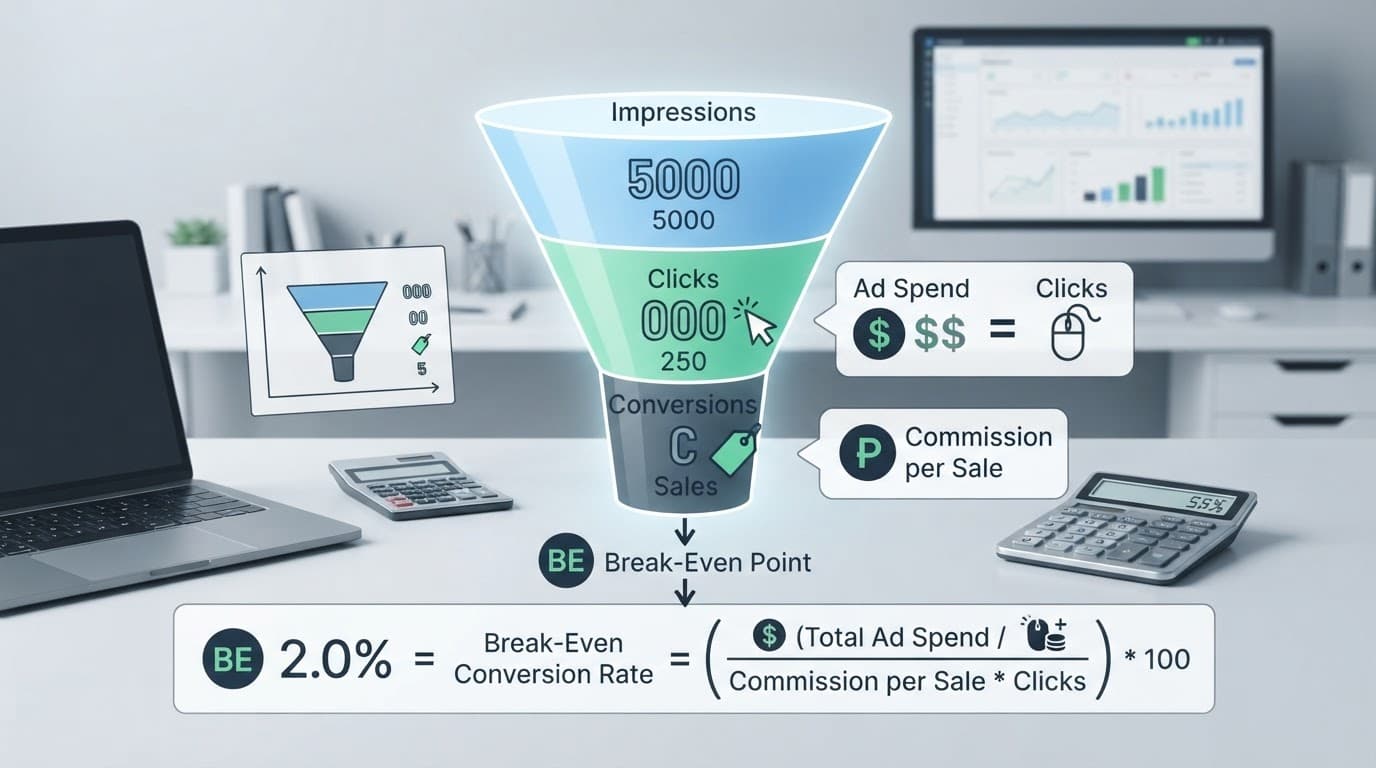
A concise formula summary
| Metric | Formula | What it tells you |
|---|---|---|
| Net commission per sale | (Average order value x commission rate x (1 – reversal rate)) + bonus | Expected earnings from one approved conversion |
| Total traffic cost | Clicks x cost per click | Spend needed to acquire the clicks |
| Required conversions | Total campaign cost / net commission per sale | Number of sales needed to break even |
| Break-even conversion rate | Required conversions / clicks | The percentage of clicks that must convert |
| Break-even ROAS | Revenue needed / ad spend | Revenue required for each $1 spent |
A 2% conversion rate means two sales for every 100 tracked affiliate clicks. Keep the denominator consistent. If you calculate clicks from your ad platform, use sales attributed to those same clicks.
A break-even rate only works when the payout is real. Pending commissions can help forecast cash flow, but approved commissions are safer for profit decisions.
Set the Assumptions Before You Run Numbers
A clean formula cannot rescue weak inputs. Write down what each number includes before you calculate.
Find the net commission, not the headline payout
Many programs advertise a percentage of the order value. However, that percentage may not be what you keep. Refunds, chargebacks, discount rules, bonuses, and excluded products can change the final amount.
Suppose an offer has:
- Average order value: $120
- Commission rate: 30%
- Refund and chargeback rate: 8%
- Bonus per approved sale: $0
Calculate the gross commission first:
$120 x 0.30 = $36
Next, account for reversals:
$36 x (1 – 0.08) = $33.12
Your net commission per sale is $33.12.
If the merchant pays a flat CPA, such as $25 for a qualified lead, you can skip the order-value calculation. Use $25, then reduce it if historical reversals affect that payout.
Affiliate terms also matter. A coupon extension, another affiliate click, or a short cookie window can overwrite your referral. Review the network’s rules before treating an advertised commission as dependable income. Partnero’s overview of affiliate tracking is useful background on how conversions get attributed.
Include costs beyond ad spend
Paid clicks are usually the largest cost, but they may not be the only one. Add landing-page software, creative production, tracking tools, contractor fees, and email costs when they exist because of the campaign.
You do not need to load an entire business overhead into every test. Instead, assign a reasonable share. For example, if a $100 monthly tracking subscription supports 10 active campaigns equally, allocate $10 to each campaign.
State your assumptions beside the calculation. These are estimates, not promised financial results. Conversion rates shift with traffic source, audience fit, device type, season, merchant pricing, page speed, and attribution.
Calculate a Break-Even Conversion Rate Step by Step
Here is a complete paid-traffic example. Assume you plan to buy 1,000 clicks for an affiliate offer.
Step 1: Calculate the traffic spend
Your cost per click is $0.80.
1,000 clicks x $0.80 CPC = $800 traffic cost
You also budget $100 for creative and tracking.
$800 + $100 = $900 total campaign cost
Step 2: Calculate earnings per approved sale
The offer pays a 25% commission on an average $160 order. Its historical reversal rate is 10%.
First, find the gross payout:
$160 x 0.25 = $40
Then reduce it for expected reversals:
$40 x (1 – 0.10) = $36
Your estimated net commission per approved sale is $36.
Step 3: Find the number of sales required
Divide total campaign cost by net commission per sale:
$900 / $36 = 25 sales
You need 25 approved sales to cover the $900 cost.
Step 4: Turn required sales into a conversion rate
Divide required sales by affiliate clicks:
25 / 1,000 = 0.025
Convert the decimal into a percentage:
0.025 x 100 = 2.5%
The campaign needs a 2.5% break-even conversion rate. At 2.5%, you are at zero profit. A rate above 2.5% creates profit, provided your real costs and reversal rate hold.
For a fast check, use the CPC version:
$0.80 / $36 = 0.0222, or 2.22%
That result excludes the extra $100 in creative and tracking. Add those fixed costs across 1,000 clicks:
$100 / 1,000 = $0.10 additional cost per click
Now calculate with fully loaded CPC:
($0.80 + $0.10) / $36 = 0.025, or 2.5%
Both methods match.
Use EPC and ROAS to Read the Result
A required conversion rate does not tell the whole story. Earnings per click, or EPC, reveals how much each outbound affiliate click earns on average.
The formula is:
EPC = Conversion rate x Net commission per sale
In the example, a 2.5% conversion rate produces:
0.025 x $36 = $0.90 EPC
Your fully loaded cost per click is also $0.90:
$900 / 1,000 clicks = $0.90
Therefore, the break-even point is confirmed:
$0.90 EPC – $0.90 cost per click = $0 profit per click
Connect conversion rate to break-even ROAS
Break-even ROAS is another way to view the same economics. ROAS compares revenue with ad spend, and Shopify’s ROAS calculation guide explains the standard revenue-to-spend formula.
For affiliate campaigns, use your commission revenue, not the merchant’s full order revenue, unless you earn on the full sale value.
In the example:
$900 commission revenue / $900 total cost = 1.0 ROAS
You need a ROAS of 1.0 to break even on commission revenue. Most marketers need a higher target because a zero-profit campaign leaves no room for reporting gaps, delayed approvals, or rising click costs.
Separate revenue statuses in reporting
A dashboard that blends pending, reversed, approved, and paid commissions can mislead you. Keep each status separate.
Pending sales are possible future income. Reversed sales show lost credit or cancelled orders. Approved sales are the best basis for campaign profitability. Paid commissions affect cash flow, but payment timing does not change whether the campaign earned a profit.
A GA4 affiliate tracking setup helps you tie UTMs and outbound click events to the source, page, and campaign that produced them. On the network side, use SubIDs or click IDs to connect approved sales to those same placements.
Check Whether the Funnel Can Support Your Target
The click-to-sale rate is only one part of the funnel. A 2.5% affiliate conversion rate might be realistic for warm email traffic and impossible for cold traffic sent directly to a complex merchant checkout.
First, define the conversion event. Are you measuring a purchase, a completed trial, a qualified lead, or a phone call? A lead offer may show a higher conversion rate than a sale offer, yet pay less per action.
Next, compare your target with evidence from similar traffic. Use your own historical data where possible. Split it by traffic source, device, country, landing page, offer, and audience segment.
Watch the clicks before the merchant page
A weak affiliate campaign can fail before someone reaches the merchant. If 10,000 visitors view a review and only 100 click an affiliate link, the visitor-to-click rate is 1%. Better buttons, clearer pricing context, stronger product fit, and a more useful comparison can improve that stage.
However, high outbound clicks with weak commissions often point elsewhere. The merchant’s page may load poorly, fail to match the ad promise, have an uncompetitive price, or lose attribution during redirects.
Use an affiliate revenue dashboard to review clicks, conversions, EPC, ROAS, and revenue together. A high click count is not a win if the economics remain below break-even.
Validate attribution before cutting a campaign
Check the affiliate link on mobile and desktop. Confirm that SubIDs, click IDs, and other tracking parameters survive every redirect. Then review the network’s reporting delay, attribution model, cookie period, reversal policy, and paid-search restrictions.
Affiliate attribution tracking practices can help clarify why an ad platform’s conversion count may differ from the affiliate network’s count. The network’s approved commission report should guide the final profitability calculation.
Lower an Unreachable Break-Even Rate
A high required rate is a warning, not a reason to force a campaign live. If cold traffic historically converts at 1% and your break-even conversion rate is 5%, the gap needs a real economic fix.
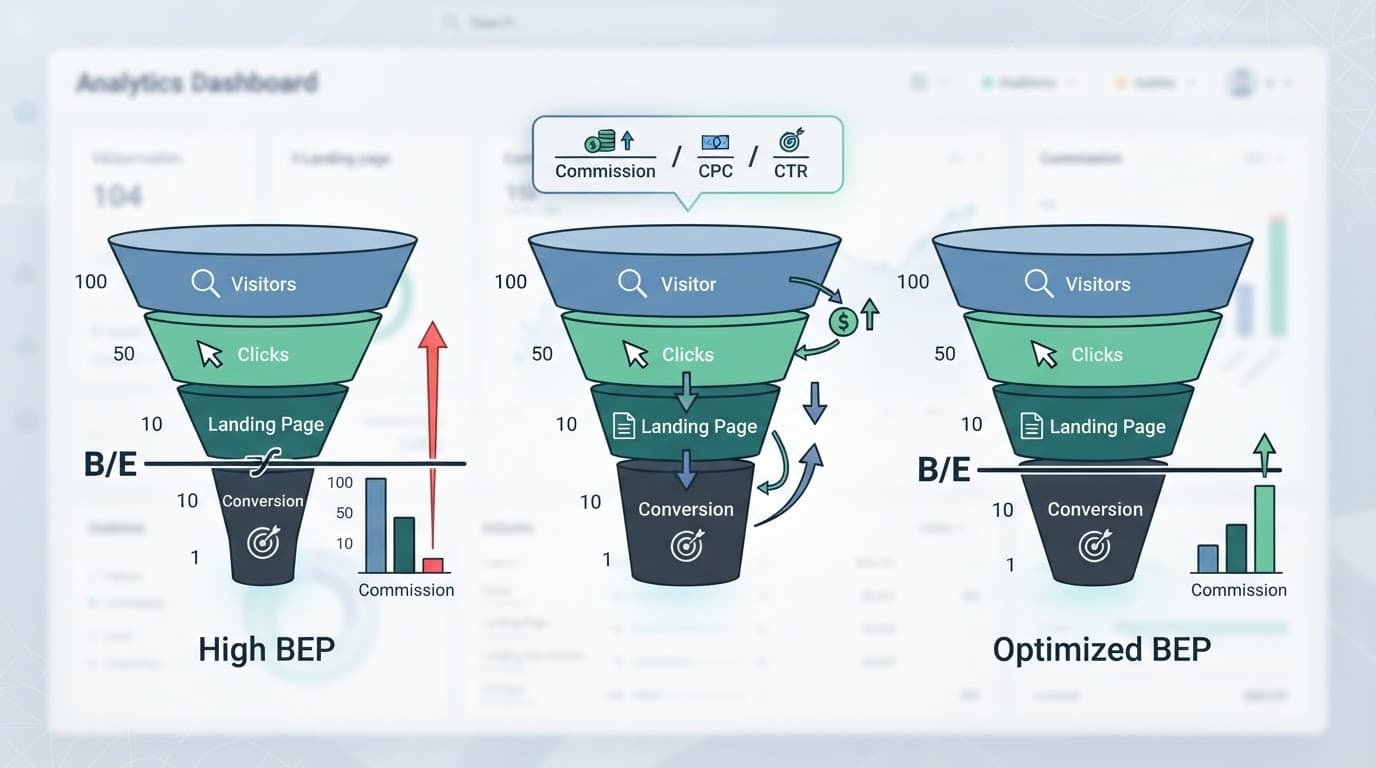
Reduce cost per click without buying worse traffic
Lower CPC through tighter targeting, better creative, excluded placements, and stronger relevance between the ad and landing page. A cheaper click is only helpful if its conversion quality holds.
In the earlier example, reducing fully loaded CPC from $0.90 to $0.72 changes the target:
$0.72 / $36 = 0.02, or 2%
That 0.5 percentage point drop can turn an impractical test into a plausible one.
Raise value per conversion
Negotiate a higher commission, find a better-paying offer, promote a higher-value plan, or use a legitimate bonus structure. Recurring commissions can improve long-term economics, but do not count future months until you understand churn and approval behavior.
For instance, raising net commission from $36 to $45 changes the original target:
$0.90 / $45 = 0.02, or 2%
You can also pre-sell the offer with a useful comparison page, email sequence, or lead magnet. Conversion funnel testing methods can help you find the point where visitors drop away. Test one meaningful change at a time, then judge it against EPC and approved commissions.
A Reusable Campaign Calculation Checklist
Run this sequence before you fund a new affiliate test:
- Record the click volume, CPC, fixed campaign costs, and the conversion event you will count.
- Calculate net commission per sale after expected refunds, chargebacks, bonuses, and excluded orders.
- Add traffic cost and allocated operating costs to find total campaign cost.
- Divide total cost by net commission to find required approved conversions.
- Divide required conversions by clicks, then multiply by 100 for the break-even conversion rate.
- Compare the target with historical performance from the same source, device mix, and offer type.
- Track pending, approved, reversed, and paid commissions separately after launch.
- Pause, adjust, or scale based on approved EPC and profit per click, not surface-level click volume.
A small spreadsheet is enough. The discipline comes from updating assumptions as real campaign data arrives.
Final Thoughts on Affiliate Break-Even Math
The most useful number in an affiliate campaign is not the commission percentage or the number of clicks. It is the break-even conversion rate built from real costs and approved earnings.
Calculate it before you spend, then keep checking it as CPC, refund rates, and merchant performance move. Clear inputs turn affiliate marketing from a hopeful guess into a decision you can defend.