
Two-tier affiliate programs pay you for qualifying customer sales and for qualifying sales generated by affiliates you recruit. Your second-tier earnings depend on those partners sending referral traffic that leads to approved transactions, so recruiting alone doesn’t guarantee income.
In affiliate marketing, compare the commission base: the same rate pays differently on sales revenue or another affiliate’s commission. Start with the money flow, then compare the tracking rules and costs behind each offer.
Key takeaways
- Tier 1 rewards your direct customer referrals; tier 2 rewards qualifying sales by recruited affiliates.
- Second-tier percentages may apply to revenue, profit, or another defined amount.
- Approved commissions, payment timing, and operating costs matter more than headline rates.
How two-tier affiliate programs work
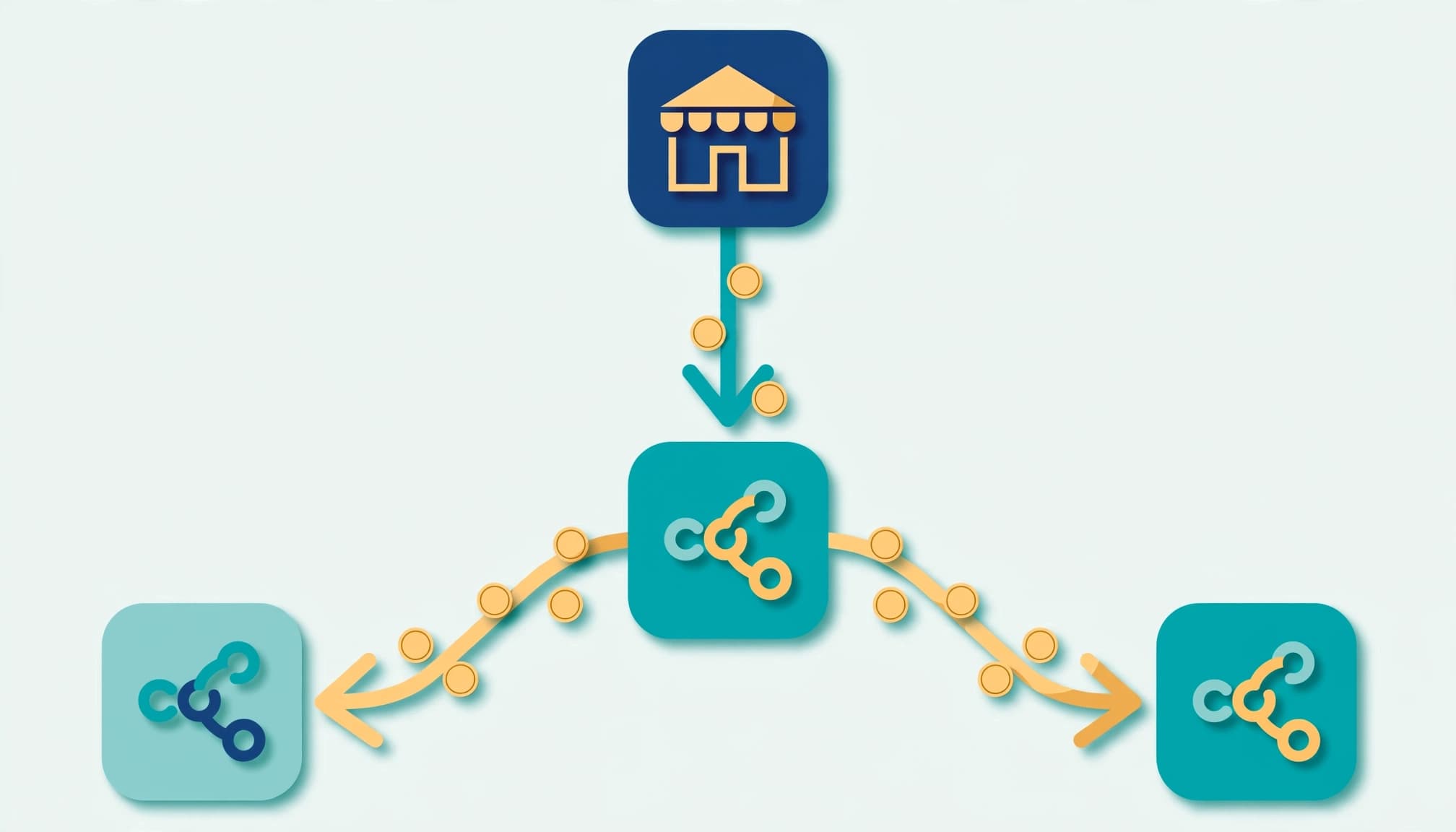
A merchant gives you an affiliate link for referring customers. An affiliate program with two tiers also lets you refer other affiliates, often through a separate recruitment link that can earn you a tier 2 commission.
Tier 1: Your direct customer referrals
When someone follows your tracking link and completes an eligible purchase, you earn the first-tier commission. The payout might be a fixed amount, a percentage, or recurring payments.
The merchant defines the qualifying transaction. A free signup, trial registration, or abandoned checkout doesn’t necessarily earn anything. Even a completed purchase may remain pending until the refund window closes.
Tier 2: Sales by recruited affiliates
A sub-affiliate is another affiliate connected to your account through the program’s referral process. When that person generates a qualifying customer sale, they receive their direct commission, and you receive the second-tier commission.
They don’t become your employee or customer. A sub-affiliate’s eligible sales, not recruitment alone, can generate your commission, as long as the relationship remains valid and the program’s duration rules allow it.
Also, a performance-based commission tier is different. Earning a higher rate after reaching a sales target doesn’t automatically create a sub-affiliate relationship.
Commission math: Who receives what?
The phrase “10% second-tier commission” is incomplete until the agreement defines what receives that percentage.
A $100 sale with two commissions
ThriveCart’s example uses a $100 product, a 50% first tier commission for the selling affiliate, and a 10% recruiter commission.
Here’s the allocation before other business costs:
| Recipient | Calculation | Amount |
|---|---|---|
| Selling affiliate | $100 x 50% | $50 |
| Recruiting affiliate | $100 x 10% | $10 |
| Merchant | $100 minus $50 minus $10 | $40 |
The merchant retains $40, but that isn’t net profit. Payment processing, refunds, product delivery, and support can reduce it further.
The percentage base changes the result
If the recruiter’s 10% applies to the selling affiliate’s $50 commission instead of the $100 sale revenue, the recruiter earns $5. The merchant then retains $45 before other costs, assuming the recruiter payout is additional.
Some agreements use profit as the base, which requires a definition of deductible expenses.
A second-tier commission needs both a calculation base and a rule explaining whose share funds it.
ThriveCart’s second-tier setup documentation supports percentage-based or fixed payouts and a configurable time limit of 1 to 365 days.
Named programs and their published commission structures
Published two-tier affiliate program structures vary widely. These reported figures include older listings, so they aren’t guarantees of current terms.
| Program | Published first-tier commission | Published second-tier commission |
|---|---|---|
| Systeme.io | 40% | 5% |
| ClickFunnels | 40% for qualifying approved affiliates | 5% in published two-tier listings |
| Builderall | 100% of the customer’s first payment, then 30% recurring | 30% recurring |
| A2 Hosting | $55 to $125 per sale | $5 per sub-affiliate sale |
| Fiverr | $30 per first order advertised officially | 10% in older two-tier listings |
| Inc Authority | Up to $80 per sale in older listings | 1% in older two-tier listings |
The published A2 Hosting example illustrates why a fixed affiliate commission for a recruiter deserves separate analysis from percentage-based offers.
ClickFunnels’ official guidance describes approval-based affiliate commission tiers, including eligibility for 40%. That approval ladder is separate from ClickFunnels’ second-tier recruitment commission, which older listings put at 5%. Check ClickFunnels’ current terms before treating either figure as guaranteed.
Systeme.io’s reported 40% first-tier rate and 5% second-tier rate are examples, not a guarantee. Check Systeme.io’s current affiliate terms before relying on them.
Builderall’s published example lists 100% of the customer’s first payment, then 30% recurring, with 30% recurring at the second tier. Confirm Builderall’s current terms before relying on that structure.
Meanwhile, the Fiverr affiliate program advertises $30 per first order. That Fiverr figure covers a first order, and older Fiverr listings show a separate second-tier rate. Those older terms shouldn’t be combined automatically with Fiverr’s advertised offer.
ClickBank and FlexOffers appear in directories that discuss second-tier opportunities. ClickBank and FlexOffers listings, along with CJ Affiliate and legacy ShareASale directories, can help identify merchants to review, but network membership doesn’t establish a recruiter commission. The individual merchant’s terms determine compensation.
Tracking, attribution, and payout timing
Two-tier tracking must establish two relationships: who recruited the affiliate and which affiliate earned credit for the customer purchase.

Recruitment credit and purchase credit are separate
The recruitment link associates a new affiliate with your account. Their customer-facing link then connects eligible purchases to them.
A buyer’s cookie duration governs purchase attribution, while ThriveCart can configure the second-tier commission period separately. The recruitment relationship can have a different duration. Neither automatically guarantees lifetime commissions.
Last-click rules, coupon attribution, and cookie overwrites can change which affiliate receives sale credit. Cross-device purchases can also create gaps. Server-side tracking can improve supported transaction matching, but it doesn’t override program eligibility rules. ShareASale, ClickBank, and FlexOffers don’t replace merchant-specific tracking or eligibility rules, and Fiverr’s own program terms govern attribution.
Pending commissions aren’t spendable cash
Keep pending, approved, reversed, and paid amounts separate. Pending earnings can disappear after refunds, duplicate-order reviews, fraudulent purchases, or invalid leads.
Approved earnings may still wait for a minimum balance, scheduled payment date, or processing hold. Currency conversion and payout fees can reduce the final deposit.
Our guide to affiliate conversion lag explains why reporting delays and payment delays need separate treatment.
For reconciliation, connect order IDs, click IDs, affiliate IDs, and timestamps where available. A recruitment count without approved customer transactions isn’t evidence of earnings.
Evaluate profitability for both sides
A generous second-tier rate can attract partners, but it also adds acquisition costs. Merchants and affiliates need to calculate earnings after costs.
For merchants: Protect contribution margin
Merchants can reach new publishers through trusted existing partners. However, each second-tier payment increases the cost of acquiring a customer.
Subtract both commissions, product costs, payment fees, expected refunds, and variable support costs from eligible revenue. Then account for tracking software, program management, and creative production.
Our affiliate profit margin guide separates commission revenue from operating profit. The same discipline helps merchants avoid paying attractive rates on unprofitable orders.
For affiliates: Measure what remains
Affiliates can earn more by introducing capable publishers to a suitable product. However, recruiting and supporting those partners takes time.
Calculate recognized commission revenue after reversals and payout fees. Then subtract expenses such as advertising, software, and contractor support.
Define how long a recurring commission lasts. Twelve eligible monthly payments differ from payments that continue throughout a customer’s subscription. Trials, failed renewals, cancellations, and commission caps all affect value.
A smaller reliable payout can outperform a large commission attached to weak conversions or frequent reversals.
Two-tier programs, MLM, and payment restrictions
The number of levels matters, but the source of compensation matters more.
How two tiers differ from MLM
A two-tier affiliate program pays for your direct sales and qualifying sales by affiliates you recruited. MLM structures may extend beyond two levels or place greater emphasis on recruitment.
That distinction alone doesn’t establish legality or quality. Real customer demand, compensation rules, and purchase requirements still matter.
Recruitment fees, mandatory purchases primarily to qualify for rewards, and earnings claims disconnected from retail sales are warning signs.
Why PayPal requires care
DAP’s payment-policy warning highlights PayPal’s restrictions around activities considered pyramid-related.
Paying commissions for prohibited activity can create account-limitation or closure risk. However, that doesn’t establish a blanket ban on every arrangement called “two-tier.”
Merchants need a compensation structure and payment method that comply with the processor’s rules. Sending payouts manually doesn’t remove those obligations.
Recruit affiliates who can generate relevant sales
In affiliate marketing, prioritize audience fit and approved customer sales over recruitment totals.
Publishers who already help the product’s intended customers have a clearer reason to participate.
Explain the product’s use case, permitted promotion methods, commission base, and payment terms. Provide approved links and useful creative assets. Our affiliate program onboarding checklist helps organize those details.
Avoid mass invitations built around earnings promises. Large recruitment totals can hide inactive accounts, unsuitable traffic, or repeated compliance problems.
Measure active partners, approved customer sales, reversal rates, and retained customers. Merchants should block self-referrals and duplicate credit under written rules.
For affiliates, useful training and occasional support can help recruits get started. Their effort, audience, and conversion performance remain outside your control.
Frequently asked questions
Which two-tier affiliate program makes the most money?
There’s no universal winner. Earnings depend on audience fit, approved sales, payout size, recurring duration, and expenses. Compare net earnings per approved customer and per hour of work, rather than ranking offers by their largest advertised percentage.
Can you add a third affiliate level?
ThriveCart’s second-tier feature doesn’t support a third level. Other software may support multi-level arrangements, but those extend beyond a two-tier structure and introduce different operational and compliance questions.
How do merchants enable second-tier affiliates?
In ThriveCart, merchants manually enable second-tier commissions for each product, choose a percentage or fixed payout, and configure the eligible duration. ThriveCart applies these settings at the product level, so terms for one offer don’t automatically apply to every other offer. Merchants configure each ThriveCart product separately.
Build Around Approved Sales, Not Recruitment Totals
Two-tier affiliate programs can reward useful introductions between merchants and capable publishers. Their value depends on approved customer sales and clear compensation rules.
Understand the commission base, separate recruitment attribution from purchase attribution, and account for reversals and operating costs. A smaller, dependable second-tier income stream is more useful than a large dashboard total that never becomes profit.